Ghetto, the local name for Venice's Jewish…
1529 CE
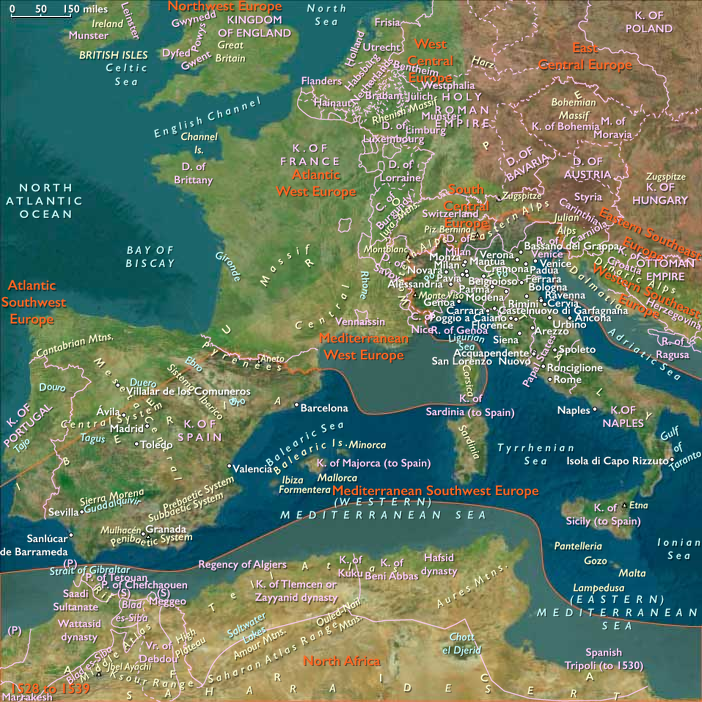
Ghetto, the local name for Venice's Jewish quarter, becomes a general term for such segregated areas, in which Jews, long accustomed to living in neighborhoods of their own, for security and for ready access to a synagogue, now begin to be systematically relegated.
In these urban enclosures, which now begin to be walled, Jews are locked in at night and during church festivals such as Holy Week, when anti-Jewish outbursts are particularly likely because of the alleged guilt of the Jews in the crucifixion of Christ.
Since lateral expansion of the ghetto, as a rule, is impossible, houses tend to be of unusual height, with consequent congestion, fire hazards, and unsanitary conditions.
When outside the walls, Jews are obliged to wear an identifying badge (usually yellow), and they are in danger of bodily harm and harassment.
The humanist scholar Richard Croke, an emissary of English monarch Henry VIII, travels to Venice in 1529, reportedly to consult with Jewish Rabbis and Christian Cabalist theologian Francesco Georgi in an attempt to garner Biblical justification for Henry's intended divorce of Catherine of Aragon and eventual remarriage to an heir-producing mate. (According to Deuteronomy 25, if a husband dies childless then the brother must marry the widow to preserve the family line; such a required marriage is called a levirate marriage. However, his law stands in contradiction with other biblical passages, chief among them Leviticus 18, which asserts that it is incest to marry one's sister-in-law.)
Some scholars see this importation of Rabbinica in support of the English Reformation as part of a growing covert commercial and intellectual alliance between England's Crown and the Jews that have fled the Inquisition.
The Ashkenazic Scuola Grande Tedesca, the oldest synagogue in Venice, opens in 1529; the Scuola Canton, also Ashkenazic, will open in 1531.
Locations
People
Groups
Regions
Southwest Europe
View →Subregions