
The Middle East: 1840–1851 CE Ottoman …
Years: 1840 - 1851
The Middle East: 1840–1851 CE
Ottoman Restoration and Egyptian Retreat
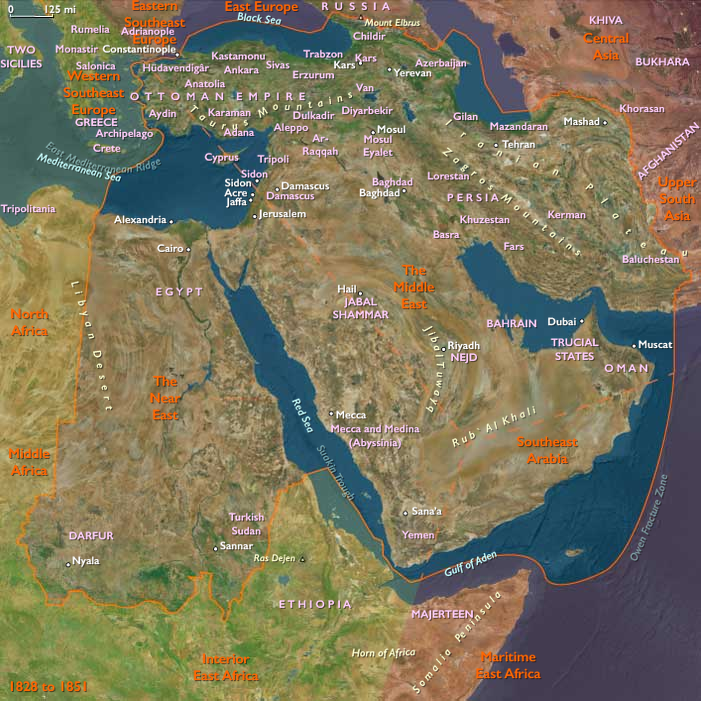
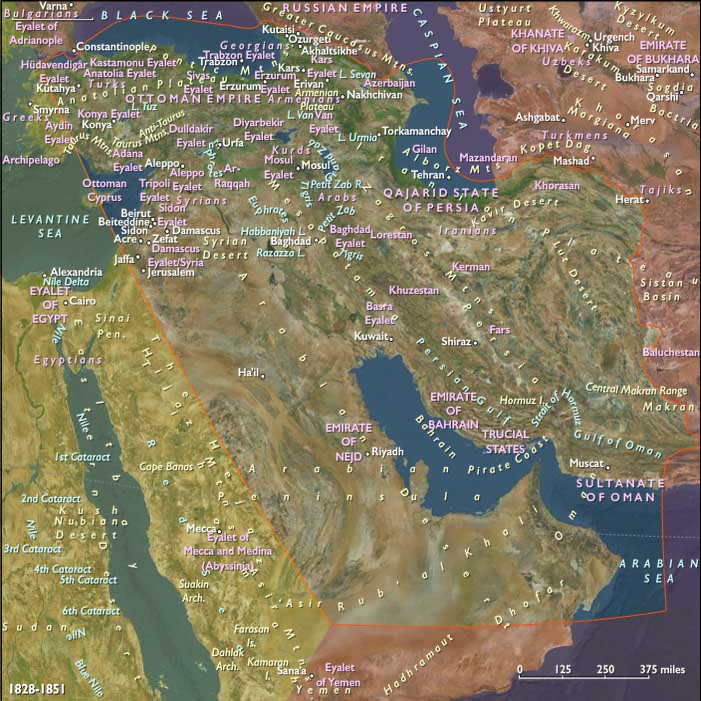
The era beginning in 1840 witnesses the restoration of direct Ottoman rule in Syria and Lebanon, following Egyptian withdrawal. The Convention of London (1840) decisively ends the Egyptian occupation, compelling Muhammad Ali Pasha to relinquish his Syrian territories back to the Ottomans while securing hereditary rule over Egypt for his family. Ottoman authorities, aiming to reestablish stability and control, initiate administrative reforms known as the Tanzimat, introducing structured taxation systems and limited modernization in the provinces. However, these reforms face resistance from local elites accustomed to greater autonomy, particularly in Syria and Mount Lebanon.
In Mount Lebanon, Bashir II Shihab pays a heavy price for his earlier allegiance to Egypt. After Egyptian withdrawal, he is deposed in 1840 and exiled, leading to political instability exacerbated by sectarian tensions among Maronites, Druze, and Muslims. Bashir III is appointed amir of Mount Lebanon on September 3, 1840, but bitter conflicts between Christians and Druzes quickly resurface under his rule. These tensions result in Bashir III's deposition on January 13, 1842, replaced by Ottoman governor Umar Pasha. To ease tensions, the Ottoman sultan partitions Lebanon into two districts under separate Christian and Druze deputy governors, known as the Double Qaimaqamate. However, this partition only deepens sectarian animosities, occasionally erupting into violence, notably in May 1845. The European powers intervene, prompting the Ottomans to establish advisory councils (majlis) representing the different religious communities.
Saudi Arabia: Turmoil and British Influence
In Arabia, the Al Saud dynasty under Faisal ibn Turki Al Saud faces intense internal strife following the assassination of his father, Turki ibn Abd Allah, in 1834. Faisal consolidates control from Riyadh by 1843 after nearly a decade of internecine warfare. During this period, Ottoman forces briefly occupy eastern Arabian territories, including Al Qatif and Al Hufuf, exploiting internal Saudi divisions.
Faisal’s reign balances relations with the Ottoman Empire and emerging British interests. Britain's strategic concern over the Persian Gulf, due to trade routes and protection of India, increasingly influences Arabian politics. The British East India Company establishes treaty relations with several Gulf emirates, intensifying British presence and shaping regional political developments. The Al Saud leverage their Wahhabi influence to maintain control over central Arabia, though their influence in the Hijaz remains limited due to Ottoman and Egyptian vigilance.
Persian Decline and Increased Foreign Intervention
In Persia, the Qajar Dynasty struggles with internal instability and external pressures following significant territorial losses to Russia. The aftermath of the Treaty of Turkmanchay (1828) leaves Persia economically and politically weakened, prompting increasing British and Russian interference—the rivalry known as "The Great Game."
Under Mohammad Shah Qajar (1834–1848), central authority erodes, leading to regional uprisings and increased autonomy of tribal leaders. Upon the accession of Naser ad-Din Shah in 1848, his prime minister, Mirza Taqi Khan Amir Kabir, initiates reforms aimed at strengthening central authority, modernizing taxation, encouraging trade and industry, and establishing the Dar ol Fonun school for elites. However, jealousy and political intrigue lead to Amir Kabir's dismissal and execution in 1851, symbolizing the persistent internal weaknesses that allow further foreign intervention.
Oman's Maritime and Diplomatic Expansion
Said bin Sultan al-Busaidi expands Oman's maritime trade, enhancing economic prosperity and international prestige. His rule is characterized by commercial diplomacy, maintaining favorable relations with Britain. Oman's East African territories, particularly Zanzibar, become major trade hubs for spices, ivory, and slaves, solidifying Oman's strategic importance to British interests in securing maritime routes between Europe and India.
Tribal Dynamics in the Gulf and the Rise of Qatar
The Al Thani clan firmly establishes itself in Qatar, asserting independence from the Al Khalifa of Bahrain and resisting external domination attempts. The ideological alignment of the Al Thani with Wahhabism continues distinguishing Qatar politically and religiously from neighboring emirates.
In Abu Dhabi, the Al Nahyan family consolidates power, leveraging alliances with Oman and Britain to secure their territorial claims. The Bani Yas tribe’s alignment further stabilizes Abu Dhabi, ensuring its growth as a regional power.
Russian Consolidation and Cultural Transformation in the Caucasus
The Russian Empire consolidates administrative control over Georgia and northern Azerbaijan, systematically introducing Russian legal, administrative, and educational reforms. Tsar Alexander I had abolished the kingdom of Kartli-Kakhetia in 1801, integrating eastern Georgia and subsequently western Georgia by 1804. Russian rule significantly transforms local societies, fostering a new educated elite influenced by Russian culture and governance. Armenian national consciousness intensifies as Armenians from Russia and former Persian provinces come under unified tsarist administration.
Russia's victory over Persia in 1828 and annexation of the area around Erevan brings thousands of Armenians into the Russian Empire, integrating them within a single legal and administrative framework. The Armenian community benefits from relative peace and economic growth under Russian rule, significantly ending previous isolation.
Legacy of the Era
From 1840 to 1851, the Middle East witnesses major geopolitical reconfigurations marked by Ottoman restoration, Persian decline, and increased British and Russian intervention. The reshaping of state structures, tribal dynamics, and communal identities during this period establishes enduring political frameworks and sectarian divisions, profoundly impacting regional politics and society into the modern era.
People
- Amir Kabir
- Bashir III
- Bashir Shihab II
- Faisal bin Turki bin Abdullah Al Saud
- Mohammad Shah Qajar
- Muhammad Ali of Egypt
- Nasser al-Din Shah Qajar
- Omer Pasha
- Said bin Sultan
- Turki bin Said
Groups
- Georgians
- Arab people
- Kurdish people
- Bedouin
- Christians, Maronite
- Alawites
- Turkmen, Syrian
- Druze, or Druse, the
- Ottoman Empire
- Bani Yas (Arab tribe)
- Mount Lebanon Emirate
- Thani, House of
- Al Khalifa family
- Al Nahayan family
- East India Company, British (United Company of Merchants of England Trading to the East Indies)
- Russian Empire
- Wahhabism
- Saud, House of
- Persia, Qajarid Kingdom of
- Georgia within the Russian Empire
- Britain (United Kingdom of Great Britain and Ireland)
- Egypt, (Ottoman) Viceroyalty of
- Bahrain, Emirate of
- France, constitutional monarchy of
- France, Second Republic of
Topics
Commodoties
Subjects
Regions
Subregions
Years: 1840 - 1851
People
- Amir Kabir
- Bashir III
- Bashir Shihab II
- Faisal bin Turki bin Abdullah Al Saud
- Mohammad Shah Qajar
- Muhammad Ali of Egypt
- Nasser al-Din Shah Qajar
- Omer Pasha
- Said bin Sultan
- Turki bin Said
Groups
- Georgians
- Arab people
- Kurdish people
- Bedouin
- Christians, Maronite
- Alawites
- Turkmen, Syrian
- Druze, or Druse, the
- Ottoman Empire
- Bani Yas (Arab tribe)
- Mount Lebanon Emirate
- Thani, House of
- Al Khalifa family
- Al Nahayan family
- East India Company, British (United Company of Merchants of England Trading to the East Indies)
- Russian Empire
- Wahhabism
- Saud, House of
- Persia, Qajarid Kingdom of
- Georgia within the Russian Empire
- Britain (United Kingdom of Great Britain and Ireland)
- Egypt, (Ottoman) Viceroyalty of
- Bahrain, Emirate of
- France, constitutional monarchy of
- France, Second Republic of
Topics
Commodoties
Subjects
Regions
Subregions