
The Middle East (1900–1911): National Awakening and…
1900 CE to 1911 CE
The Middle East (1900–1911): National Awakening and Ottoman Transformation
The era from 1900 to 1911 marks a critical juncture in Middle Eastern history, dominated by the rise of nationalist movements, internal struggles within the Ottoman Empire, and escalating imperial rivalries. The Young Turk revolution transforms Ottoman politics, while regional identities and nationalist movements gain new momentum, profoundly influencing future developments.
Rise of the Young Turks and Constitutional Reform
In 1908, a reformist group known as the Young Turks seizes power in Istanbul, significantly altering Ottoman political dynamics. Opposed to the autocratic rule of Sultan Abdul Hamid II, the Young Turks seek to revive the Ottoman Empire through Western-inspired modernization, constitutional governance, secularism, and a sense of pan-Ottoman patriotism, moving away from the pan-Islamic ideology that had previously shaped Ottoman policy.
Upon assuming power, the Young Turks restore the previously suspended 1876 Ottoman constitution, inaugurate new parliamentary elections, and reopen the Ottoman Parliament. Although the constitution remains largely autocratic—emphasizing the primacy of imperial authority—it introduces concepts of representative governance, civil liberties, and national identity to the political landscape.
The parliamentary experience has notable effects throughout the empire, including in Ottoman provinces such as Iraq. Iraqi delegates, primarily from Baghdad's established elite families, participate actively in parliamentary sessions, gaining valuable insights into representative governance and political organization. This exposure becomes instrumental in the later emergence of Iraqi nationalism and movements toward self-government.
Armenian Nationalism and Ottoman Reaction
While the Young Turks initially promise reforms favorable to minority communities, hopes quickly fade among Armenians. Nationalist activities, spearheaded by the influential Armenian Revolutionary Federation (ARF or Dashnak), continue throughout Ottoman Armenia, although political circumstances worsen under Young Turk rule. Armenian intellectuals and political leaders increasingly fear the Young Turks' emphasis on Turkish nationalism, which appears threatening to non-Turkish minorities within the empire. This fear grows as the Young Turks impose tighter central control, promoting Turkish cultural dominance and marginalizing ethnic minorities, further alienating the Armenian population and setting the stage for future violence.
Persia: Constitutional Revolution and Foreign Influence
In Persia, the early twentieth century is marked by internal turmoil and increasing foreign intervention. Anger over economic concessions granted to foreign powers, notably the British and Russians, and deep dissatisfaction with autocratic rule lead to the Persian Constitutional Revolution beginning in 1905. Iranian intellectuals, merchants, and clerics unite in demanding representative government, legal reform, and reduced foreign influence. By 1906, Persian revolutionaries succeed in compelling Mozaffar al-Din Shah Qajar to adopt a constitution and establish the first Persian parliament, or Majlis.
The constitutional government struggles, however, weakened by internal divisions and continued foreign interference. Both Britain and Russia exploit Persia’s instability to expand their respective spheres of influence, culminating in the Anglo-Russian Agreement of 1907, which divides Persia into spheres of control: northern Persia under Russian influence, southern Persia under British control, and a neutral buffer zone in the center. Although the constitutional revolution initially succeeds in limiting royal authority, the sustained pressures from foreign powers and entrenched conservative forces ultimately undermine Persia’s fledgling democracy.
Azerbaijan: Industrial Growth and Cultural Revival
In Russian-controlled Azerbaijan, Baku’s thriving oil industry continues to fuel economic prosperity and urban growth. Baku rapidly becomes a cosmopolitan center, with increased investment by foreign companies alongside prominent Russian economic dominance. Meanwhile, Azerbaijani nationalism begins to coalesce around cultural revival, linguistic reform, and political activism. Azerbaijani intellectuals emphasize their distinct Turkic-Muslim identity, drawing inspiration from the broader pan-Turkic movement.
Nationalist and intellectual movements in Azerbaijan, influenced by Persian, Ottoman, and European ideas, encourage greater political consciousness among the Azerbaijani elite, preparing the region for heightened nationalist aspirations in subsequent decades.
Arabian Peninsula: Al Saud Revival and British Influence
In the Arabian Peninsula, the Al Saud family, displaced by the Rashidi dynasty in the previous decades, mounts a resurgence led by the charismatic young leader, Abdulaziz ibn Saud. In 1902, Abdulaziz boldly retakes Riyadh, reestablishing Al Saud authority in central Arabia. Supported by alliances forged through tribal ties and religious legitimacy derived from Wahhabi Islam, Abdulaziz gradually expands Al Saud dominance in the Najd region, increasingly challenging Rashidi authority.
Meanwhile, the British strengthen their strategic presence along the Persian Gulf coast, solidifying control through a network of treaties with local rulers, collectively known as the Trucial States. British efforts primarily aim at safeguarding maritime routes to India and preventing other European powers, particularly Germany and Russia, from gaining influence. This strategic approach entrenches British political and military dominance in areas such as Kuwait, Bahrain, Qatar, and the future United Arab Emirates, defining the geopolitical map of the Gulf region for decades to come.
Lebanon and Syria: Intellectual Awakening and Political Tensions
Lebanon and Syria continue their intellectual and cultural renaissance during this period, largely influenced by foreign educational institutions and publications flourishing in Beirut and other urban centers. Institutions such as the American University of Beirut and Saint Joseph’s University produce generations of educated elites who actively debate and promote nationalism, secularism, and political reform.
Yet political tensions simmer beneath this intellectual revival. The Arab nationalist movement intensifies, fueled by resentment against Ottoman centralization policies promoted by the Young Turks. In Beirut and Damascus, clandestine groups proliferate, comprising both Christian and Muslim intellectuals who demand Arab autonomy or independence, sowing seeds of future rebellion.
Legacy of the Era (1900–1911)
The years from 1900 to 1911 set the stage for dramatic transformations in the Middle East. The rise of the Young Turks, the Persian constitutional struggle, resurgent Al Saud power, and vibrant nationalist movements throughout the region herald the impending collapse of traditional imperial orders. By introducing constitutionalism, representative governance, and secular nationalism, this era significantly reshapes political consciousness across the region, laying the groundwork for profound and turbulent changes that will unfold in the aftermath of World War I.
Groups
Commodities
Regions
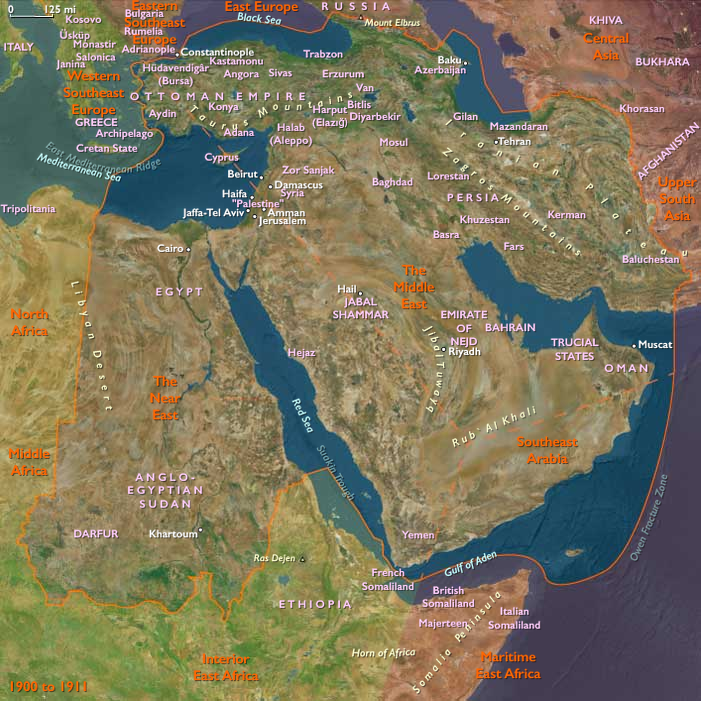
The Near and Middle East
View →Subregions
