
The Middle East: 916–927 CE Abbasid Decline…
916 CE to 927 CE
The Middle East: 916–927 CE
Abbasid Decline and Regional Assertion
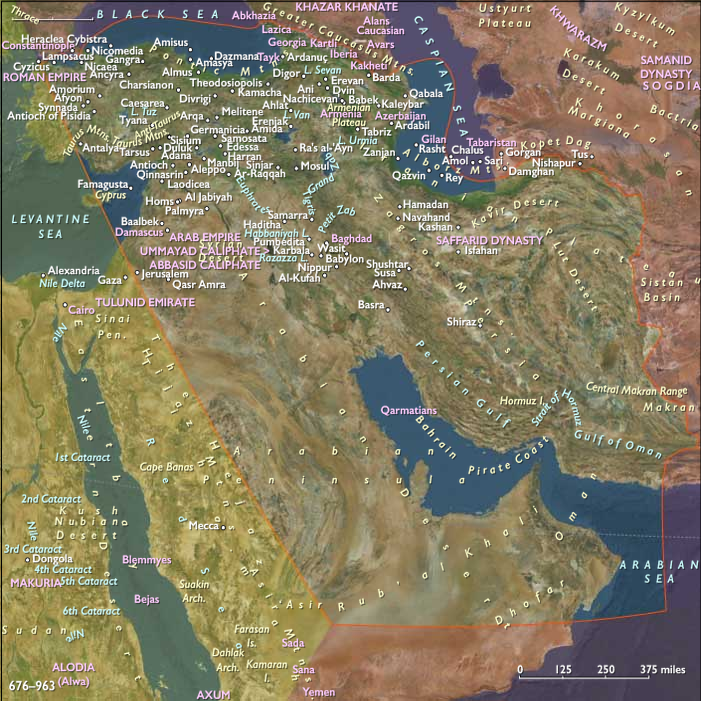
From 916 to 927 CE, the fragmentation of the Abbasid Caliphate deepens as central authority wanes further, giving rise to increasingly independent regional dynasties and power centers.
Consolidation of Independent Dynasties
In eastern Iran, the Samanids strengthen their rule and influence, promoting Persian culture and language and marking a significant shift away from Abbasid political and cultural dominance. Their capital, Bukhara, flourishes as a major intellectual and cultural center.
Continued Influence of the Qarmatians
The Qarmatians, maintaining their stronghold in Bahrain under the leadership of Abu Sa'id al-Hasan al-Jannabi, continue to challenge Abbasid control. Their radical, egalitarian beliefs remain influential, and their raids increasingly threaten trade routes and pilgrimage paths, posing a significant threat to the weakened Abbasid administration.
Cultural and Scientific Advances
Despite political instability, the intellectual and scientific climate remains vibrant. Agha Bakr Muhammad ibn Zakariya al-Razi (al-Razi) continues his groundbreaking medical and pharmaceutical research in Baghdad, contributing significantly to Islamic medicine and influencing medical practice throughout the medieval world.
Theological and philosophical discourse thrives with figures like Saadia Gaon, who continues his influential leadership at the Talmudic academy of Sura, engaging vigorously in religious scholarship and debate.
Kurdish Socio-Political Evolution
The identity of the Kurds continues to evolve, with their presence increasingly recognized across northern Mesopotamia and adjacent mountainous regions. Though still primarily identified by their pastoral nomadism, Kurdish groups begin to emerge more distinctly within the complex mosaic of Middle Eastern societies.
Linguistic Evolution
The transition from Middle Iranian to Modern Iranian languages progresses, reflecting broader cultural and social shifts within Persian-speaking communities, and laying the groundwork for the linguistic identities that will dominate the region for centuries.
This period, therefore, marks a critical juncture where decentralized power structures solidify, shaping the cultural and political landscapes of the Middle East well beyond the weakening grasp of the Abbasid Caliphate.
People
Groups
Topics
Subjects
Regions

The Near and Middle East
View →Subregions
Middle East
View →Related Events
No active filters.
Showing 10 events out of 53361 total
East Central Europe (916–927 CE): Establishment of the Magyar Principality, Ascendancy of Saxony under Henry the Fowler, and the Rise of the Přemyslid State
Between 916 and 927 CE, East Central Europe—comprising modern-day Poland, Czechia, Slovakia, Hungary, and eastern portions of Germany and Austria east of 10°E and north of a line from approximately 48.2°N at 10°E to the Austro-Slovenian border near 46.7°N, 15.4°E—underwent major transformations shaped by the establishment of a powerful Magyar principality, the ascendancy of Saxony under Henry the Fowler, and the formation of the Bohemian Přemyslid state. These significant developments marked the emergence of new medieval political entities, stabilizing the region after decades of turmoil and laying foundational structures that would define East Central Europe for centuries.
Political and Military Developments
Formation of the Magyar Principality
-
Under Árpád's successors, the Magyars solidified their control over the Carpathian Basin, creating a formidable political and military power capable of both internal consolidation and extensive raiding expeditions across Europe, significantly reshaping regional power dynamics.
Saxon Ascendancy under Henry the Fowler
-
Henry the Fowler (r. 919–936), succeeding his father Otto the Illustrious as Duke of Saxony and elected King of East Francia in 919, dramatically strengthened Saxon political and military authority. His reign marked the definitive rise of the Liudolfing (Ottonian) dynasty, significantly fortifying East Francia's eastern frontiers.
Emergence and Consolidation of the Přemyslid State
-
In Bohemia, the Přemyslid dynasty emerged prominently under Duke Wenceslaus I (r. c. 921–935), consolidating political authority, integrating local Slavic tribes, and establishing a nascent state structure that would profoundly shape Bohemian medieval history.
Economic and Technological Developments
Economic Stabilization and Trade Revival
-
With more stable regional political entities emerging, disrupted trade networks gradually revived, facilitating renewed economic activity in Bavaria, Saxony, and Bohemia, centered on agriculture, metalworking, and expanding long-distance commerce.
Expansion of Defensive Infrastructure
-
Henry the Fowler notably fortified East Francia’s eastern frontier, erecting extensive defensive systems, fortresses, and fortified towns, notably against persistent Magyar threats, significantly influencing military and urban development across Saxony and eastern Bavaria.
Cultural and Artistic Developments
Magyar Cultural Integration
-
Settled in the Carpathian Basin, the Magyar elite began assimilating local and regional cultural influences, creating a distinctive synthesis evident in artifacts, burial practices, and early settlement structures.
Saxon Ecclesiastical Patronage and Cultural Growth
-
Henry the Fowler’s reign saw extensive ecclesiastical patronage and cultural flourishing, reflected in manuscript production, monastic foundation, and artistic achievements, further solidifying Saxon cultural identity and Christian integration.
Bohemian Cultural and Religious Consolidation
-
Under the Přemyslids, Bohemian cultural identity deepened, with significant ecclesiastical patronage and consolidation of Slavic Christian traditions originally fostered by the Moravian missions, creating a lasting religious-cultural framework.
Settlement and Urban Development
Magyar Settlement Consolidation
-
Permanent Magyar settlements developed, notably around strategic locations such as Esztergom and Székesfehérvár, becoming important administrative, military, and cultural centers in early medieval Hungary.
Fortified Urban Centers in Saxony and Bavaria
-
Henry the Fowler systematically expanded and fortified key Saxon and Bavarian urban centers, significantly improving regional security and economic vitality, setting the foundations for medieval German urbanization.
Growth of Přemyslid Political and Ecclesiastical Centers
-
Emerging Bohemian centers like Prague became focal points for political, administrative, and ecclesiastical activities, initiating a sustained period of urban and regional development under Přemyslid leadership.
Social and Religious Developments
Reinforcement of Christian Institutions
-
The period witnessed strengthened ecclesiastical networks throughout Saxony, Bavaria, and Bohemia, embedding Christianity deeper into regional identities, social practices, and political institutions.
Formation of Distinct Regional Identities
-
The consolidation of distinct identities—Magyar, Saxon, and Bohemian—through dynastic rule, religious affiliations, and cultural traditions marked the formative phase of lasting regional and national communities in East Central Europe.
Long-Term Consequences and Historical Significance
The era 916–927 CE established crucial political, cultural, and social foundations for medieval East Central Europe. The solidification of Magyar power, the decisive ascendancy of Saxony under Henry the Fowler, and the formation of the Přemyslid state defined clear political entities, stabilizing the region after prolonged instability. These formative developments significantly influenced the medieval trajectory of East Central Europe, shaping future dynastic, cultural, and geopolitical landscapes.
Eastern Southeast Europe (916–927 CE): Bulgarian Zenith and Cultural Flourishing
Settlement and Migration Patterns
Continued Stability and Integration
From 916 to 927 CE, Eastern Southeast Europe maintained demographic stability, with ongoing integration and consolidation of Bulgarians, Slavs, and Daco-Romans, reinforcing regional cohesion.
Political and Military Developments
Simeon’s Expansion and Ambitions
Tsar Simeon I of Bulgaria, styling himself “Tsar of the Bulgars and Autocrat of the Greeks,” significantly consolidated his power and aspired to capture the throne of Constantinople. Under his reign, Bulgaria achieved its greatest territorial extent and influence, frequently challenging Byzantine dominance.
Bulgarian Golden Age
This era represented a golden age for Bulgaria, characterized by remarkable artistic, cultural, and commercial expansion. The capital, Preslav, was transformed into a magnificent city, described by contemporaries as rivaling Constantinople in splendor.
Serbian Strategic Balancing
Serbia continued navigating a strategic balance between Bulgarian and Byzantine influences, cautiously strengthening its internal political structures while maintaining regional significance.
Economic and Technological Developments
Economic Prosperity and Craftsmanship
The prosperity during this period was reflected in the remarkable growth of craft industries in Preslav, where artisans specialized in ceramics, stonework, glass, woodworking, and metalwork. Preslav’s tile work, notably the distinctive “Preslav style,” surpassed contemporary rivals and was widely exported, particularly to Constantinople and Kievan Rus.
Continued Defense and Infrastructure
Ongoing enhancements in defensive infrastructure and fortifications supported sustained economic resilience and safeguarded vital trade networks and agricultural productivity.
Cultural and Artistic Developments
Flourishing of Preslav and Bulgarian Arts
Cultural and artistic expressions thrived under Simeon’s patronage, significantly contributing to Preslav’s emergence as a cultural capital. Artistic developments in ceramics and tile work notably defined Bulgarian cultural identity and were highly sought after by surrounding regions.
Intellectual and Literary Activity
Scriptoria and educational institutions saw continued expansion, reinforcing Bulgaria’s cultural prestige and contributing significantly to the region’s intellectual heritage and literary production.
Social and Religious Developments
Slavonic Movement and Religious Reform
A notable Slavonic movement emerged, advocating for the reform of the recently established Bulgarian Orthodox Church, driven by evangelical Christian ideals. This movement further strengthened the integration of Bulgarian and Slavonic identities.
Continued Dominance of Orthodox Christianity
Orthodox Christianity continued its pivotal role in societal structures, significantly shaping cultural identity, community cohesion, and regional stability. Religious institutions remained influential in promoting social harmony.
Long-Term Consequences and Historical Significance
The period from 916 to 927 CE marked the zenith of Bulgarian political power, cultural prosperity, and artistic flourishing under Tsar Simeon I. The economic, cultural, and religious achievements of this era had enduring impacts, solidifying Bulgaria’s regional prominence and leaving lasting cultural legacies that continued to influence Eastern Southeast Europe.
The powerful Bulgarian ruler Simeon, who calls himself “Tsar of the Bulgars and Autocrat of the Greeks,” consolidates power in Bulgaria and covets the throne of Constantinople.
The Bulgarian kingdom has reached its greatest size under Simeon, who has presided over a golden age of artistic and commercial expansion and made Preslav made into a magnificent capital, which observers describe as rivaling Constantinople.
The artisans of its commercial quarter specialize in ceramics, stone, glass, wood, and metals, and Bulgarian tile work in the “Preslav style” surpasses its contemporary rivals and is eagerly imported by Constantinople and Kievan Rus.
A local Slavonic movement develops, aimed at reforming, in the name of an evangelical Christianity, the recently established Bulgarian Orthodox Church.
A new class of aristocracy, whose wealth and power are based on land ownership and who hold most of the higher military posts, arises within the East Roman Empire.
A dualistic, neo-Manichaean doctrine imported especially from the Paulicians develops into the Bogomil movement.
Mediterranean Southwest Europe (916–927 CE): Continued Papal Decline, Andalusian Fragmentation, and Cultural Persistence
The era 916–927 CE in Mediterranean Southwest Europe is characterized by continuing papal instability under the influence of powerful Roman aristocrats, increasing fragmentation within Al-Andalus, and enduring cultural resilience among diverse religious communities.
Papal Turmoil and the Saeculum Obscurum
This period continues the Saeculum obscurum, a turbulent era initiated in 904 CE with Pope Sergius III, during which the papacy remains dominated by the powerful and corrupt Theophylacti family. Papal authority suffers significantly from scandals, factional struggles, and political manipulation, severely undermining Rome’s spiritual and political influence across Europe.
Andalusian Fragmentation and Regional Autonomy
In Al-Andalus, Emir Abd al-Rahman III (r. 912–961 CE) inherits a territory fragmented by regional rebellions and decentralized power structures. Despite ongoing internal strife, Abd al-Rahman III gradually asserts his authority, laying the foundations for future centralization and recovery. Powerful local families and independent governors continue to challenge central authority, though signs of renewed political consolidation begin to emerge.
Mozarab and Jewish Communities' Resilience
Mozarab communities retain their cultural identity, playing essential roles as intermediaries between Islamic and Christian cultures, preserving religious traditions, scholarship, and local administration. Lucena continues as a thriving center for Andalusian Jewry, maintaining vibrant intellectual and cultural activity that enriches Iberian society.
Continued Economic Prosperity and Technological Advancement
Technological advancements, notably the sustained use of the Catalan forge, continue driving economic stability and prosperity throughout the region. Enhanced iron production facilitates agricultural productivity, urban growth, and strengthened military capabilities, maintaining Mediterranean Southwest Europe's economic vitality despite broader political instability.
Legacy of the Era
The era 916–927 CE underscores continuing papal corruption and political instability, the slow yet determined recovery efforts within Al-Andalus, and enduring cultural resilience within Mozarab and Jewish communities. These developments significantly influence the evolving medieval landscape of Mediterranean Southwest Europe, laying foundations for future consolidation and cultural flourishing.
North Africa (916–927 CE)
Fatimid Consolidation, Berber Realignment, and Continued Regional Dynamism
Between 916 and 927 CE, North Africa witnesses the consolidation of the Fatimid Caliphate in Ifriqiya alongside the continuing political realignments among various Berber entities in Morocco and the western Maghreb.
In Ifriqiya, Caliph Ubaydallah al-Mahdi Billah (909–934 CE) further solidifies Fatimid rule from the newly established capital of Mahdia. Under his leadership, the Fatimids expand administrative control, strengthening economic foundations through robust Mediterranean trade and improved agricultural productivity. Al-Mahdi Billah effectively utilizes the support of Kutama Berbers, ensuring military stability and regional dominance.
In Morocco, the fragmented Idrisid Dynasty continues its gradual decline, with diminished central authority giving rise to increased autonomy among influential Berber tribes, notably the Miknasa and Maghrawa. This fragmentation enables these tribal confederations to develop independently, establishing stronger local political structures and economic networks.
The independent Emirate of Nekor in the Rif region maintains its prosperity through Mediterranean trade, preserving its economic and cultural autonomy. Along Morocco's Atlantic coast, the Barghawata confederation remains a distinctive political and religious entity, further asserting its independence.
In the Saharan region, Sijilmasa, strategically governed by influential Tuareg tribes, remains a critical trans-Saharan trade hub, solidifying its position as an indispensable center of commerce linking the Mediterranean to sub-Saharan Africa.
By the conclusion of 927 CE, the political landscape of North Africa reflects a clear Fatimid ascendancy in the east, marked by stability and economic growth. Concurrently, the western Maghreb maintains a dynamic, fragmented structure, characterized by autonomous Berber states and tribal confederations, setting the stage for continued regional evolution in subsequent decades.
Atlantic Southwest Europe (916–927 CE): Reunification under Ordoño II, Renewed Stability, and Cultural Flourishing
Between 916 and 927 CE, Atlantic Southwest Europe—including Galicia, northern and central Portugal, Asturias, Cantabria, and northern Spain south of the Franco-Spanish border (43.05548° N, 1.22924° W)—experienced significant political reunification, renewed stability, and sustained cultural growth. Under the capable rule of King Ordoño II (914–924 CE) and the initial years of his successor, King Fruela II (924–925 CE), and later Alfonso IV (925–931 CE), the previously fragmented Asturian territories were swiftly reconsolidated into the Kingdom of León, restoring cohesive governance, economic resilience, and cultural continuity. The Basques under the Kingdom of Pamplona continued maintaining political independence and influencing regional dynamics.
Political and Military Developments
Effective Reunification under Ordoño II
King Ordoño II successfully restored centralized authority over territories previously fragmented by Alfonso III’s division among his sons. By 918 CE, Ordoño firmly reunited Galicia, Asturias, and León, re-establishing unified governance and strategic military coordination, significantly strengthening frontier defenses along the Duero River against Islamic al-Andalus.
Brief Succession Uncertainty and Restored Stability
After Ordoño II’s death in 924 CE, brief instability occurred with the short reign of his brother, Fruela II (924–925 CE). This was quickly stabilized by the accession of Alfonso IV ("the Monk," 925–931 CE). Alfonso IV continued strengthening centralized authority, effectively maintaining stability and regional unity.
Continued Basque Autonomy under Sancho Garcés I
In the Kingdom of Pamplona, Sancho Garcés I (905–925 CE) and subsequently García Sánchez I (925–970 CE)maintained robust Basque independence. Pamplona skillfully balanced diplomatic relationships between León, al-Andalus, and neighboring territories, reinforcing Basque autonomy and significantly shaping Iberian politics.
Economic Developments
Renewed Economic Prosperity
Political reunification greatly enhanced regional economic stability. Villa-based agriculture, livestock husbandry, artisanal crafts, and mining activities—particularly gold and silver extraction in Galicia and Asturias—flourished consistently, significantly enriching regional prosperity and sustainability.
Stable Maritime and Regional Trade Networks
Coastal settlements such as Bracara Augusta (Braga) and smaller ports along Galicia and northern Portugal continued steady maritime commerce, maintaining reliable economic exchanges with broader Atlantic and Mediterranean markets. These trade connections reinforced regional resilience and prosperity.
Cultural and Religious Developments
Sustained Growth of Santiago de Compostela
The pilgrimage tradition to Santiago de Compostela maintained robust growth, steadily increasing in religious significance, economic benefit, and cultural prominence. Santiago’s pilgrimage tradition remained deeply embedded in regional identity, fostering cultural unity and religious devotion across Atlantic Southwest Europe.
Robust Ecclesiastical Authority and Social Cohesion
Bishoprics—particularly Braga, Lugo, Asturica Augusta, and Santiago de Compostela—continued their pivotal role, providing moral leadership, community governance, education, and social cohesion. Ecclesiastical institutions remained central to civic life, deeply integrating orthodox Christianity within regional cultural identity.
Monastic Revival and Scholarly Flourishing
Monastic communities continued thriving as essential cultural, educational, and economic centers, preserving manuscripts, advancing literacy and scholarship, enhancing agricultural productivity, and providing vital social welfare. Monasteries significantly contributed to cultural continuity and historical preservation.
Persistent Cultural Syncretism
The longstanding synthesis of orthodox Christianity with indigenous Celtic and Iberian traditions persisted robustly, especially in rural Galicia, Asturias, and northern Portugal. This cultural integration reinforced regional unity, resilience, and local distinctiveness.
Civic Identity and Governance
Restored Centralized Royal-Ecclesiastical Governance
Under Ordoño II’s reunification and Alfonso IV’s stabilizing rule, governance effectively integrated royal and ecclesiastical authority, providing stable central administration balanced by regional autonomy. Civic identities remained strongly anchored to León’s monarchy, ecclesiastical institutions, and pilgrimage traditions to Santiago de Compostela, re-establishing the region as the cohesive center of Iberian Christian identity.
Stable Basque Political and Cultural Autonomy
The Basques, centered around Pamplona, maintained their distinctive territorial independence, political autonomy, and civic identity. Their sustained autonomy decisively influenced broader regional dynamics, strengthening their distinct medieval identity.
Notable Tribal Groups and Settlements
-
Astures and Cantabri: Continued providing political cohesion, military strength, and core regional identity, decisively shaping Leónese governance structures.
-
Galicians and Lusitanians: Maintained resilient local governance, economic prosperity, and cultural autonomy, pragmatically cooperating with Leónese royal authority.
-
Basques: Maintained and solidified political independence, autonomy, and distinct governance under Pamplona, actively influencing regional political developments.
Long-Term Significance and Legacy
Between 916 and 927 CE, Atlantic Southwest Europe:
-
Successfully reunited and stabilized politically, decisively shaping future medieval territorial boundaries, governance structures, and regional cohesion under the Kingdom of León.
-
Sustained economic prosperity, robust ecclesiastical institutions, and vibrant cultural traditions, significantly influencing regional identity and historical continuity.
-
Reinforced Basque autonomy, decisively influencing subsequent Iberian regional dynamics and political identities.
This era significantly advanced political, economic, and cultural foundations, shaping Atlantic Southwest Europe's medieval trajectory and enduring historical legacy.
Atlantic West Europe (916–927): Emergence of Regional Powers and Continued Carolingian Decline
Between 916 and 927, Atlantic West Europe witnessed the continued erosion of Carolingian royal authority, the consolidation and expansion of regional powers, especially Normandy, Flanders, Aquitaine, Anjou, and the Burgundian kingdoms, and the beginnings of political stabilization following the era of Viking raids.
Political and Military Developments
-
West Francia: Enduring Instability
- King Charles the Simple (r. 898–922) struggled against increasingly powerful nobles, ultimately losing his throne after being deposed in 922, leading to civil unrest and further fragmentation of royal power.
- Robert I, count of Paris, briefly became king (922–923) but was killed in battle against Charles’ supporters; Rudolph of Burgundy succeeded him, bringing Burgundy into a more prominent political role in West Francia.
-
Normandy: Consolidation under Rollo
- Duke Rollo (r. 911–927) successfully transformed the Viking-controlled territory into the stable Duchy of Normandy, integrating local populations and establishing Rouen as a major center of power and trade.
-
Flanders and Anjou: Strengthening Territorial Control
- Arnulf I of Flanders (r. 918–965) solidified territorial gains, enhancing Flanders' military and economic capabilities, particularly through fortifications and expanding trade networks.
- In Anjou, Fulk I the Red (r. 898–942) reinforced his authority through strategic marriages and aggressive territorial expansion along the Loire.
-
Aquitaine: Stability and Cultural Patronage
- William II of Aquitaine (r. 918–926) continued his predecessor's efforts, reinforcing regional governance, supporting religious institutions, and providing stability in southern and western France.
-
Upper and Lower Burgundy: Internal Stability
- Rudolph II of Upper Burgundy (r. 912–937) managed internal stability, while Lower Burgundy (Provence) under Louis the Blind (until 928) experienced weakening central control, allowing regional nobles greater independence.
Economic and Social Developments
-
Growth of Regional Economies
- Economic revival was evident, particularly in Normandy, Flanders, and Aquitaine, where stability fostered agricultural improvements, trade expansion, and urban growth.
- Rouen, Bruges, Tours, and Nantes strengthened their roles as commercial hubs and fortifications, benefiting from growing local markets and increased political stability.
-
Integration of Viking Settlers
- In Normandy, the integration of Norse settlers encouraged agricultural and commercial development, leading to improved economic conditions and increased cultural blending with local Frankish populations.
Religious and Cultural Developments
-
Expansion of Cluniac Influence
- The Abbey of Cluny, founded in 910, significantly increased its influence, promoting monastic reform and religious independence, particularly across Burgundy, Aquitaine, and the Loire Valley.
-
Monastic and Scholarly Revival
- Monastic centers continued to preserve classical and religious manuscripts, supporting early signs of intellectual revival and education, especially in prominent monasteries like Saint-Martin of Tours and Cluny Abbey.
Legacy and Significance
By 927, Atlantic West Europe was increasingly characterized by powerful regional principalities rather than centralized royal control:
- The weakening Carolingian monarchy ceded practical authority to regional rulers in Normandy, Flanders, Anjou, Aquitaine, and Burgundy.
- The Duchy of Normandy firmly established itself, foreshadowing its later expansionist role, notably the Norman conquest of England in the following century.
- Regional economic stabilization, particularly through revived trade and fortified towns, paved the way for the urban revival of the High Middle Ages.
- Cluniac monasticism deepened religious reform and cultural vitality, significantly shaping medieval European spirituality.
This era set critical foundations for the political, economic, and cultural contours that defined Atlantic West Europe through the High Middle Ages.
Northwest Europe (916–927 CE): Anglo-Saxon Ascendancy and Norse Integration
Continued Expansion Under Edward the Elder
Between 916 and 924 CE, Edward the Elder, king of Wessex, continued his steady expansion into territories previously dominated by Danish rulers. In cooperation with his sister, Æthelflæd, Lady of the Mercians, Edward systematically strengthened fortifications (burhs) and secured strategic victories, notably capturing Bedford (917 CE), Derby (917 CE), and Nottingham (918 CE). By the time of Æthelflæd’s death in 918 CE, most of Mercia had come under Edward’s authority, significantly diminishing Danish influence.
Edward’s Integration of Mercia
Following Æthelflæd’s death, Edward swiftly moved to secure Mercia. Initially, Æthelflæd’s daughter, Ælfwynn, briefly succeeded her mother but was quickly removed by Edward. By 919 CE, Edward effectively consolidated Mercia under direct Wessex control, uniting Anglo-Saxon power south of the Humber River and fundamentally altering England’s political landscape.
Consolidation of Norse Settlements in Ireland
In Ireland, Dublin remained a crucial Norse-Gaelic commercial center. Though periodic hostilities occurred between Gaelic and Norse rulers, alliances increasingly developed, reflecting an emerging cultural hybridization. The stability of Dublin during this era solidified Norse influence in Ireland, setting the stage for future political dynamics on the island.
Norwegian Authority Under Harald Fairhair
During these years, the aging Harald Fairhair maintained relative stability in Norway following decades of consolidation after the Battle of Hafrsfjord. Although regional chieftains occasionally challenged royal authority, no significant threats undermined his rule. Continued stability, however, encouraged ongoing emigration, primarily toward Iceland and the British Isles.
Development of Iceland’s Political Structure
Iceland’s population grew rapidly as settlers fleeing centralized Norwegian rule continued to arrive. By 920 CE, Icelandic communities had begun establishing local chieftaincies and informal regional assemblies. These would soon evolve into the Althing, officially founded in 930 CE, making Iceland one of the earliest parliamentary systems.
Scotland’s Strengthening Under Constantine II
Constantine II (reigned 900–943 CE), King of Alba, continued stabilizing Scottish territories. His strategic alliances and military strength curbed Viking encroachment from the Hebrides and Northern Isles, reinforcing Alba’s identity as a unified kingdom. His reign marked a significant step toward the development of medieval Scotland.
Succession of Athelstan and Unification of England
Edward the Elder’s death in 924 CE marked the accession of his son, Athelstan (r. 924–939 CE), widely regarded as one of the most significant Anglo-Saxon kings. In 927 CE, Athelstan completed the unification of English territories by taking control of York, securing submission from northern English and Scottish kings. This event, often considered the foundation of a unified English kingdom, significantly shaped England's political future.
Religious Continuity and Cultural Preservation
Throughout these years, monastic communities continued their roles as preservers of culture and learning across Northwest Europe. Intellectual traditions and legends, such as those surrounding King Arthur, remained important symbols of cultural identity.
Legacy of the Era
By 927 CE, Northwest Europe had entered a transformative era marked by the decisive consolidation of Anglo-Saxon rule under Edward the Elder and Athelstan. Their successes significantly weakened Norse political dominance in England, while simultaneously, vibrant Norse communities persisted in Ireland and Iceland, establishing enduring cultural and political legacies throughout the region.