The first contacts between the people of…
1684 CE to 1827 CE
The Portuguese missionaries John Cabral and Stephen Cacella had visited Lhasa in 1628, after which Cabral had traveled to Nepal.
The first Capuchin mission is founded in Kathmandu in 1715.
These contacts, however, affect only a minuscule number of people.
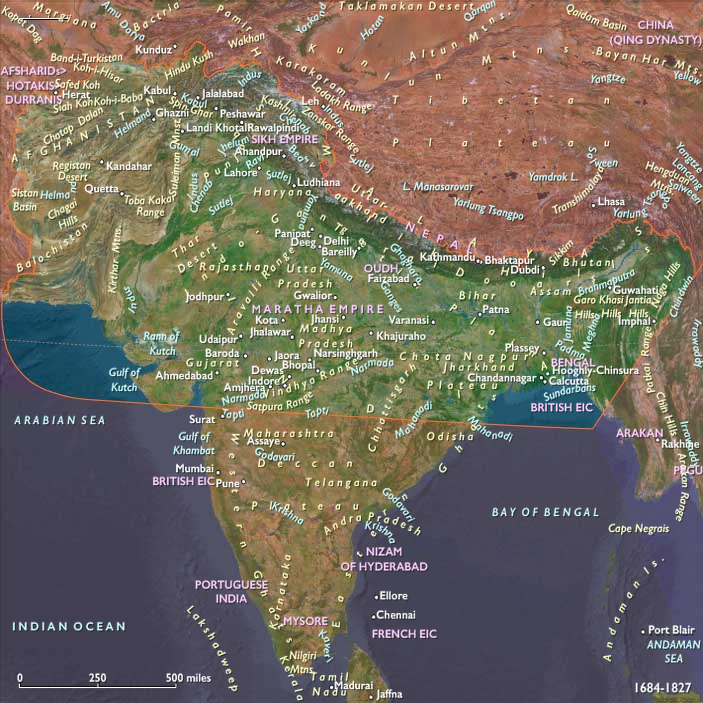
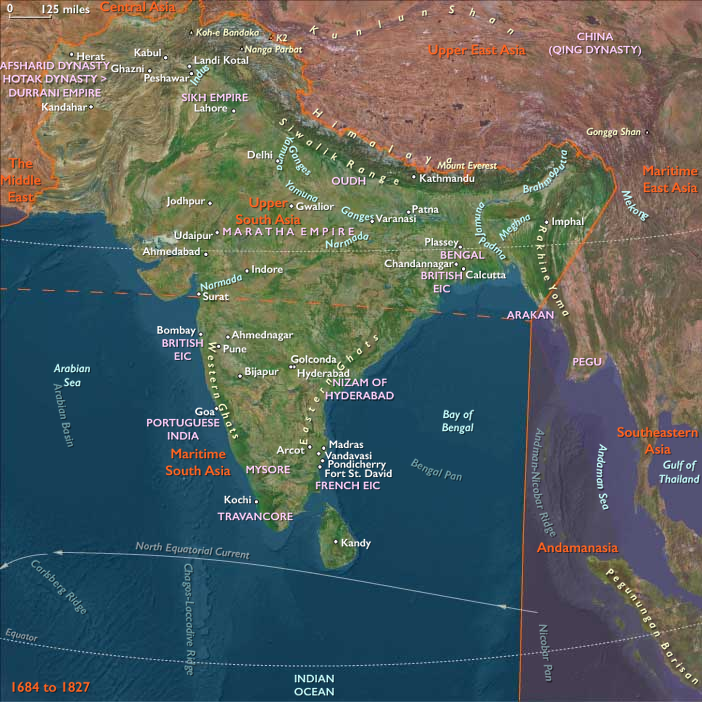
Of far greater importance is the growth of British power in India, notably in Bengal to the southeast of Nepal, during the eighteenth century.
By 1764 the British East India Company, officially a private trading corporation with its own army, has obtained from a decaying Mughal Empire the right to govern all of Bengal, at this time one of the most prosperous areas in Asia.
The company explores possibilities for expanding its trade or authority into Nepal, Bhutan, and toward Tibet, where the Nepalese have their own trading agencies in important settlements.
The increasingly powerful company is emerging as a wild card that can in theory be played by one or more of the kingdoms in Nepal during local struggles, potentially opening the entire Himalayan region to British penetration.
Locations
Groups
Kirat people
View →
Bengalis
View →
Persian people
View →
Pashtun people (Pushtuns, Pakhtuns, or Pathans)
View →
Buddhism
View →
Khas peoples
View →
Indian people
View →
Chinese (Han) people
View →
Tibetan people
View →
Rajasthan, Rajput Kingdoms of
View →
Rajputs
View →
Islam
View →
Muslims, Sunni
View →
Newar people
View →
Christians, Roman Catholic
View →
Capuchin, Order of Friars Minor
View →
Tibet, Lamacracy of
View →
Bhutan, Kingdom of
View →
Chinese Empire, Qing (Manchu) Dynasty
View →
Mughal Empire (Delhi)
View →
Britain, Kingdom of Great
View →
East India Company, British (United Company of Merchants of England Trading to the East Indies)
View →
Bengal, Nawabs of
View →
India, East India Company rule in
View →
Bengal Presidency
View →
Topics
Subjects
Regions
South Asia
View →Subregions