Atlantic Southwest Europe (676–819 CE): Collapse of…
676 CE to 819 CE
Atlantic Southwest Europe (676–819 CE): Collapse of the Visigothic Kingdom, the Emergence of Asturias, and the Reorganization of the Atlantic Frontier
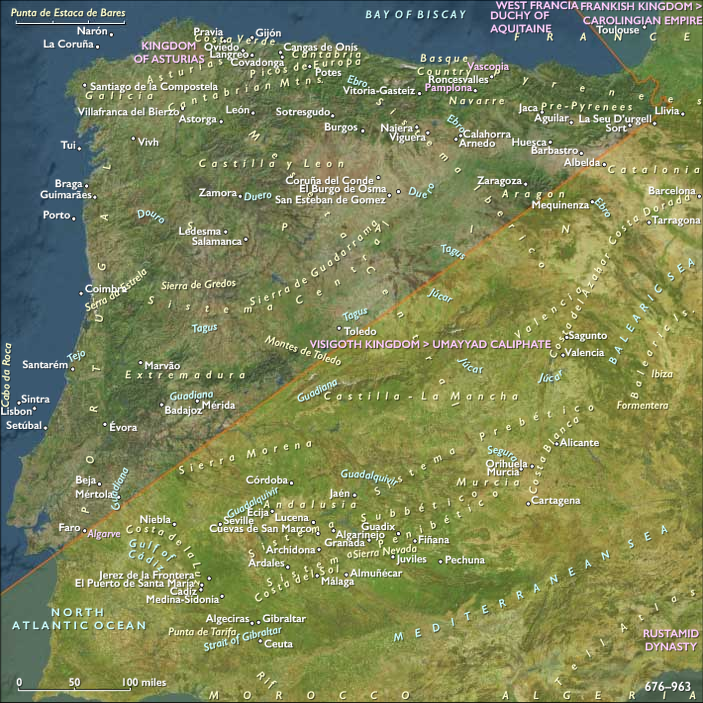
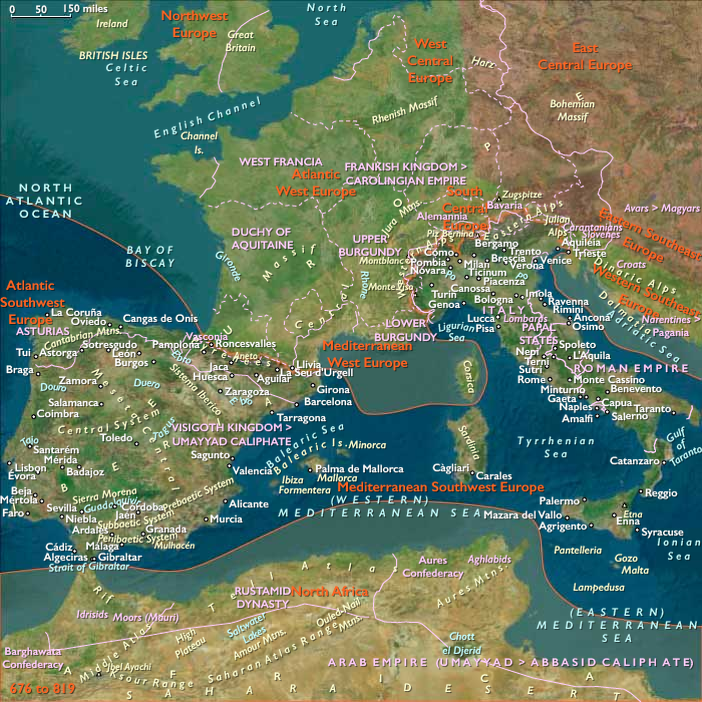
Between 676 and 819 CE, Atlantic Southwest Europe—comprising central and northern Portugal, including Lisbon and the Sado estuary, together with Galicia, Asturias, Cantabria, the Basque Country, western La Rioja, northwestern Navarre, the far western Spanish Pyrenees, nearly all of Castile and León apart from its southeastern portion, and northwestern Extremadura—underwent one of the most consequential political transformations in its history. The collapse of the Visigothic Kingdom, the rapid expansion of al-Andalus, and the gradual emergence of the Kingdom of Asturias reshaped patterns of political authority across the region. Yet beneath these dramatic events, the Atlantic landscape displayed remarkable continuity. River valleys, forests, estuaries, mountain pastures, and long-established agricultural systems continued to organize settlement, exchange, and everyday life, ensuring that environmental stability outweighed political upheaval in shaping the region's long-term development.
Environmental Change and Landscape Organization
The environmental systems that had structured Atlantic Southwest Europe since the Iron Age remained fundamentally unchanged. Extensive oak, chestnut, beech, and mixed deciduous forests continued to dominate Galicia, Asturias, Cantabria, northern Portugal, and the western Pyrenean foothills, while the Douro, Mondego, Tagus, Sado, Minho, and upper Ebro valleys supported productive agricultural landscapes cultivated over many centuries.
Cultivated land remained concentrated in river valleys, lower hillsides, and coastal plains, while mountain districts continued supporting seasonal grazing and woodland management. The Cantabrian Mountains and western Pyrenees retained their importance as ecological barriers and communication corridors, encouraging localized political development while facilitating pastoral movement between upland and lowland communities.
Roman roads, bridges, and river crossings continued serving movement throughout the region. Although centralized maintenance declined, local communities, monasteries, bishops, and aristocratic estates preserved many transportation routes that had connected Atlantic Iberia since the Roman period. Atlantic estuaries and sheltered harbors likewise remained essential gateways linking inland settlements with maritime exchange.
Settlement and Subsistence
Settlement remained overwhelmingly rural and highly dispersed. Villages, farmsteads, pastoral hamlets, monasteries, episcopal centers, and modest market settlements dominated the landscape, while older Roman municipalities such as Braga, Lugo, Astorga, Olisipo (Lisbon), Pamplona, and Oiasso continued serving as regional centers despite reduced political authority.
Agriculture remained diverse and remarkably resilient. Wheat, barley, rye, oats, millet, legumes, vineyards, orchards, vegetables, and flax were cultivated according to local environmental conditions, while cattle remained the principal measure of wealth throughout the humid Atlantic districts. Sheep, goats, pigs, and horses supported mixed farming systems extending from the coastal plains into the western Meseta and mountain valleys.
Forestry, beekeeping, hunting, and the gathering of woodland products supplemented agricultural production, while Atlantic fisheries, shellfish harvesting, salt production, and modest shipbuilding remained vital to numerous coastal communities. The economy continued to rest upon environmental diversity rather than specialization, allowing communities to adapt successfully to shifting political conditions.
Exchange and Regional Interaction
Although the political geography of Iberia changed dramatically after 711 CE, regional exchange remained surprisingly durable. Coastal navigation continued linking Lisbon, the Portuguese coast, Galician estuaries, Cantabrian ports, and the Bay of Biscay with western Gaul, the Frankish kingdoms, Ireland, and Britain. Inland, the Douro, Tagus, upper Ebro, and established Roman road network continued connecting agricultural districts, episcopal centers, and mountain communities.
Commercial exchange increasingly reflected political diversity. Southern portions of the subregion incorporated into al-Andalus participated in Islamic commercial systems extending across Iberia and the western Mediterranean, while northern communities strengthened Atlantic and trans-Pyrenean relationships. These overlapping economic spheres ensured that the region remained interconnected despite the emergence of new political frontiers.
Agricultural products, livestock, wool, leather, timber, iron, salt, fish products, pottery, and locally manufactured goods continued circulating widely through regional markets. Exchange remained largely decentralized, depending upon numerous local centers rather than a few dominant cities.
Institutions and Belief
Christian institutions became the principal organizers of social and cultural life across the northern and western portions of the subregion. Bishoprics at Braga, Lugo, Astorga, Iria Flavia, Pamplona and other cities exercised increasing authority over education, charitable activity, land management, dispute resolution, and regional administration.
Monastic communities expanded steadily throughout Galicia, Asturias, northern Portugal, the Cantabrian valleys, and portions of the upper Douro. These institutions remained integrated within surrounding agricultural landscapes rather than standing apart from them. Their farms, vineyards, orchards, mills, scriptoria, guest houses, and workshops became increasingly familiar elements of the countryside, contributing to both economic productivity and cultural continuity.
The reputed discovery of the tomb of Saint James near Compostela around 813 CE marked one of the defining religious developments of the period. Although pilgrimage remained modest during these early decades, the emerging shrine immediately strengthened the religious prestige of the Asturian kingdom and laid the foundations for one of medieval Europe's great pilgrimage traditions.
In territories incorporated into al-Andalus, Christian communities generally continued functioning as protected religious minorities while adapting to new administrative and fiscal structures. Jewish communities likewise remained active within several urban centers, contributing to the commercial and cultural diversity of southern districts.
Political Developments
The final decades of Visigothic rule were marked by increasing aristocratic rivalry, weakening royal authority, and growing regional autonomy. These internal divisions contributed significantly to the rapid collapse of the Visigothic monarchy following the Muslim invasion of 711 CE.
The Islamic conquest rapidly incorporated central Portugal, Lisbon, the Tagus basin, northwestern Extremadura, and portions of the upper Ebro into the expanding Umayyad administration of al-Andalus. Existing towns, agricultural estates, taxation systems, and transportation networks frequently continued operating under new political leadership, illustrating the substantial continuity of the underlying landscape despite the dramatic transfer of sovereignty.
In the Cantabrian Mountains, however, the difficult terrain, dispersed settlement, and resilient local aristocracies encouraged the gradual emergence of an independent political center. Under Pelayo and his successors, the Kingdom of Asturias slowly consolidated authority across Asturias and increasingly into Galicia and neighboring districts. The Battle of Covadonga, traditionally dated to approximately 722 CE, acquired enduring symbolic importance as the beginning of organized Christian resistance, although the kingdom's growth remained gradual and depended as much upon diplomacy, settlement, and regional alliances as military success.
During the reigns of Alfonso I, Fruela I, Silo, and particularly Alfonso II, Asturian authority expanded through the careful integration of local aristocracies, episcopal institutions, and existing settlement networks rather than through direct territorial conquest alone. Royal administration remained relatively modest, relying heavily upon monasteries, bishops, noble households, and local communities.
The Basque territories and western Pyrenean valleys continued following their own political trajectory. Communities in these districts negotiated relationships variously with Asturias, the Carolingian frontier, neighboring Ebro polities, and al-Andalus while preserving strong traditions of local autonomy. Rather than forming a fixed frontier, the upper Ebro basin became a zone of continual diplomatic, commercial, and military interaction linking northern Iberia with Aquitaine and the Frankish world.
Likewise, the Douro basin should not be understood as an empty defensive zone. Population densities shifted unevenly, some settlements contracted or relocated, and political authority became more fragmented, but agricultural communities, churches, estates, and local centers persisted throughout much of the valley. The frontier remained a dynamic landscape of negotiation rather than an abandoned wilderness.
Legacy of the Age
Between 676 and 819 CE, Atlantic Southwest Europe underwent a profound political recomposition while preserving extraordinary environmental continuity. The Visigothic kingdom disappeared, al-Andalus became established across much of southern and central Iberia, and the Kingdom of Asturias emerged as the principal Christian polity of the Atlantic north. Yet these political changes unfolded upon landscapes whose rivers, forests, mountain corridors, agricultural valleys, estuaries, and Atlantic maritime routes had organized regional life for more than a millennium.
Christian bishoprics, expanding monasteries, local aristocracies, village communities, and modest market towns increasingly replaced Roman provincial administration as the principal institutions of regional cohesion. At the same time, Islamic administration introduced new political and commercial connections into the southern portions of the subregion without fundamentally altering their agricultural foundations.
By 819 CE, Atlantic Southwest Europe had become a politically plural but environmentally unified region. Asturias, Galicia, northern Portugal, the Basque Country, the upper Ebro, the Douro basin, and the Andalusi-controlled south all remained connected through enduring ecological systems, inherited transportation corridors, and long-established patterns of exchange. The medieval Atlantic landscape that would shape the following centuries had largely taken form—not through the creation of entirely new environments, but through the adaptation of ancient ones to new political realities.
Images

Atlantic Southwest Europe in the Early Medieval (Lower) Age
People
Groups
Topics
Commodities
Subjects
Regions
Southwest Europe
View →Subregions