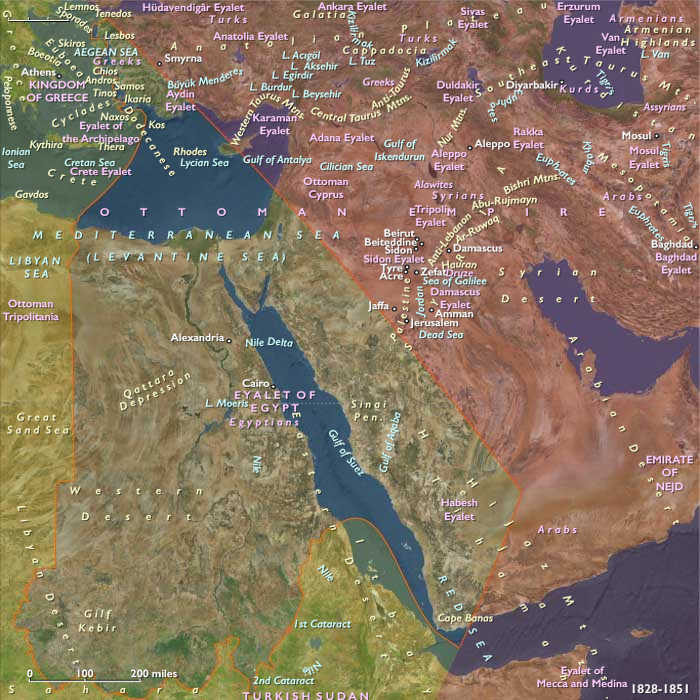
The Near East, 1828 to 1839 CE:…
1828 CE to 1839 CE
The Near East, 1828 to 1839 CE: Muhammad Ali’s Ambitions and International Rivalries
British Strategic and Economic Concerns
Historian Afaf Lutfi al-Sayyid-Marsot argues that by the early nineteenth century, Britain perceives Muhammad Ali’s Egypt as a significant threat to its strategic and economic interests. Economically, Britain’s textile industry depends heavily on Egyptian cotton, which is processed in the mills of Lancashire and returned as finished goods. Muhammad Ali’s policy of monopolizing trade irritates British and French commercial interests despite both countries engaging in protectionist practices themselves.
Strategically, Britain prioritizes maintaining a secure overland route through Egypt to India, crucial for imperial communications. Concerns deepen due to Muhammad Ali’s robust military buildup and his close diplomatic ties with France, seen as a potential rival in the region.
Egyptian Industrialization and Economic Policies
Muhammad Ali actively promotes industrial growth, establishing state-run factories producing textiles from cotton, jute, silk, and wool. Workers are conscripted into these factories, which employ nearly 200,000 people by the mid-1830s. Additional industries, such as sugar processing, indigo dyeing, glassmaking, and leather tanning, are developed with foreign advisors and imported machinery.
To protect these nascent industries, Muhammad Ali imposes embargoes against cheap British textiles that previously flooded Egyptian markets. The state’s trade policy emphasizes monopolies, designed to ensure a favorable balance of trade and minimize foreign competition.
Agricultural Expansion and Centralized Control
Agriculture underpins Muhammad Ali’s broader economic strategy. He dramatically expands Egypt’s cultivated area and directs production toward lucrative export crops like long-staple cotton, rice, indigo, and sugarcane. Revenue from agriculture finances extensive public works, including irrigation networks, dams, canals, and industrial development.
Muhammad Ali’s government exerts direct control over agricultural resources, dictating crop types, planting areas, and quantities. This centralized approach effectively eliminates intermediary merchants, as the government directly buys from farmers and sells to foreign markets.
Egyptian Military Expansion and the Syrian Campaign
Britain, guided by Foreign Minister Lord Palmerston, commits to preserving the integrity of the weakening Ottoman Empire, preferring it intact yet manageable for British interests. Muhammad Ali’s ambitious invasion of Syria in 1831 directly challenges this British policy. The invasion is partly triggered by Ottoman refusal to grant Muhammad Ali control over Syria and Morea in exchange for his earlier assistance against the Greek independence movement.
The earlier naval defeat at Navarino in 1827 significantly weakens the Ottoman-Egyptian naval presence in the Mediterranean, providing Muhammad Ali further incentive to assert his independence through military force. Britain, alongside Russia, decisively intervenes to force Muhammad Ali’s withdrawal from Syria, restoring Ottoman authority.
Ottoman Rule and Regional Instability in Jordan
From 1831 to 1839, Ottoman control in what is now Jordan is temporarily displaced by Muhammad Ali’s Egyptian troops during his broader regional revolt. Muhammad Ali’s occupation provokes a diplomatic backlash from Britain and Russia, leading to his eventual withdrawal and the re-establishment of Ottoman governance in the region.
Legacy of the Era: Muhammad Ali’s Developmental Vision and International Resistance
The years 1828 to 1839 vividly illustrate Muhammad Ali’s ambitious developmental policies, emphasizing industrialization, agricultural expansion, and centralized economic control. However, these same ambitions provoke significant international resistance, particularly from Britain, which seeks to safeguard its strategic and economic interests by maintaining Ottoman territorial integrity. Muhammad Ali’s era thus sets the stage for persistent geopolitical tensions and shapes the trajectory of the Near East’s modernization and integration into global economic networks.
Groups
Commodities
Subjects
Regions
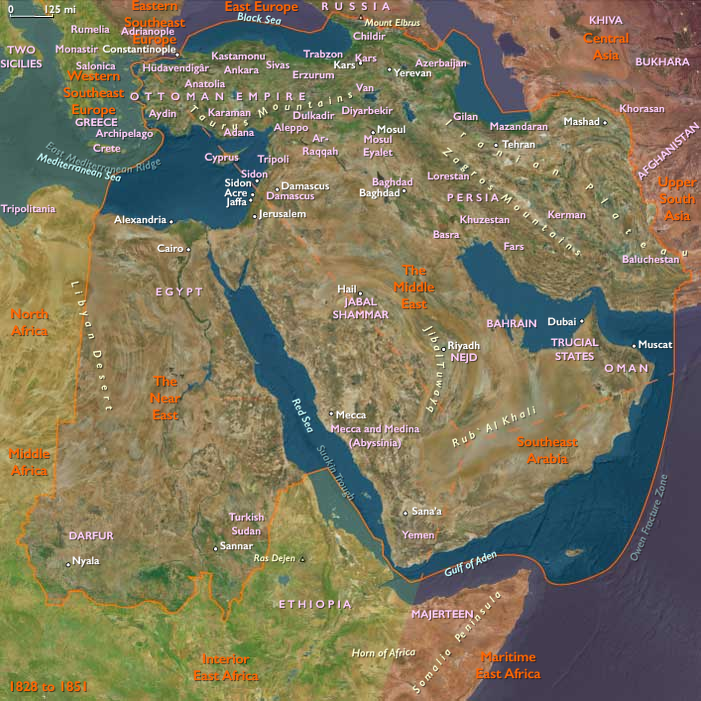
The Near and Middle East
View →Subregions