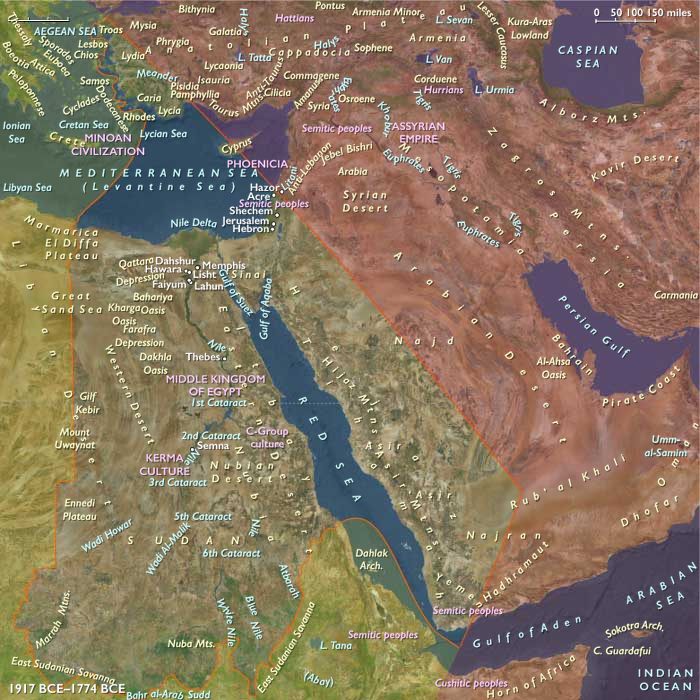
The Near East (1917–1774 BCE): Trade, Cultural…
1917 BCE to 1774 BCE
The Near East (1917–1774 BCE): Trade, Cultural Flourishing, and Dynastic Shifts
Egyptian Trade and Relations with Nubia (Kush)
Over the centuries, active trade routes have developed between Egypt and the region of Nubia (Kush). Egyptian caravans carry grain into Kush, returning with valuable commodities including ivory, incense, hides, and the prized stone carnelian, used both for jewelry and arrowheads. Notably, Egyptian merchants highly value gold and slaves, who serve as domestic servants, concubines, and soldiers in the pharaoh's armies.
During the Middle Kingdom (ca. 2100–1720 BCE), Egypt intensifies its influence over Nubia, establishing a series of forts along the Nile as far south as Semna in northern Sudan to safeguard the valuable gold mines of Wawat.
Rise of Middle Bronze Age Canaan
Recorded history in Canaan commences with the Middle Bronze Age, a period pivotal for understanding the context of early biblical narratives. Egyptian texts from the nineteenth century BCE first document significant urban centers such as Akko (Acre)—with its notable harbor—and the inland city of Jerusalem. The ancient city of Shechem, centered around a fertile, well-watered oasis, also becomes historically significant, serving as a vital passage through Palestine's central hill country.
Egypt's Thirteenth Dynasty and Internal Stability
Although traditionally viewed as chaotic, the Thirteenth Dynasty may have been relatively stable, maintaining a central government based at Itj-tawy near the Faiyum. Despite limited monumental records, this dynasty exhibits continuity in governance.
Senusret III and Egyptian Expansion
Pharaoh Senusret III (1878–1839 BCE) embarks on punitive expeditions into Nubia and the Levant, effectively managing restive provinces and initiating a period of territorial expansion. His military exploits give rise to the legendary figure of Sesostris, a conqueror credited by later historians with vast territorial acquisitions, extending as far as Thrace. Senusret III’s reign represents a cultural zenith, witnessing advances in arts, crafts, trade, and urban planning.
Amenemhat III and Egypt’s Architectural Achievements
Pharaoh Amenemhat III (1860–1814 BCE) continues Egypt’s assertive foreign policy and undertakes significant architectural projects, including the renowned mortuary temple known as the "Labyrinth" at Hawara. His initiatives to drain the marshy areas of the Faiyum using elaborate waterwheels dramatically expand cultivable land, further bolstering Egypt’s prosperity.
End of the Twelfth Dynasty and Queen Sobekneferu
The brief reign of Queen Sobekneferu concludes around 1802 BCE, marking the end of the Twelfth Dynasty and Egypt’s prosperous Middle Kingdom. Her death without heirs initiates a transitional era of weakened centralized authority.
Artistic and Literary Innovations
Middle Kingdom sculpture introduces the enduringly popular block statue, characterized by a cloaked figure seated with knees drawn up to the chest. Though royal portraiture grows more naturalistic, Egyptian art maintains traditional Old Kingdom standards.
Literary culture flourishes notably during this period. Texts such as The Story of Sinuhe, The Instructions of Amenemhat, The Tale of the Eloquent Peasant, and moral works such as the Prisse Papyrus demonstrate significant advancements in narrative and didactic literature. Papyri containing mathematical texts, such as the Moscow Mathematical Papyrus, showcase Egypt’s advanced intellectual climate. Additionally, the Papyrus of Kahun documents early veterinary practices.
Metallurgy and Craftsmanship
Egyptian artisans excel in various metalworking techniques, including repoussé, ajouré, granulation, enameling, and lapidary arts, demonstrating exceptional craftsmanship that contributes significantly to international trade and cultural prestige.
Amorite and Canaanite Developments
The term Amurru during the second millennium BCE broadly describes both the ethnic Amorites and a geographic-political region in Syria and northern Palestine, centered at Hazor. The cultural legacy of the Amorites is inherited by the Canaanites, whose city-building activities reintroduce urban life in southern Palestine. Their religious tradition centers around El and Baal, deities associated with fertility and nature, and their archaic Hebrew language sets the linguistic foundation for later biblical Hebrew.
Urban Developments and Canal Construction
The city of Memphis, despite losing political primacy to Thebes, remains a central hub for commerce and artistry, with significant architectural projects, notably the Temple of Ptah, enhanced by pharaohs such as Amenemhat I and II. Egyptian tradition attributes early attempts at canal construction linking the Nile with the Red Sea to the legendary Sesostris (possibly Senusret II or III). Historical accounts by Aristotle, Strabo, and Pliny later reference these ambitious engineering projects, underscoring Egypt’s innovative infrastructural developments.
Hebron and Its Archaeological Significance
The Canaanite royal city of Hebron, located in the southern Judaean Hills, undergoes significant fortification during the Early Bronze Age, experiences destruction, and is resettled during the late Middle Bronze Age, reaffirming its strategic and historical importance.
The period spanning 1917–1774 BCE is thus marked by substantial advancements in trade, urban development, art, literature, and governance, leaving a lasting imprint on Near Eastern civilizations.
People
Groups
Commodities
Subjects
Regions
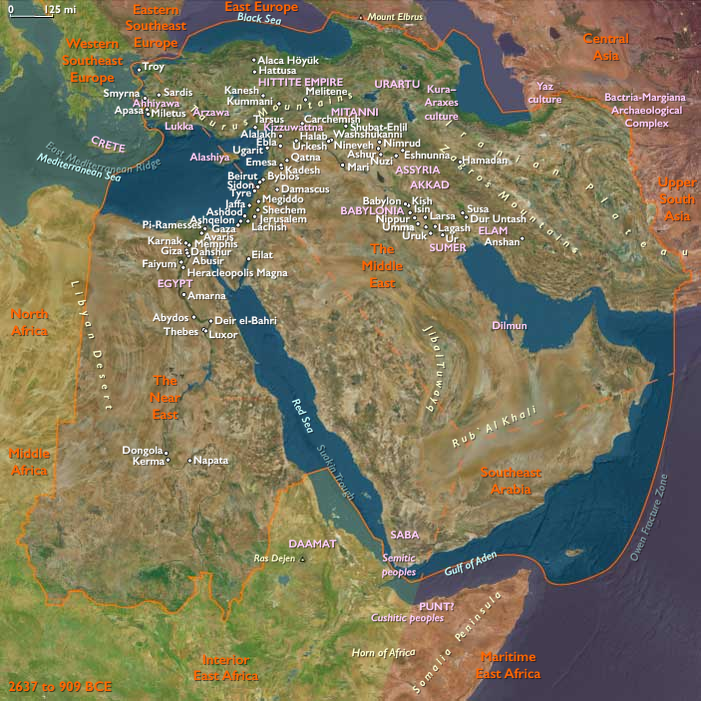
The Near and Middle East
View →Subregions