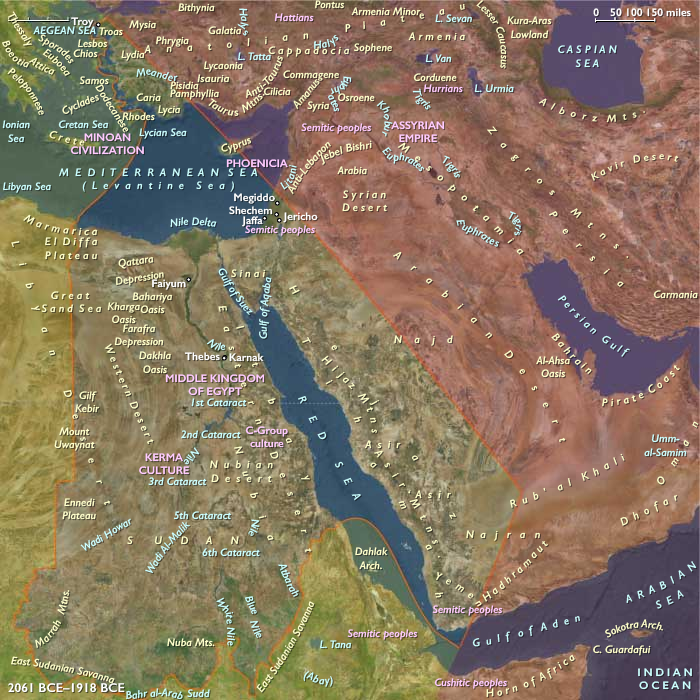
The Near East (2061–1918 BCE): Revival, Reunification,…
2061 BCE to 1918 BCE
The Near East (2061–1918 BCE): Revival, Reunification, and Cultural Flourishing
Nubia (Kush) and Egyptian Influence
The earliest recorded history of Northern Sudan (Nubia) emerges from Egyptian descriptions, labeling the region upstream from the first cataract as Kush, often derogatorily termed "wretched." Despite periods of reduced direct control by Egypt, the Kushite region remains profoundly influenced culturally and religiously by Egypt's enduring presence and activities for over two millennia.
Artistic and Cultural Developments in Egypt
During the third millennium BCE, Egyptian tomb decorations increasingly depict formalized scenes of warfare, hunting, and ceremonial rites, reflecting societal values and everyday life. By 2000 BCE, such images notably include scenes of ox branding, demonstrating advancements in animal husbandry and agricultural organization. Egyptian art experiences a shift towards greater naturalism, especially in royal portraiture, while still adhering to traditional proportional and postural norms.
The craftsmanship of Egyptian artisans reaches remarkable sophistication. They extensively utilize indigo dye, ornamental wire, gold jewelry, and decorative glass, including beads and elaborately designed unguent jars featuring intricate colored patterns. Highly skilled Egyptian metalworkers further enhance the rich cultural legacy through exquisite ornamental metalwork.
Revival of Pyramid Construction and Architecture
Under the Eleventh Dynasty, pyramid building resumes with renewed vigor. Architectural innovations appear, including combined mortuary temples and tombs adorned with painted and sculptured colonnades. The architecture and decorative arts of this period reflect a reestablished centralized monarchy that seeks to recapture the grandeur of the earlier Old Kingdom.
Emergence of Luxor (Thebes) and the Cult of Amun-Re
Thebes (modern Luxor) rises to prominence during this era, known as Waset ("city of the scepter") and as a religious and political epicenter. Renowned for luxury, artistic expression, wisdom, and religious authority, the city gains stability under Mentuhotep II, who reunifies Egypt following the turmoil of the First Intermediate Period.
The local deity Amun, later identified with the ram and goose, gains national prominence as Amun-Re, merging with Re, the principal god of Heliopolis. This fusion symbolizes the divine legitimacy of the reunited monarchy. The elaborate temple complex at Karnak emerges as a major religious center, notably during the reign of Senusret I (circa 1971–1926 BCE), reflecting the city’s ascending cultural and religious status.
Medical and Intellectual Advances
Egypt's intellectual culture blossoms, as evidenced by the Papyrus of Kahun (1900 BCE), which provides one of the earliest known records of veterinary medicine. Additionally, Egyptian papyrus documents from this period explore the realm of dreams and their interpretations, illustrating an advanced intellectual and literary tradition.
Military and Political Dynamics
During this era, Egypt’s competing Tenth and Eleventh dynasties clash for dominance amidst ongoing semi-autonomy of provincial rulers. These internal struggles are complicated by simultaneous military engagements with Nubian and Palestinian warriors, sought both as allies and mercenaries. Ultimately, Nebhepetre Mentuhotep of the Eleventh Dynasty reunifies Egypt in the early twenty-first century BCE, reestablishing a stable, centralized government and inaugurating Egypt's Middle Kingdom.
Linguistic Developments
Linguistically, this period marks a continuation and slight evolution from Old Egyptian—spoken during the Old Kingdom and First Intermediate Period—to Middle Egyptian, the classical form of the language. A distinctive characteristic remains the tripling of ideograms, phonograms, and determinatives to denote plurality.
Canaanite Urban and Trade Growth
The seaport of Jaffa gains significance as an essential commercial hub around 2000 BCE, enhancing the region’s maritime trade network. Megiddo, strategically positioned along a critical trade route connecting Egypt and Assyria, becomes a fortified city by the end of the third millennium BCE, safeguarding regional trade and communication.
Cultural Shifts in Anatolia and Troy
Following Troy II's destruction in 2250 BCE, subsequent settlements (Troy III-V) feature fortified but increasingly compact citadels, suggesting shifting economic conditions. Around the twentieth century BCE, a substantial migration triggered presumably by the Hittites reshapes Anatolia. Although Troy itself is not destroyed at this time, evident cultural changes indicate new populations influencing the region.
Understanding Egyptian Kingdom Periods
Historians classify Egyptian history into "kingdom" periods of strong centralized governance, unified territory, and stable succession, contrasted with "intermediate" periods marked by decentralization and civil strife. The end of the Old Kingdom following the Sixth Dynasty (circa 2181 BCE) initiates the First Intermediate Period, characterized by fragmentation and instability. However, the establishment of the Twelfth Dynasty's centralized government restores the unified cultural and political structures of the Old Kingdom, collectively forming a significant, coherent developmental phase in ancient Egyptian civilization.
Groups
Commodities
Subjects
Regions
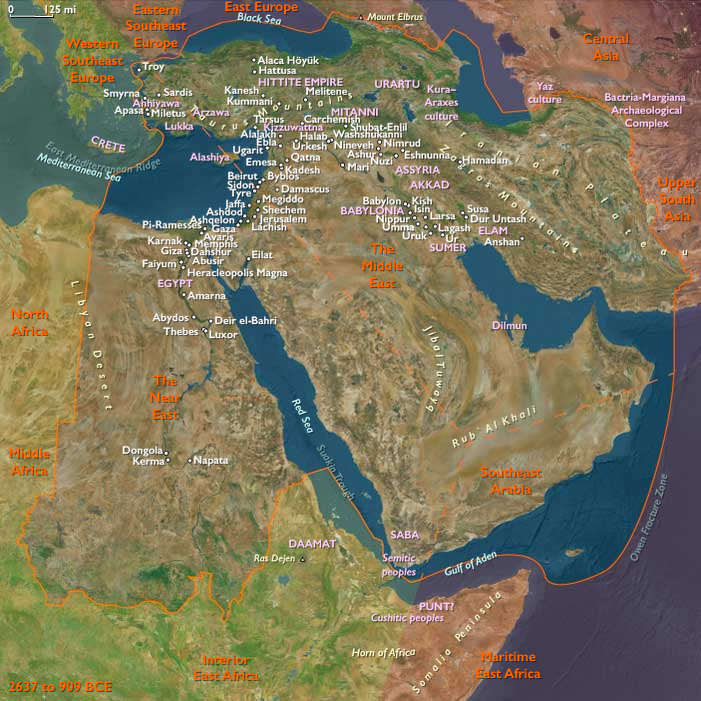
The Near and Middle East
View →Subregions