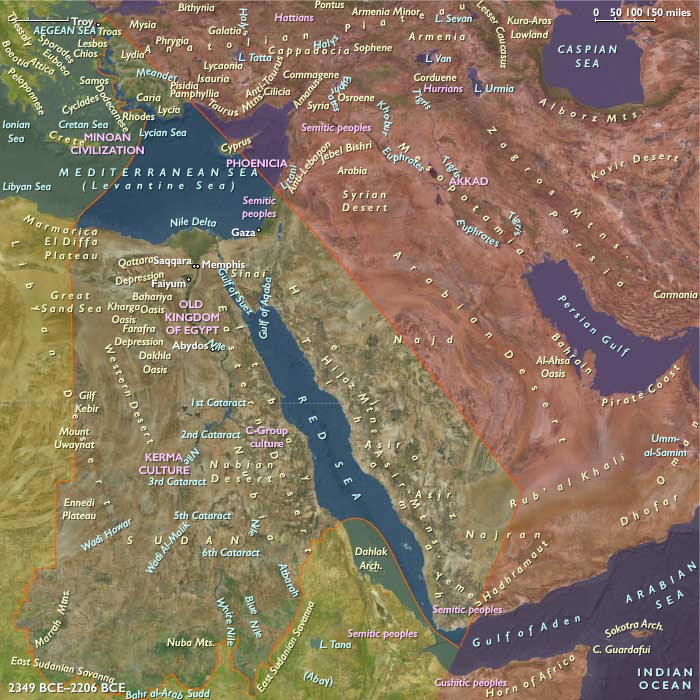
The Near East (2349–2206 BCE): Cultural Flourishing…
2349 BCE to 2206 BCE
The Near East (2349–2206 BCE): Cultural Flourishing and Shifting Power Dynamics
Establishment of Shedyet (Crocodilopolis)
Around 2300 BCE, the city of Shedyet (later known as Crocodilopolis) emerges as a major religious center in Egypt's Heptanomis region, situated southwest of Memphis. This city, capital of the Arsinoites nome, becomes the foremost center for the worship of Sobek, the crocodile god. A sacred crocodile named Petsuchos, lavishly adorned with gold and gemstones, is worshipped in a specially constructed temple complete with a pond and food offerings. Upon the death of a Petsuchos, another crocodile takes its sacred place, perpetuating the tradition.
Religious Transformations and the Ascendance of Osiris
In the Sixth Dynasty (circa 2345–2183 BCE), royal patronage shifts significantly from the sun god toward the god Osiris, who becomes central to Egyptian religious practices. Osiris symbolizes resurrection and eternal life, ideals increasingly associated with deceased kings. This transition is vividly captured in the Pyramid Texts, the world’s oldest known religious scriptures, inscribed on pyramid walls and sarcophagi at Saqqara, dating back to between 2400 and 2300 BCE. These texts codify beliefs about the afterlife and royal divinity, reinforcing Osiris’s prominence.
Socio-Political Shifts and Emergence of Feudalism
The Sixth Dynasty witnesses growing influence among provincial nobles and wealthy officials, who compete with pharaohs in the splendor of their funerary monuments. This signals the onset of a feudal era, as provincial lords become increasingly powerful, challenging centralized royal authority. Administrative systems evolve, marked notably by the establishment of an organized relay system using horseback messengers and relay stations, initially for official correspondence but later expanded to commercial and private uses.
Artistic Innovation and Bronze Craftsmanship
Egyptian artisans excel in bronze working during this period, creating finely detailed works, such as the life-size bronze depiction of King Pepi I and his son (circa 2300 BCE). Bronze sheets, pressed into molds or skillfully shaped over wooden forms, illustrate advanced metallurgical techniques and artistic capabilities of Egyptian craftsmen.
Ecological and Faunal Changes
Exotic fauna such as elephants and giraffes, once prevalent west of the Nile Valley, retreat permanently southward around 2300 BCE, indicating ecological shifts affecting regional biodiversity.
Military and Territorial Challenges
Egypt faces increasing external pressures during this era. Regional kingdoms in Canaan and southern Nubia strengthen significantly, placing Egypt on the defensive. Despite continuous military campaigns, Egypt’s dominance over these regions becomes increasingly tenuous as local powers assert their independence.
Daily Life, Fashion, and Cosmetics
Egyptians of the Old Kingdom wear simple yet elegant clothing suited to their warm climate. Men typically wear belted linen loincloths, occasionally complemented by linen capes or animal hides. Women don linen tunics or skirts extending from chest to ankles, often held by shoulder straps. Accessories, including belts, collars, and ornate headdresses of gold and semi-precious stones, provide embellishments. The use of wigs, cosmetics such as kohl (for eyes) and henna (for hair and body), and daily beauty routines involving oils and perfumes, demonstrate a highly refined culture of personal adornment.
Advances in Mummification and Export Trade
Mummification practices evolve notably by 2350 BCE. Egyptians begin placing crystal pieces on the foreheads of the deceased and coating mummies with green-tinted plaster masks. The demand for scents and unguents—previously restricted to ritualistic purposes—expands into an important export industry. Ingredients from across the Mediterranean, including almond, olive, sesame oils, frankincense, myrrh, saffron, rosewater, and chypre, are compounded in Egypt and traded widely as perfumes, creams, and lotions.
Troy’s Golden Age and Subsequent Decline
In Anatolia, the city of Troy II flourishes economically around 2250 BCE, strategically positioned to control the vital trade route through the Dardanelles. The city is fortified with formidable stone walls enclosing a royal acropolis. However, Troy II’s prosperity abruptly ends in destruction by fire, mistakenly identified by the archaeologist Schliemann as Homeric Troy. Among the ruins, valuable gold jewelry and ceremonial vessels—dubbed “Priam's Treasure”—are discovered. The subsequent settlement, Troy III, marks a clear economic and architectural decline.
Rise and Fall of Canaanite Settlements
The Canaanite city of Gaza, specifically the site of Tell as-Sakan, experiences renewed growth beginning around 2500 BCE. Yet by 2250 BCE, civilization in Gaza and surrounding regions dramatically collapses. Urban centers are abandoned, replaced by semi-nomadic, pastoral communities, ushering in a period of significant demographic and cultural transformation across the region.
This era marks a time of cultural flourishing, shifting power dynamics, and significant social, ecological, and religious transformations across Egypt and the broader Near East.
People
Groups
Commodities
Subjects
Regions
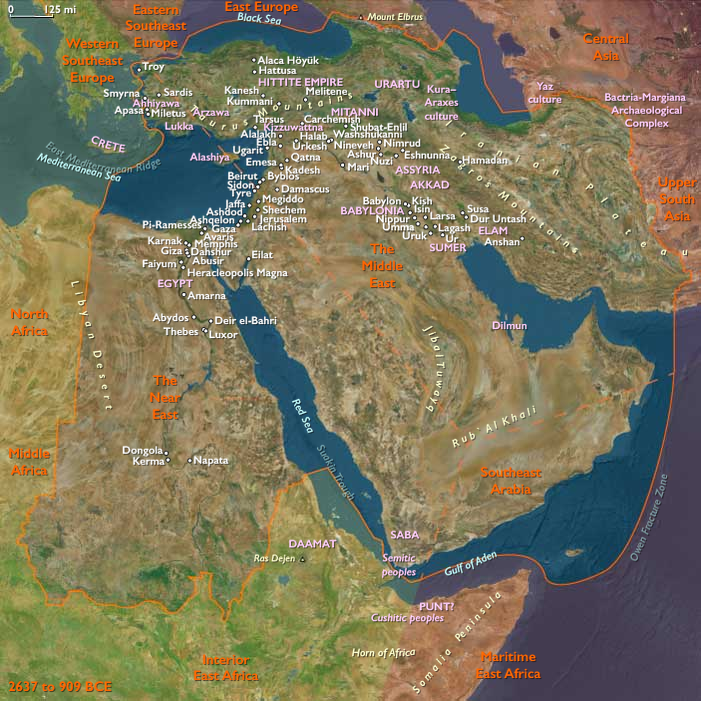
The Near and Middle East
View →Subregions