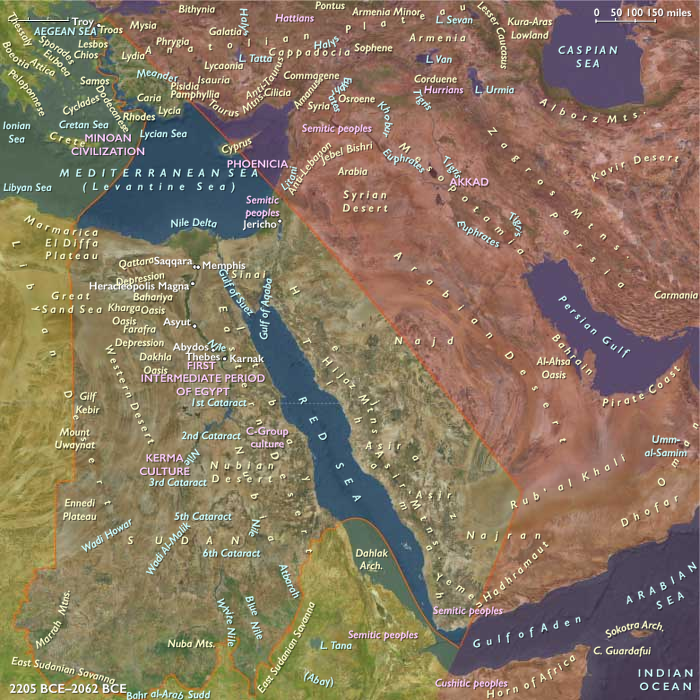
The Near East (2205–2062 BCE): Climatic Crisis…
2205 BCE to 2062 BCE
The Near East (2205–2062 BCE): Climatic Crisis and Societal Collapse
Environmental Catastrophe: The Drying of Lake Faiyum
Between 2200 and 2150 BCE, the Near East experiences severe climate disruptions, dramatically evidenced by the complete drying of Lake Faiyum, a significant body of water fed by the Nile. Professor Fekri Hassan of University College London provides definitive scientific evidence of this climatic event, underscoring the extraordinary drought conditions that Egypt endures during these years. The evaporation of this lake, previously sixty-five meters deep, starkly illustrates the environmental crisis confronting Egyptian civilization.
The Great Hunger and Societal Breakdown
The period from approximately 2180 to 2160 BCE, termed the “great hunger,” witnesses unprecedented drought and agricultural collapse in Upper Egypt. These devastating conditions precipitate widespread famine, starvation, and even reports of cannibalism. Concurrently, birth rates plummet, and devastating outbreaks of plague further compound the human suffering, culminating in the collapse of the central government under Egypt’s Sixth Dynasty around 2150 BCE.
Political Fragmentation and the End of Central Authority
The collapse of centralized government signals a rapid descent into anarchy. Egypt forfeits its territorial and trade gains in Nubia and West Asia, as the weakened state can no longer maintain external control. The Seventh Dynasty, described in Manetho's histories, proves ephemeral and ineffectual, likely functioning as an oligarchy attempting in vain to stabilize Egypt. The subsequent Eighth Dynasty, claiming lineage from Sixth Dynasty monarchs and ruling from Memphis, also struggles to assert real authority amid escalating regional conflicts and widespread disorder.
Insights from the Lamentation Texts
Few official records survive from this turbulent era, yet significant insights emerge from fictional writings known as the Lamentations, produced in the early Middle Kingdom. These texts poetically describe societal collapse, natural disasters, invasions by "Asiatic bowmen," and breakdowns in governance. Particularly striking are references to taxation demands remaining high despite abnormally low Nile floods—evidence of harsh fiscal policies detached from reality and indicative of administrative disarray. A notable example of such crises is also recorded on the Famine Stele at Elephantine.
First Intermediate Period: Chaos and Decentralization
The fall of the Eighth Dynasty around 2130 BCE marks the definitive end of Egypt’s Old Kingdom, ushering in the chaotic First Intermediate Period. During this era, Egypt fragments into decentralized feudal states as hereditary landowners establish independent regional courts and administrations. Violence, famine, and widespread death characterize the period, with archaeological records showing significant increases in burial numbers due to elevated mortality rates.
Additionally, tombs and pyramids from earlier dynasties are systematically looted, an event lamented in contemporary texts, which describe bodies being removed from their sacred resting places. This desecration prompts the proliferation of protective magical spells on mummies during the subsequent Middle Kingdom, previously a royal prerogative.
Regional Impacts in Anatolia and Palestine
The climatic and societal crises extend beyond Egypt. Around 2100 BCE, at least three hundred Anatolian cities, including Troy III, are destroyed or abandoned, many by fire. Simultaneously, civilization in Palestine collapses into a predominantly rural and nomadic state. Jericho, specifically, suffers catastrophic damage from an earthquake, leading to a prolonged cessation of urban life.
Feudal Fragmentation and Emergence of Regional Lords
With the loss of central pharaonic authority, hereditary local landowners rise to prominence, transforming their estates into independent political entities. Egypt thus transitions into a patchwork of small, feudal kingdoms, each governed autonomously. This fragmented governance structure persists throughout the Seventh to the Eleventh dynasties, profoundly reshaping Egyptian society and politics, and marking the era as one of profound transition and uncertainty.
People
Groups
Commodities
Subjects
Regions
The Near and Middle East
View →Subregions