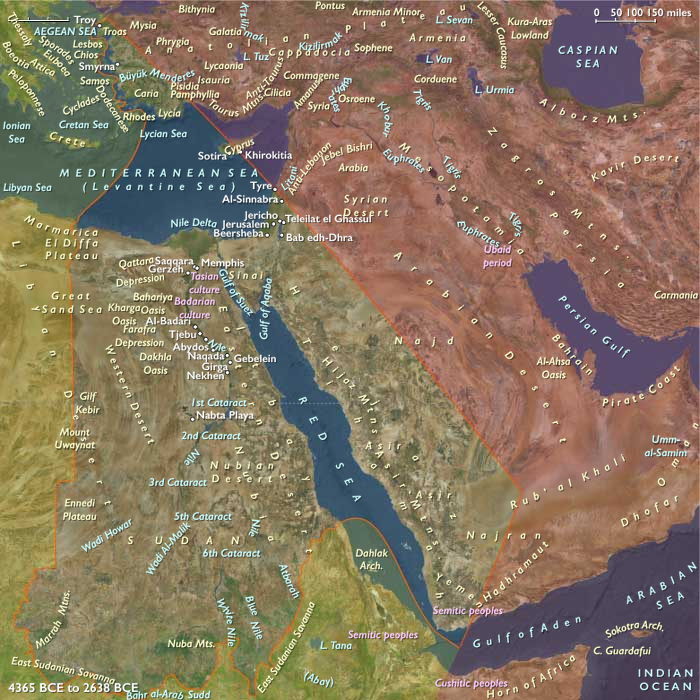
Near East (4,365 – 2,638 BCE) Late…
4365 BCE to 2638 BCE
Near East (4,365 – 2,638 BCE) Late Neolithic–Chalcolithic — Canal Gardens, Copper, and Maritime Aegean
Geographic and Environmental Context
The Near East includes Egypt, Sudan, Israel, most of Jordan, western Saudi Arabia, western Yemen, southwestern Cyprus, and western Turkey (Aeolis, Ionia, Doris, Lydia, Caria, Lycia, Troas) plus Tyre (extreme SW Lebanon).-
Anchors: the Nile Valley and Delta; Sinai–Negev–Arabah; the southern Levant (with Tyre as the sole Levantine node in this subregion); Hejaz–Asir–Tihāma on the Red Sea; Yemen’s western uplands/coast; southwestern Cyprus; western Anatolian littoral (Smyrna–Ephesus–Miletus–Halicarnassus–Xanthos; Troad).
Climate & Environment
-
Flood variability increased; Delta marshes fluctuated; Aegean coasts stable; Arabian west slope drier, highlands stable.
Subsistence & Settlement
-
Canal/levee fields in Nile Delta/Valley matured; orchard–garden mosaics; caprine herding in Sinai–Negev; mixed farming in Ionia–Lydia–Caria.
-
Yemen western terraces in embryo; Hejaz oases (Ta’if-like) incipient.
Technology
-
Copper metallurgy in Anatolia; advanced pottery; reed boats; early sails; improved qanat/terrace conceptions in Arabia highlands (proto-forms).
Corridors
-
Nile–Delta–Mediterranean shipping; Anatolian maritime loops; overland Sinai/Negev into the southern Levant.
Symbolism
-
Temple precincts (Egyptian cores outside our exact geography but influence strong); Aegean cape sanctuaries; ancestor cults.
Adaptation
-
Canal/qanat + terraces hedged droughts; coastal fisheries stabilized diets.
Images

The Near East in the Late Holocene
Groups
Topics
Commodities
Subjects
Regions
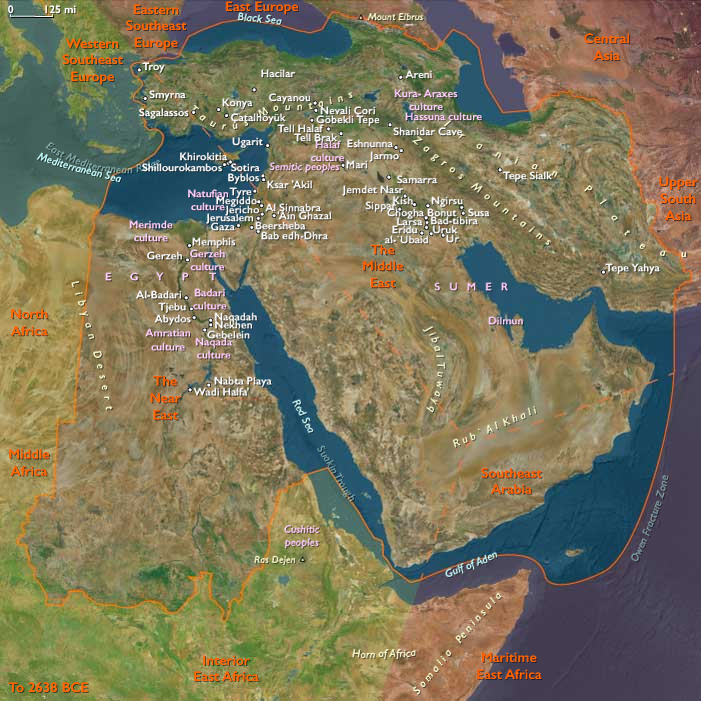
The Near and Middle East
View →Subregions