
The Near East (3069–2926 BCE): Urban Expansion…
3069 BCE to 2926 BCE
The Near East (3069–2926 BCE): Urban Expansion and Egyptian Innovations
Urbanization and Cultural Diffusion
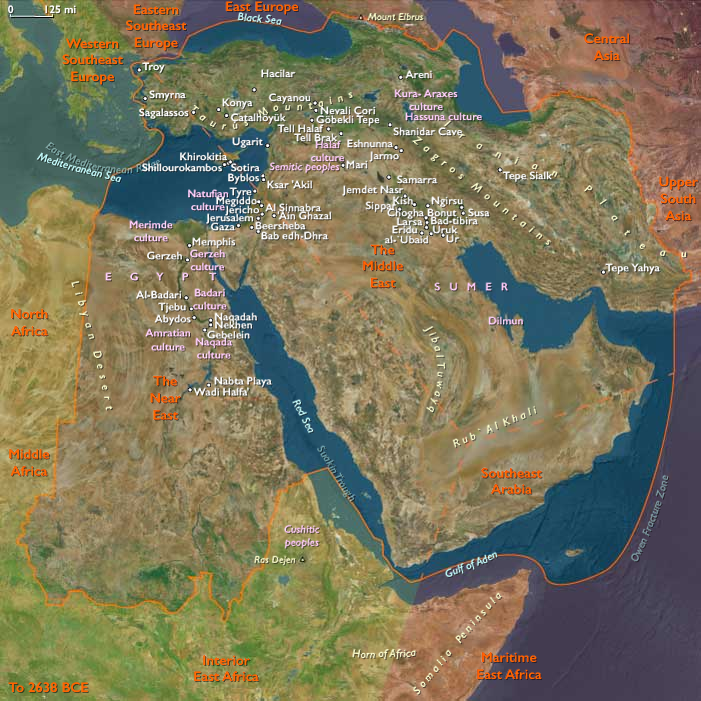
A significant cultural influence originating from Syria spreads through the Near East, marked by the widespread use of copper and stone tools. Migrant groups traveling along the Jericho–Dead Sea–Bir es-Saba–Gaza–Sinai route settle throughout present-day Israel, Syria, Lebanon, and Jordan. By 3000 BCE, these migrations significantly contribute to regional urbanization. Independent city-states arise on plains and coastal areas, protected by substantial mud-brick walls and sustained by surrounding agricultural villages.
Developments in Canaan and Coastal Cities
Jericho, previously intermittently occupied, renews urban life around 3000 BCE, repeatedly reconstructing its walls to sustain urban stability. Nearby, Tell Bet Yerah (Khirbat al-Karak or Al-Sinnabra) flourishes as an Early Bronze Age urban site near the Sea of Galilee, indicating trade and political interactions with Egypt’s First Dynasty, underscored by the discovery of a stone palette decorated with Egyptian motifs.
Along the coastal Plain of Sharon in Israel, burial customs evolve, featuring cremation and the use of individualistic, house-shaped clay ossuaries, reflecting contemporary architectural variation.
Early Settlement at Troy and Izmir
In Anatolia, around 3000 BCE, the city of Troy (modern-day Hissarlik, Turkey) emerges with a fortified settlement. The inhabitants primarily utilize bone and stone tools, despite an awareness of copper metallurgy.
Similarly, archaeological excavations at Izmir (ancient Smyrna) reveal continuous settlement dating from Neolithic through Chalcolithic periods. Graves dating approximately to 3000 BCE indicate Izmir's role as a prominent settlement, contemporary with early Troy, underscoring the region’s long-established cultural significance.
Egyptian Cultural and Technological Advances
By 3000 BCE, Egypt experiences considerable technological and cultural progress. Egyptians begin crafting decorative objects with colored glass glazes, notably adorning pottery and beads. Jewelry emerges as a significant cultural artifact, with Egyptians producing intricate goldwork.
Egyptians also adopt indigo, a vat dye sourced from tropical Indigofera plants, enhancing textile production. The presence of high-warp looms, as depicted in Egyptian artworks (such as those discovered at Beni Hasan), highlights advanced weaving techniques.
Facing a shortage of large native timber, Egyptians undertake extensive maritime voyages, reaching Crete to import cedar wood for construction, a round-trip journey of approximately 600 miles (950 kilometers). Reed boats, adapted to Nile conditions, remain common for local navigation.
Culinary and Agricultural Innovations
Egyptian diets diversify significantly, including pigeon prepared through various sophisticated culinary methods, enjoyed particularly among wealthier classes.
Agricultural advancements, especially improved plows drawn by oxen (depicted in Egyptian imagery circa 3000 BCE), significantly increase crop yields, leading to population growth. Limestone flakes and papyrus documents record granary transactions, indicating organized agricultural management.
Early Egyptian Anatomical Interests and Burial Practices
Hieroglyphics and papyri reveal an emerging Egyptian interest in anatomy, linked to mummification practices. The earliest known Egyptian sarcophagus dates from about 3000 BCE. Egyptians construct elaborate tombs, or mastabas, featuring subterranean burial chambers topped by stone or brick structures. Monumental art from this era depicts giant dogs, akin to modern Great Danes, suggesting early selective breeding.
Music, Writing, and Taxation Systems
Egyptian pottery from the early First Dynasty depicts musical instruments resembling those in contemporary Mesopotamia, including harps, drums, sistra (metal rattles), and reed pipes.
Around 3000 BCE, Egyptians transition from pictorial representations to a developed writing system expressing the Egyptian language through symbols, known as hieroglyphics. Egyptian scribes also establish hieratic script, a cursive style written with reed pens on papyrus scrolls, replacing clay tablets.
The earliest recorded taxation system emerges in Egypt between 3000–2800 BCE, marked by the ceremonial "Following of Horus," during which the Pharaoh collects taxes. Concurrently, an organized judicial system develops, anchored in royal authority.
International Trade and Cultural Exchange
The urban centers emerging in the Levant during this period maintain robust trade links with Egypt, facilitating cultural exchange. Notably, Egyptian sailors’ voyages to Crete establish early Mediterranean trade networks, securing essential resources like cedar wood.
Groups
Commodities
Subjects
Regions
The Near and Middle East
View →Subregions
