The Council of Reims and the Political…
October 1119 CE
The Council of Reims and the Political Struggles of 1119
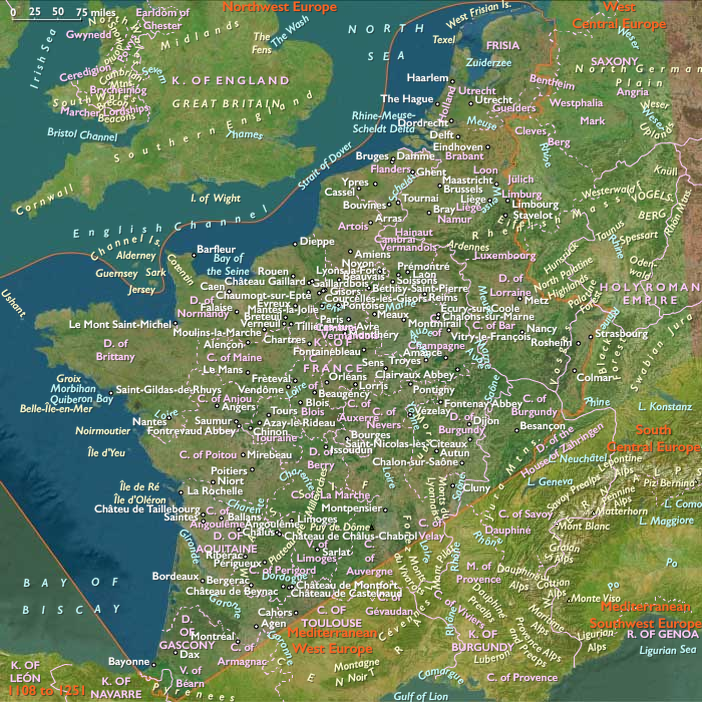
In October 1119, Pope Calixtus II convened the Council of Reims, attended by King Louis VI of France, most of the French nobility, and over four hundred bishops and abbots. The council was meant to address Church reforms, but it quickly became a stage for political disputes, particularly over Normandy and the ongoing Investiture Controversy.
The Arrival of Henry V and the Emperor’s Power Play
- Holy Roman Emperor Henry V arrived for a personal conference at Mousson, where a diplomatic negotiation was expected.
- However, he brought an army of over thirty thousand men, suggesting he intended to use intimidation rather than negotiation.
- Fearing that force might be used to extract prejudicial concessions, Pope Calixtus II remained at Reims, avoiding direct engagement with the Emperor.
The Normandy Dispute: Henry I vs. the French Barons
- King Henry I of England faced French complaints over his acquisition and management of Normandy.
- Despite a strong defense by Geoffrey, Archbishop of Rouen, Henry's case was drowned out by the pro-French elements in the council.
- However, Calixtus II refused to take Louis VI’s side, instead advising both rulers to seek peace rather than ruling in favor of William Clito’s claim to Normandy.
Despite diplomatic efforts:
- Amaury de Montfort came to terms with Henry, effectively removing one of his major enemies.
- However, Henry and William Clito could not reach a settlement, leaving the dispute over Normandy unresolved.
Church Reforms and the Excommunication of the Emperor
In addition to the Norman conflict, the council also addressed important Church reforms:
- Decrees against lay investiture, reinforcing the Church’s stance against secular rulers appointing bishops.
- Condemnation of simony (the buying and selling of Church offices).
- Regulations against clerical concubinage, reinforcing demands for priestly celibacy.
The most significant political decision came on October 30, 1119:
- Since Emperor Henry V refused to compromise, the council formally excommunicated both Henry V and his antipope, Gregory VIII.
- This was a decisive move in the Investiture Controversy, further isolating the Holy Roman Emperor from the papacy.
Aftermath and Consequences
- Henry I left the council politically bruised but held onto Normandy, as Louis VI failed to gain papal support for William Clito’s claim.
- Pope Calixtus II solidified his authority by reaffirming the Church’s independence from imperial influence, while condemning Henry V.
- The Investiture Controversy would continue, but the emperor’s position was weakened, leading to eventual negotiations that would culminate in the Concordat of Worms (1122).
Though no definitive resolution came from the Council of Reims, it marked a significant moment in medieval power struggles, with papal authority, royal ambitions, and dynastic conflicts all competing for dominance.
Locations
People
Groups
Commodities
Regions

West Europe
View →Subregions