
Jean Fouquet: Artistic Innovation and French Identity …
Years: 1448 - 1448
Jean Fouquet: Artistic Innovation and French Identity after the Hundred Years' War (ca. 1447)
Jean Fouquet, born in Tours around 1420, emerged as one of the most influential French painters of the mid-15th century, playing a pivotal role in shaping French visual culture. Before 1447, Fouquet traveled to Italy, where he notably executed a portrait of Pope Eugene IV (died 1447), known today only through later copies. During this formative Italian period, Fouquet carefully absorbed elements of contemporary Italian Renaissance style and composition, subsequently merging them with the distinctively French aesthetic traditions upon his return to France.
Settling again in his native Tours, Fouquet rapidly secured prestigious commissions from prominent figures of the French court, including King Charles VII, his influential treasurer Étienne Chevalier, and the chancellor Guillaume Jouvenel des Ursins. Fouquet’s artistic synthesis combined the refined naturalism and innovative perspectives observed in Italy with a distinctly French sensibility and iconographic tradition, aligning closely with the emerging political and cultural aims of the Valois monarchy.
Indeed, Fouquet’s artwork became intimately associated with the French court's broader project of reinforcing national identity following decades of warfare and cultural fragmentation during the Hundred Years' War. His elegant portraits, religious paintings, and manuscript illuminations articulated a confident, sophisticated vision of French monarchy and identity at a moment when France sought cultural as well as political renewal and cohesion in the aftermath of prolonged conflict with England.
In sum, Jean Fouquet's career exemplifies how artistic innovation intersected with broader political objectives, contributing to France’s emerging national identity and cultural confidence in the mid-fifteenth century.
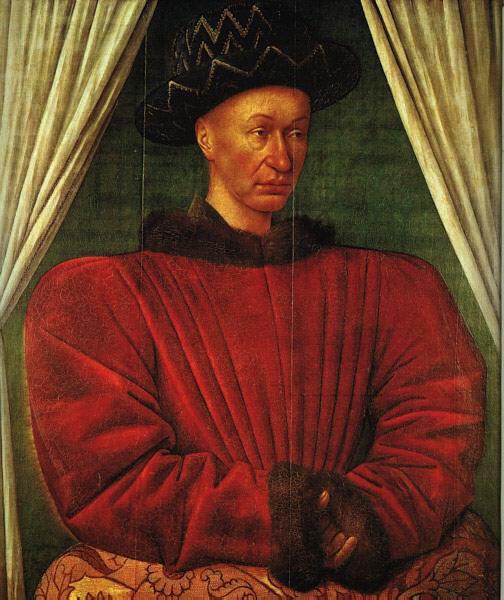
Jean Fouquet: Portrait of Charles VII of France (oil on panel); 85.7 × 70.6 cm (33.7 × 27.8 in); Louvre Museum
Locations
People
Groups
- Christians, Roman Catholic
- France, (Valois) Kingdom of
- England, (Plantagenet, Lancastrian) Kingdom of
Topics
- Hundred Years' War
- Portraits, Renaissance
- Renaissance, Italian
- Northern Renaissance
- Hundred Years' War: French Victory
- Western Art: 1444 to 1456
Subjects
Regions
Subregions

Related Events
Showing 10 events out of 41613 total
Years: 1448 - 1448
Jean Fouquet: Portrait of Charles VII of France (oil on panel); 85.7 × 70.6 cm (33.7 × 27.8 in); Louvre Museum
Locations
People
Groups
- Christians, Roman Catholic
- France, (Valois) Kingdom of
- England, (Plantagenet, Lancastrian) Kingdom of
Topics
- Hundred Years' War
- Portraits, Renaissance
- Renaissance, Italian
- Northern Renaissance
- Hundred Years' War: French Victory
- Western Art: 1444 to 1456
Subjects
Regions
Subregions