
The Portuguese have been fighting Calicut since…
February 1508 CE
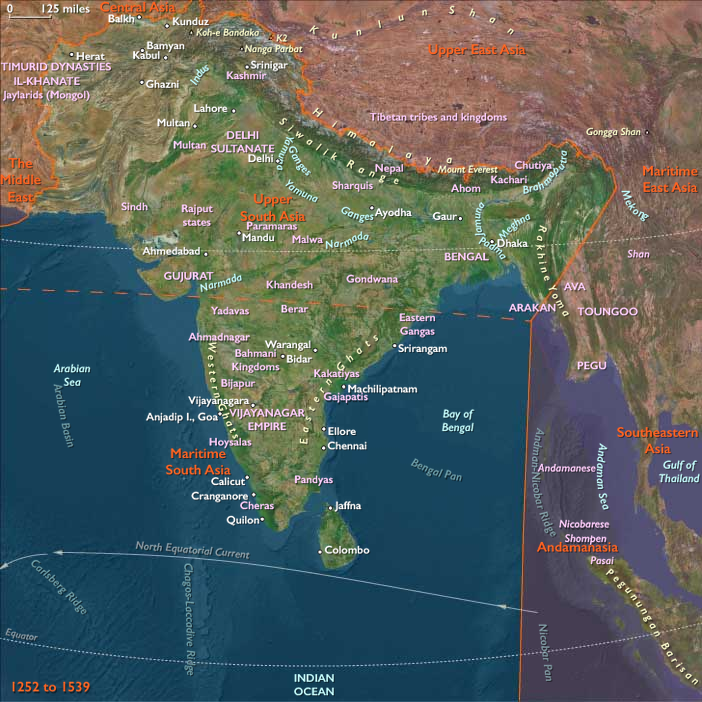
The Portuguese have been fighting Calicut since the arrival of Vasco da Gama in 1498, while allying with its local rival Kingdom of Cochin, where they have established their headquarters.
The northern region of Gujarat, mainly Khambhat, is even more important: the Gujarat Sultanate is an essential intermediary in east–west trade, between the Red Sea, Egypt and Malacca: Gujarati are important middlemen bringing spices from the Maluku Islands as well as silk from China, and then selling them to the Egyptians and Arabs.
When Portugals’s twenty-one vessels under King Manuel’s viceroy, Dom Francisco de Almeida, arrived in 1505 to strengthen the fledgling Portuguese empire in East Africa and India, Sultan Mahmud Begada of Gujarat, his field threatened, had allied with the Kozhikkodu Samutiri (anglicised to Zamorin of Calicut).
He then asks his trading partners, the Mamluk Sultanate, for help.
Portuguese intervention is seriously disrupting trade in the Indian Ocean, threatening Muslim as well as Venetian interests, as the Portuguese become able to undersell the Venetians in the spice trade in Europe.
The Mamluks and their European trade partners, the Venetians, have become wealthy from monopolizing the flow of spices from India to Europe.
Venice breaks diplomatic relations with Portugal and starts o look at ways to counter its intervention in the Indian Ocean, sending an ambassador to the Egyptian court.
Venice negotiates for Egyptian tariffs to be lowered to facilitate competition with the Portuguese, and suggests that "rapid and secret remedies" be taken against the Portuguese.
The sovereign of Calicut, the Zamorin, has also sent an ambassador asking for help against the Portuguese.
Egyptian Mamluks soldiers have little expertise in naval warfare, and Portuguese often attack and steal supplies of Malabar timber from India, so Mamluk Sultan, Al-Ashraf Qansuh al-Ghawri appeals to Ottoman support.
The Ottoman Sultan, Beyazid II—whose navy had helped Spanish Moors and Sephardic Jews expelled by the Spanish Inquisition in 1492—supplies Egypt with Mediterranean-type war galleys manned by Greek sailors and Ottoman volunteers, mainly Turkish mercenaries and freebooters.
These vessels, which Venetian shipwrights help disassemble in Alexandria and reassemble on the Red Sea coast, have had to brave the Indian Ocean.
The galley warriors can mount light guns fore and aft, but not along the gunwales because these cannon would interfere with the rowers.
The native ships (dhows), with their sewn wood planks, can carry no heavy guns at all.
Hence, most of the coalition's artillery consists of archers, whom the Portuguese can easily outshoot.
The Egyptian-Ottoman fleet, whom the Portuguese called under the generic term the "rumes" (Romes), sends for India to support Gujarat in 1507.
After fortifying Jeddah against a possible Portuguese attack, the fleet then passes through Aden at the tip of the Red Sea, where they receive support from the Tahirid Sultan, and then, in 1508, crosss the Indian Ocean.
People
Groups
Topics
Commodities
Subjects
Regions
South Asia
View →Subregions
