
The reign of Nicolò III d’Este, son…
1438 CE
The reign of Nicolò III d’Este, son of Alberto, has marked the strengthening of Estensi domination in Ferrara and the introduction of Estensi influence generally in Italian politics.
After having defeated an attempt by the Paduans to achieve hegemony in Ferrara, the Estensi duke had become intermediary in the political and military contests in the Italian states and extended his dominions.
Personally, Nicolò is known for his sensuality; a Ferrarese saying runs, “On both sides of the River Po they all are Nicolò's sons.” He had had his son Ugo and his young second wife, Parisina Malatesta, beheaded because they were found guilty of adultery together.
But he has devoted himself to the exterior manifestations of a religious faith—going on a pilgrimage to the Holy Sepulchre and to Vienna's Saint Anthony and playing host to the Council of Ferrara, which opens on January 8, 1438.
This is officially the second part of the council transferred from Basel, although a group of dissident churchmen has remain in Basel.
The Greek delegation, numbering about seven hundred, includes the patriarch of Constantinople Joseph II, 20 metropolitans, and the emperor.
The Greeks’ mission, in part, is to seek aid from the West against the Turks.
Discussions are held on purgatory and on the phrase Filioque (“and from the Son”) of the Nicene Creed, which sets forth the doctrine that the Holy Spirit proceeds from both the Father and the Son.
The Greeks hold that the Spirit proceeds from the Father only and have refused to accept the Filioque.
Locations
People
Groups
Regions
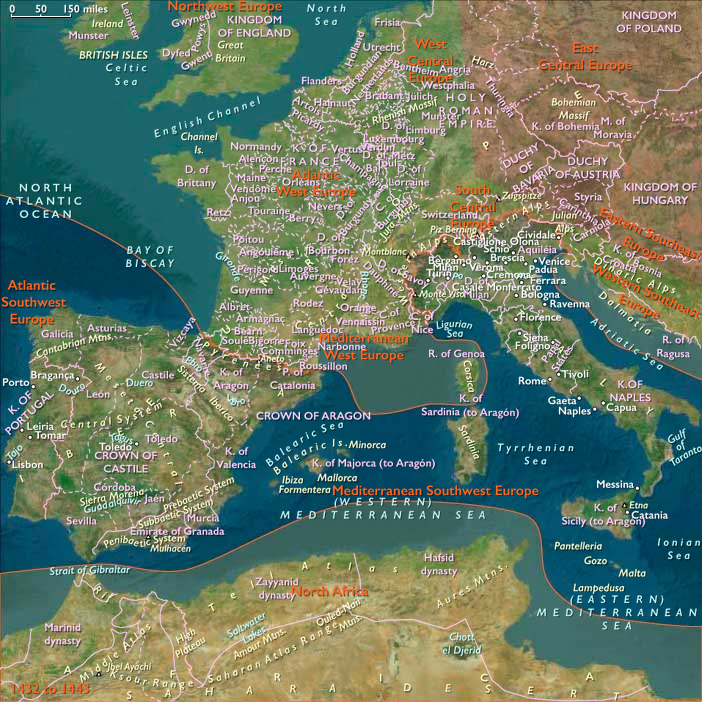
Southwest Europe
View →Subregions
