
Atlantic West Europe (100–243): Stability, Prosperity, and…
100 CE to 243 CE
Atlantic West Europe (100–243): Stability, Prosperity, and Early Signs of Imperial Strain
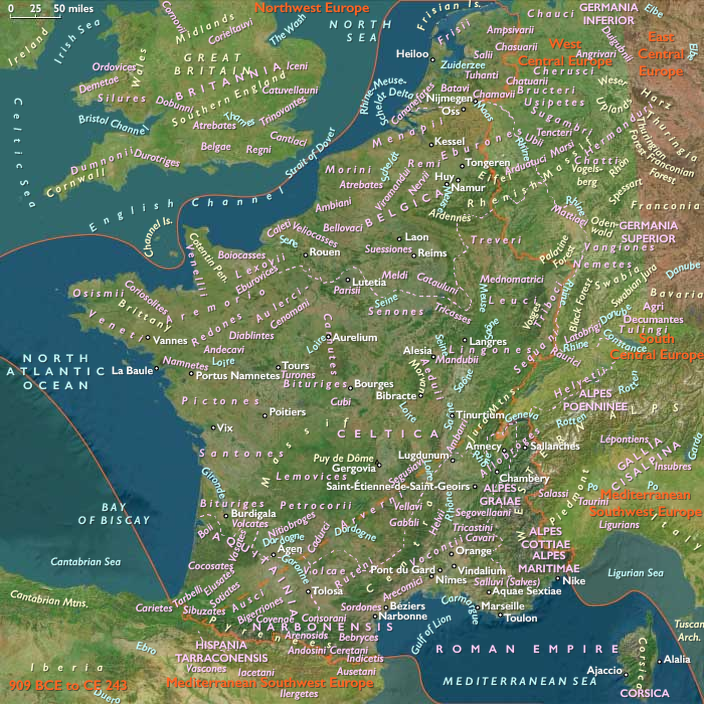
Between 100 and 243 CE, Atlantic West Europe—including Aquitaine, the Atlantic coast, northern and central France, Alsace, and the Low Countries—experienced a prolonged era of stability and prosperity under the Roman Empire, followed by the emergence of challenges that anticipated later imperial turmoil.
Political and Military Developments
Stability Under the Antonines (100–180)
-
The Antonine emperors (96–192 CE) provided nearly a century of peace, often referred to as the empire's “golden age,” promoting stable governance and economic prosperity.
-
The frontier along the Rhine, including Alsace and the Low Countries, saw careful management, with fortified limes and frequent Roman military presence ensuring peace and order.
Early Signs of Frontier Pressure (180–243)
-
Following Marcus Aurelius's death (180 CE), increased pressure from Germanic tribes like the Alemanni and the Franks began challenging Roman authority in the Rhine region.
-
Emperor Septimius Severus (r.193–211 CE) and his successors undertook campaigns to secure the northeastern borders, reflecting a growing defensive orientation.
Economic and Social Developments
Economic Prosperity and Regional Specialization
-
Aquitaine emerged as a major exporter of wine, especially from Bordeaux (Burdigala), fueling trade routes to Britannia, the Mediterranean, and throughout Gaul.
-
The Low Countries developed strong textile production and trade networks, connecting with both northern Britain and Mediterranean markets.
-
Cities such as Autun (Augustodunum), Trier (Augusta Treverorum) (though Trier itself is beyond the defined boundaries, its influence reached into Alsace and northern Gaul), and Reims (Durocortorum) prospered as regional administrative and commercial hubs.
Infrastructure and Urban Development
-
Roman infrastructure—extensive roads, aqueducts, villas, amphitheaters—continued expanding, notably in Aquitaine and along major river routes, reinforcing economic integration and administrative control.
-
Significant urban growth occurred in coastal and interior centers, including Bordeaux, Autun, Nantes (Portus Namnetum), and Tours (Caesarodunum), fostering vibrant municipal cultures.
Early Signs of Economic Strain (after 200 CE)
-
Increased taxation and administrative demands placed additional burdens on rural populations, signaling future economic pressures.
-
Trade routes became vulnerable to disruptions due to broader imperial instability and frontier conflicts emerging in the early 3rd century.
Cultural and Religious Developments
Flourishing Gallo-Roman Culture
-
A distinctive Gallo-Roman culture flourished, marked by thriving urban life, Roman-style architecture, bath complexes, temples, and vibrant marketplaces.
-
Regional integration into Roman cultural norms was extensive, though traditional Celtic practices persisted, creating a unique blend of Roman and local traditions.
Religious Pluralism and Early Christianity
-
Traditional Celtic-Roman religions and cults (dedicated to local deities such as Epona, Cernunnos, and water spirits) remained popular, especially in rural and border areas.
-
Early Christian communities emerged gradually in major urban centers, such as Autun, Bordeaux, and Tours, initially limited in scale but laying foundations for later Christian expansion.
Intellectual and Cultural Figures
-
Sidonius Apollinaris (born in the 5th century, though representative of a longer regional tradition) exemplified the literary and rhetorical culture fostered in the region's educational centers.
-
Urban elites maintained Roman literary and philosophical traditions, demonstrating the vitality and adaptability of Roman cultural forms in Gaul.
Challenges and Long-term Significance
By 243 CE, Atlantic West Europe stood at a crossroads:
-
Economic prosperity under stable Roman governance had allowed significant urban and commercial development, fostering a vibrant Gallo-Roman society.
-
Increasing frontier pressures along the Rhine and mounting administrative burdens hinted at the empire’s forthcoming third-century crisis.
-
Early Christianity and enduring local religious practices coexisted, setting the stage for profound religious and social transformations in the subsequent centuries.
Thus, this age represented both the peak of Roman integration in Atlantic West Europe and the onset of challenges that would significantly reshape the region in the centuries that followed.
Groups
Topics
Commodities
Regions
West Europe
View →Subregions
