Revolutionaries assassinate Tsar Alexander II In 1881.…
1876 CE to 1887 CE
His son Alexander III initiates a period of political reaction, which intensifies a counter-reform movement that had begun in 1866.
He strengthens the security police, reorganized as the Okhrana, gives it extraordinary powers, and places it under the Ministry of the Interior.
Dmitry Tolstoy, Alexander's minister of the interior, institutes the use of land captains, who are noble
overseers of districts, and he restricts the power of the zemstvos and dumas.
Alexander III assigns his former tutor, the reactionary Konstantin Pobedonostsev, to be the procurator of the Holy Synod of the Orthodox Church and Ivan Delianov to be the minister of education.
In their attempts to 'save" Russia from "modernism," they revive religious censorship, persecute
the non-Orthodox and non-Russian population, foster anti-Semitism, and suppress the autonomy of the universities.
Their attacks on liberal and non-Russian elements alienate large segments of the population. The nationalities, particularly Poles, Finns, Latvians, Lithuanians, and Ukrainians, react to the regime's
efforts to Russify them by intensifying their own nationalism.
Many Jews emigrate or join radical movements.
Secret organizations and political movements continue to develop despite the regime's efforts to quell them.
Groups
Regions
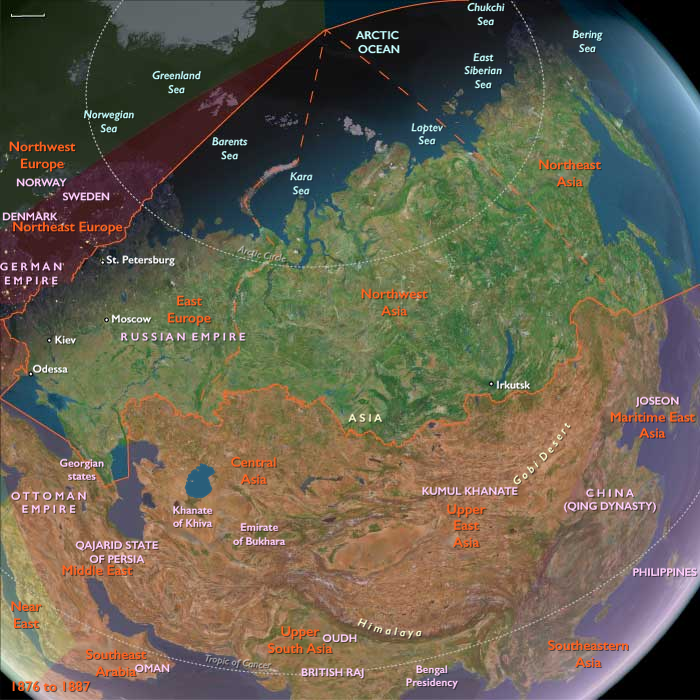
Northeastern Eurasia
View →Subregions