
The so-called Ecclesiastical Schools of Zaragoza had…
1477 CE
The so-called Ecclesiastical Schools of Zaragoza had later consolidated into the School of Zaragoza.
References from 1335 indicate there was a School of Arts (known as liberal arts, since the classics included in the "trivium and "quadrivium" were taught there).
The cultural activities and endeavors of the leaders of Zaragoza had obtained authorization from Pope Sixtus IV in 1474 and, at the petition of Ferdinand, heir to the Aragonese throne, it had been made a General School of Arts.
Coinciding with the introduction of the printing press, evidence of an interest in knowledge, ratification of the General School of Arts had been obtained from King John II in 1476.
Thus the Aragonese capital can now grant the degree of Bachelor of Arts.
In 1477, the Rector Pedro de la Cabra and a representative of the town council prepares the school’s first bylaws.
Locations
Regions
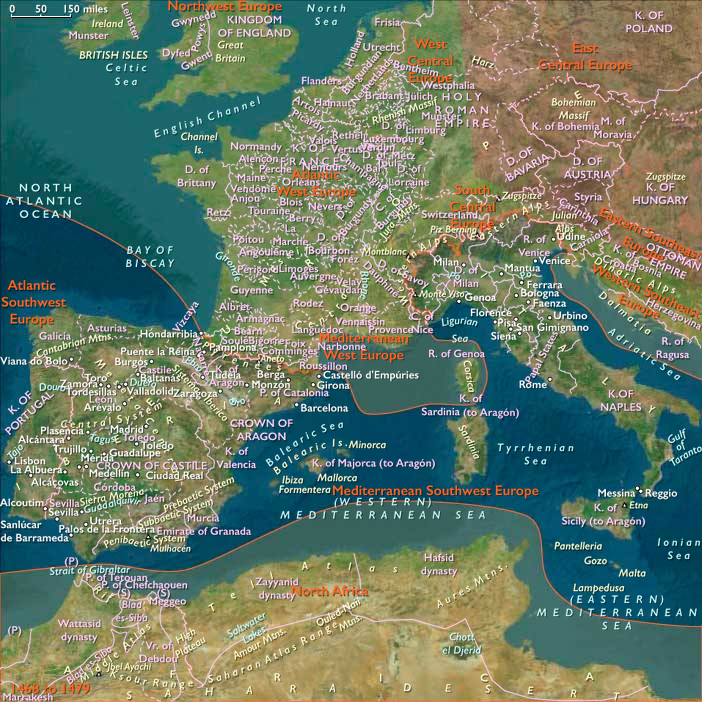
Southwest Europe
View →Subregions
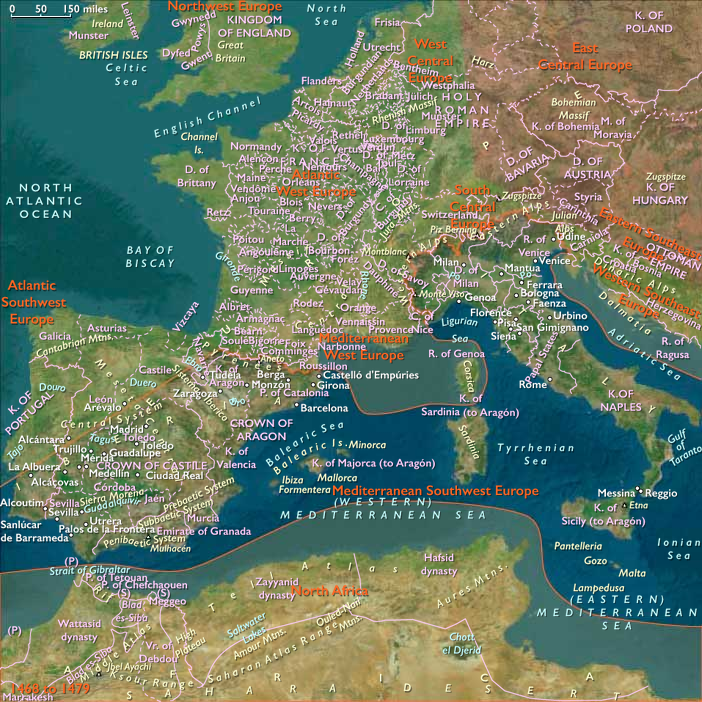
Mediterranean Southwest Europe
View →Related Events
Showing 10 events out of 201 total
Construction begins in 1478 on the Franciscan friary of San Juan de los Reyes in Toledo, founded by King Ferdinand II of Aragon and Queen Isabella I of Castile to commemorate both the birth of their son John and their victory at the Battle of Toro 1476 over the army of Afonso V of Portugal.
John’s birth, on June 30, 1478, in Seville, opens new possibilities for the dynastic stability of the Isabellian side.
Bonaventure is formally canonized in 1484 by the Franciscan Pope Sixtus IV, and ranked along with Thomas Aquinas as the greatest of the Doctors of the Church by another Franciscan, Pope Sixtus V, in 1587.
Bonaventure is regarded as one of the greatest philosophers of the Middle Ages.
Fra Giovanni Giocondo, who is is known to have been engaged from 1476 to 1488 in Verona on the Loggia del Consiglio, had worked as a engineer at Poggioreale in Naples around 1490.
Born in Verona around 1433, he had joined the Dominican Order at the age of eighteen and had been one of the many of this Order who promulgate the Renaissance.
Afterwards, however, he had left the Dominicans and entered the Franciscan Order.
Giocondo had begun his career as a teacher of Latin and Greek in Verona, where Julius Caesar Scaliger had been one of his pupils.
A learned archaeologist and a superb draftsman, the young priest had visited Rome, sketched its ancient buildings, written the story of its great monuments, and recorded, deciphered and explained many defaced inscriptions.
He has stimulated the revival of classical learning by making transcriptions of ancient manuscripts, one of which, completed in 1492, he presents to Lorenzo de' Medici.
Giocondo soon returns to his native town, where he builds bridges and planned fortifications for Treviso, acting as architect engineer, and head-builder during the construction.
In Verona, Giocondo designs the Palazzo del Consiglio for Maximilian I, Holy Roman Emperor.
It is considered one of the finest buildings in Verona and is famed for the decorations of its loggia.
Thomas de Quincey also attributes the church of Santa Maria della Scala to Giocondo.
He is then summoned to Venice, along with a number of other well-known architects, to discuss the protection of the lagoons against the rivers.
Giocondo's plan of altering the Brenta's bed and leading this river to the sea is accepted by the Venetians, and the undertaking is a complete success.
Cisneros, from his new position, had set about reforming the Franciscan order in Spain.
The ordained friars have had to become celibate, giving up the practice of having "wives" (concubines, Spanish barraganas).
They now have to reside in the parish in which they are supposed to work, attend confession, and preach every Sunday.
There has been intense opposition.
By 1498, the reforms have been expanded to include not only Franciscans but other religious orders as well.
The resistance is so fierce that four hundred monks and friars have left for Africa with their "wives" and converted to Islam.
The Minister General of the order himself had come from Rome to attempt to temper the archbishop's strict reforms, but Cisneros, backed by the influence of a strong Queen, has managed to impose them.
The mystical movement whose Spanish adherents are known as the Alumbrados (Spanish: “Enlightened Ones”; Italian: “Illuminati”), originating primarily among the reformed Franciscans, claims that the human soul, having attained a certain degree of perfection, is permitted a vision of the divine and enters direct communication with the Holy Spirit.
As Alumbrados believe the soul can neither advance from this state nor retrogress, they regard participation in the liturgy, good works, and observance of the exterior forms of religious life as unnecessary for those who have received the “Light.” The historian Marcelino Menéndez y Pelayo found the name as early as 1492 (in the form aluminados, 1498), and traced the group to a Gnostic origin.
He thought their views were promoted in Spain through influences from Italy.
The Preparation of the Second India Armada (1500)
Following Vasco da Gama’s successful but fraught voyage to India (1497–1499), King Manuel I of Portugal immediately ordered the assembly of a larger, better-armed fleet to consolidate Portugal’s presence in the Indian Ocean trade and improve diplomatic relations with the rulers of the East.
This new fleet, the Second India Armada (1500), was designed to correct the mistakes of Gama’s expedition and to secure Portuguese dominance in the spice trade.
Fleet Composition and Leadership
- The Second Armada consisted of 13 ships and 1,500 men, making it significantly larger than Gama’s fleet.
- Unlike Vasco da Gama, who was from the Order of Santiago, this expedition was led by Pedro Álvares Cabral, a nobleman and master of the Order of Christ.
- Cabral had no prior naval or military experience, and his appointment was primarily political.
Key Figures on the Expedition
- Sancho de Tovar – Exiled Castilian nobleman, designated vice-admiral and successor if something happened to Cabral.
- Pedro Escobar – Experienced navigator placed in technical command of the fleet.
- Nicolau Coelho – Veteran of Gama’s 1497 expedition, leading a ship again.
- Pêro de Alenquer – Veteran pilot from Gama’s first voyage.
- Bartolomeu Dias and his brother Diogo Dias –
- Bartolomeu was the first to round the Cape of Good Hope in 1488.
- Diogo had served as a clerk on Gama’s voyage.
- They were assigned a special mission to Sofala in East Africa, while the rest of the fleet sailed for Calicut.
Ship Ownership and Financial Backing
- Most ships were crown-owned, but some were privately financed:
- Luís Pires’s ship was outfitted by Diogo da Silva e Meneses, Count of Portalegre.
- The Anunciada, captained by Nuno Leitão da Cunha, was owned by D. Álvaro of Braganza, cousin of the king, and financed by Italian merchants:
- Florentine bankers Bartolomeo Marchionni and Girolamo Sernigi.
- Genoese financier Antonio Salvago.
Mission and Special Passengers
- Ten ships were destined for Calicut (Malabar, India).
- Two ships (commanded by the Dias brothers) were sent to Sofala in East Africa.
- One ship was designated to be burned and scuttled along the way (a common practice to leave a vessel for emergency repairs or reinforcements).
Notable Individuals on Board
- Gaspar da Gama – A Goese Jew captured by Vasco da Gama in 1498, now serving as translator and intermediary.
- Four Hindu hostages – Taken by Vasco da Gama in 1498 during negotiations in Calicut.
- The Sultan of Malindi’s ambassador – Returning home after having traveled to Lisbon with Gama.
- Twenty Portuguese degredados (convicts) – Deployed as forced explorers.
- Their sentences could be reduced by being abandoned on foreign shores to explore inland on the Crown’s behalf.
- Known names: Afonso Ribeiro, João Machado, Luiz de Moura, António Fernandes (also a ship carpenter).
- The First Portuguese Christian Missionaries to India
- Eight Franciscan friars and eight chaplains, led by Fr. Henrique Soares of Coimbra.
Strategic Goals of the Second Armada
-
Establish Permanent Trade Relations in India
- Cabral was instructed to secure better commercial terms with Calicut, avoiding the diplomatic failures of Gama’s first mission.
- The fleet carried lavish gifts and letters for the Zamorin of Calicut and other eastern rulers.
-
Expand Portuguese Influence Along the African Coast
- The Dias brothers’ mission to Sofala aimed to establish Portuguese control over East African trade routes.
-
Strengthen Portuguese Naval Presence in the Indian Ocean
- The fleet was well-armed, prepared to defend Portuguese interests against Arab and Indian resistance.
The Significance of Cabral’s Mission
- This expedition ultimately led to the accidental discovery of Brazil, when Cabral deviated westward in the Atlantic and sighted land in April 1500.
- It also paved the way for future Portuguese dominance in the Indian Ocean, ensuring that Portugal would control the lucrative spice trade for the next century.
The Second India Armada, much larger and better prepared than Gama’s fleet, marked the next phase of Portugal’s maritime empire, reinforcing its global ambitions and commercial power.
Cabral's instructions are several-fold.
The priority is to secure a treaty with Zamorin's Calicut, the principal commercial entrepôt of the Kerala spice trade and dominant feudal city-state on the Malabar coast of India.
Calicut had been visited by Vasco da Gama's first armada in 1498, but failed to impress the elderly ruling Manivikraman Raja Zamorin ('Samoothiri Raja') of Calicut, and no agreements had been signed.
Cabral's instructions are precisely to succeed where Gama had failed, and to this end is entrusted with magnificent gifts to present to the Zamorin.
Cabral is under orders to establish a factory in Calicut, to be placed under Aires Correia, the designated factor for Calicut.
The second priority, assigned to the brothers Bartolomeu Dias and Diogo Dias, is to search out the East African port of Sofala, near the mouth of the Zambezi river.
Sofala had been secretly visited and described by the explorer Pêro da Covilhã during his overland expedition a little over a decade earlier, and he had identified it as the end-point of the Monomatapa gold trade.
The Portuguese crown is eager to tap into this gold source, but Gama's armada had failed to find it.
The Dias brothers are instructed to find and establish a factory at Sofala under designated factor Afonso Furtado.
To this end, instructions are probably also given to secure the consent of Kilwa (Quíloa), the dominant city-state of the East African coast and putative overlord of Sofala.
Like Sofala, Kilwa had been visited by Covilhã, but overlooked by Gama.
A minor objective includes the delivery of a group of Franciscan missionaries to India.
It is said that Vasco da Gama had misinterpreted the Hinduism he saw practiced in India as a form of 'primitive' Christianity.
He believed its peculiar characteristics were a result of centuries of separation from the mainstream church in Europe.
Gama recommended that missionaries be sent to India to help bring the practices of the 'Hindu church' up to date with Roman Catholic orthodoxy.
To this end, a group of Franciscan friars, led by Fr. Henrique Soares of Coimbra, has joined the expedition.
Finally, the Second Armada is also a commercial spice run.
The crown and private merchants who have outfitted the ships expect full cargoes of spices to return to Lisbon.
Cabral's fleet of thirteen ships had set out from the Tagus on March 9, 1500, reaching the Cape Verde island of São Nicolau on the 22nd in the middle of a storm. (One of the ships, either the privately outfitted ship of Luís Pires or the crown ship of Vasco de Ataide was either too damaged by the tempest to continue, and returned to Lisbon, or was lost around Cape Verde, respectively.)
From Cape Verde, Cabral strikes southwest.
The reasons for this unusual direction have been speculated upon endlessly.
The most probable hypothesis is that Cabral was simply following the wide arc in the South Atlantic to catch a favorable wind to carry them to the Cape of Good Hope.
Pedro Cabral's fleet, after nearly thirty days of sailing (forty-four since departure), finds the first indications of nearby land on April 21 and sights the Brazilian coast the following day, seeing the outlines of a hill they name Monte Pascoal, some sixty kilometers south of modern Porto Seguro, Bahia.
The following morning, the armada anchors at the mouth of the Frade river and a group of local Tupiniquim Indians assembles on the beach.
Cabral dispatches a small party, headed by Nicolau Coelho, in a longboat ashore to make first contact.
Coelho tosses his hat in exchange for a feathered headdress, but the surf is too strong for a proper landing and opening of communication, so they return to the ships.
Strong overnight winds on prompt the armada to lift anchor and sail some ten leagues (forty-five kilometers) north, finding harbor behind the reef at Cabrália Bay, just north of Porto Seguro.
The pilot Afonso Lopes goes sounding in a rowboat.
He spies a native canoe, captures the two Indians on board, and brings them back to ship.
The language barrier prevents questioning, but they are fed and given cloth and beads.
The cultural differences are staggering, fed with honey and cake, they spit them out and are deeply surprised with the sight of a chicken.
The next day a party led by Nicolau Coelho and Bartolomeu Dias goes ashore, accompanied by the two natives.
Armed Tupiniquim warily approach the beach, but on a signal from the two natives, lay down their bows, and allow the Portuguese to land and collect water.
A Franciscan friar goes ashore to celebrate the first known Christian mass on the American mainland, curiously watched by some two hundred Tupiniquim Indians.
For much of the week, interaction between the Portuguese and the Tupiniquim gradually increases.
There is a brisk trade in European iron nails, cloth, beads and crucifixes in return for American amulets, spears, parrots and monkeys.
There is only the slightest hint that precious metals might be found in the hinterlands.
Portuguese degredados are assigned to spend the night in Tupiniquim villages, while the remainder of the crews sleep aboard ships.
Cabral makes preparations to resume the journey to India.
The Portuguese pilots, assisted by the physician-astronomer Master João Faras and his astronomical instruments, determine that the land lies east of the Tordesillas line, prompting Cabral to formally claim Brazil for the Portuguese crown, bestowing upon it the name of Ilha de Vera Cruz ("Island of the True Cross"—later renamed Terra de Santa Cruz, "Land of the Holy Cross", upon the realization that it is not an island).
Cabral dispatches the supply ship back to Lisbon on May 2, with the Brazilian items and a letter to King Manuel I of Portugal composed by the factor’s secretary Pêro Vaz de Caminha to announce the discovery.
It also carries a separate private letter to the king from Master João Faras, in which he identifies the main guiding constellation in the southern hemisphere, the Southern Cross (Cruzeiro).
The supply ship will arrive in Lisbon in June.
Leaving behind a couple of Portuguese degredados with the Tupiniquim of Porto Seguro, Cabral orders the eleven remaining ships to set sail the next day and continue on their route to India via the Cape of Good Hope.
Cabral's armada, after crossing the Atlantic ocean from Brazil, reaches the Cape of Good Hope in late May.
The fleet faces headlong winds for six straight days.
Four ships are lost at sea in the process—including the Sofala-destined ship of Bartolomeu Dias.
The three others are the crown-owned ships of Aires Gomes da Silva, Simão de Pina and Vasco de Ataíde (if Ataíde had not been lost earlier at Cape Verde, he is certainly lost by this time; some scholars contend Pires was lost now, and Ataíde was lost earlier).
In any case, the fleet is reduced to seven ships.
Facing strong winds, the seven split into smaller groups, to meet again on the other side.
Cabral holds two ships together with his own.