...the territory of Miletus south of the…
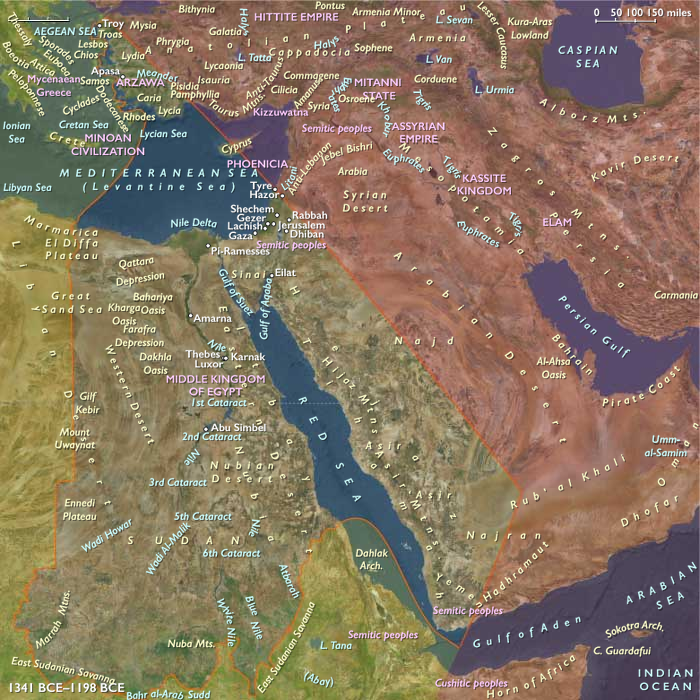
1341 BCE to 1198 BCE
...the territory of Miletus south of the Maeander River, thus extending for a north-south distance of about one hundred miles (one hundred and sixty kilometers).
Its habitable area consists principally of three flat river valleys, the Hermus (modern Gediz), Cayster (Küçük Menderes), and Maeander (Büyük Menderes), that lead down between mountain ranges of five thousand to six thousand feet (fifteeen hundred to eighteen hundred meters) to empty into deeply recessed gulfs of the Aegean coast.
It will come to be known in the tenth century BCE as Ionia.
Miletus, which may first have been a Minoan colony, is first mentioned in the Hittite Annals of Mursili II as Millawanda.
Millawanda in about 1320 BCE supports the rebellion of Uhha-Ziti of Arzawa.
Mursili orders his generals Mala-Ziti and Gulla to raid Millawanda, and they proceed to burn parts of it (damage from LHIIIA:2 has been found on-site: Christopher Mee, Anatolia and the Aegean in the Late Bronze Age, p. 142).
In addition, the town is fortified according to a Hittite plan (ibid, p. 139).
Millawanda is then mentioned in the "Tawagalawa letter", written by a Hittite king (generally accepted as Hattusili III) to a king of Ahhiyawa around 1250 BCE and part of a series including the Manapa-Tarhunta letter (about 1295 BCE) and the Milawata letter (about 1240 BCE), all of which are less securely dated.
The Tawagalawa letter notes that Milawata has a governor, Atpa, who is under the jurisdiction of "Ahhiyawa" (a growing state probably in LHIIIB Mycenaean Greece, or possibly in western Anatolia); and that the town of Atriya is under Milesian jurisdiction.
During the LHIIIA:2 period, kings of "Ahhiyawa" began to come to the attention of the Hittites, possibly as rulers of the "Achaean" states.
They rise in LHIIIB almost to the status of the Great Kings in Egypt and Assyria.
The Manapa-Tarhunta letter also mentions Atpa.
Together the two letters tell that the adventurer Piyama-Radu had humiliated Manapa-Tarhunta before Atpa (in addition to other misadventures); a Hittite king then chased Piyama-Radu into Millawanda and, in the Tawagalawa letter, requested Piyama-Radu's extradition to Hatti.
The Hittite king refers in this letter, to former hostilities between the Hittites and the Ahhiyawans over Wilusa, which had now been resolved amicably: "Now as we have come to an agreement on Wilusa over which we went to war..."
The Milawata letter mentions a joint expedition by the Hittite king and a Luwiyan vassal (probably Kupanta-Kurunta of Mira) against Milawata (apparently its new name), and notes that Milawata (and Atriya) are now under Hittite control.
Probably the only Greek-speaking communities on the west coast of Anatolia at this time are the walled Mycenaean colonies at Miletus and ...
Locations
Groups
Topics
Regions
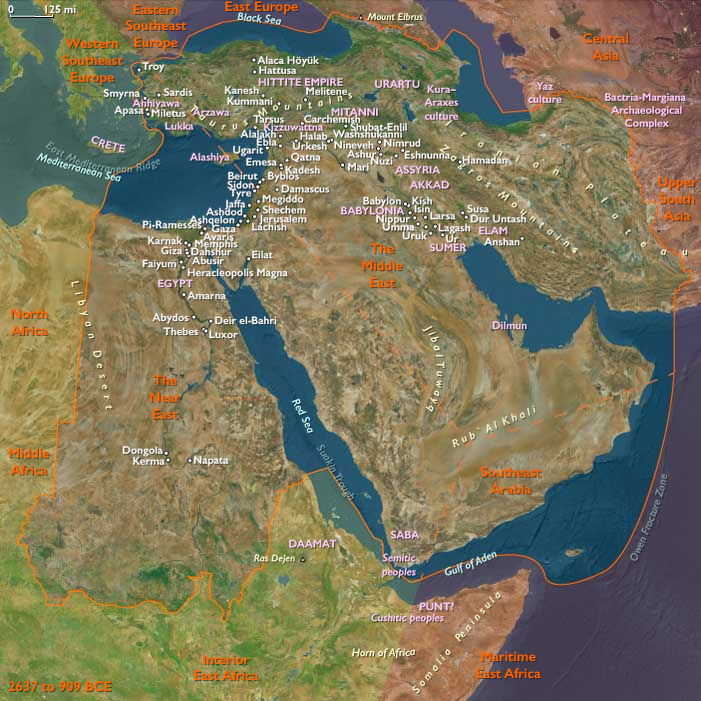
The Near and Middle East
View →Subregions