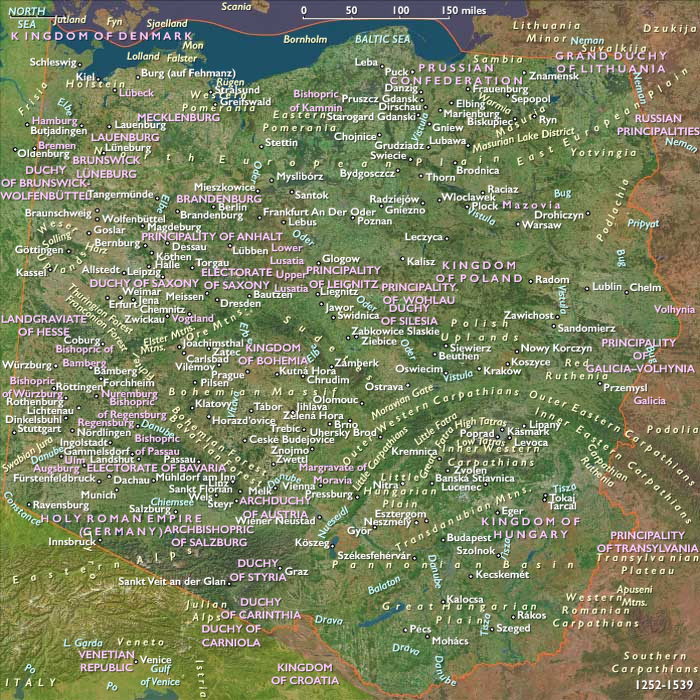
The fourteenth century in Bohemia, particularly the…
1252 CE to 1395 CE
The fourteenth century in Bohemia, particularly the reign of Charles IV (1342-78), is considered the Golden Age of Czech history.
The Premyslid line has died out by this time, and, after a series of dynastic wars, a new Luxemburg dynasty captures the Bohemian crown.
Charles, the second Luxemburg king, had been raised at the French court and is cosmopolitan in attitude.
He strengthens the power and prestige of the Bohemian Kingdom.
In 1344 Charles elevates the bishopric of Prague, making it an archbishopric and freeing it from the jurisdiction of Mainz and the Holy Roman Empire.
The archbishop is given the right to crown Bohemian kings.
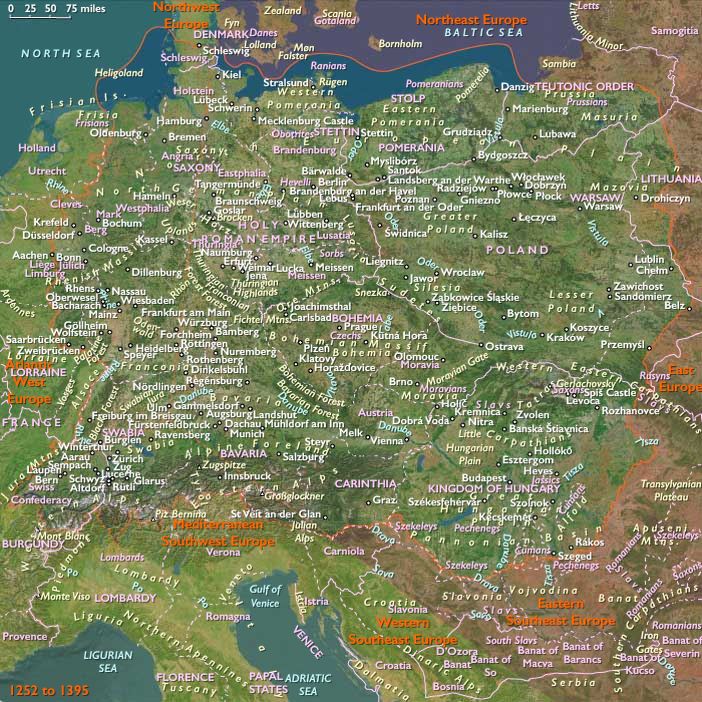
Charles curbs the Czech nobility, rationalized the provincial administration of Bohemia and Moravia, and makes Brandenburg, Lusatia, and Silesia into fiefs of the Czech crown.
In 1355 Charles is crowned Holy Roman Emperor.
In 1356 he issues a Golden Bull defining and systematizing the process of election to the imperial throne and making the Czech king foremost among the seven electors.
The Bohemian Kingdom ceases to be a fief of the emperor.
Groups
Regions
Central Europe
View →Subregions