The Burgundian Union and the Rise of…
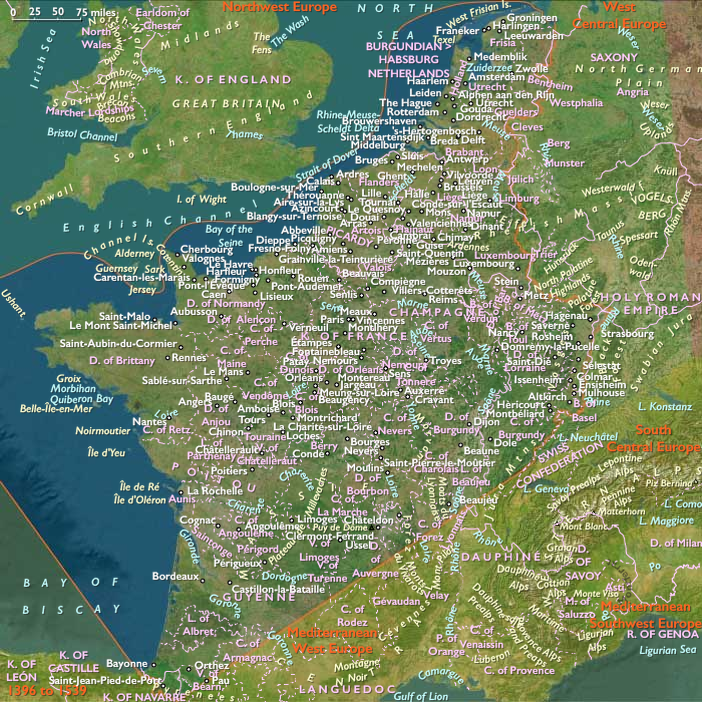
1396 CE to 1539 CE
The Burgundian Union and the Rise of the Low Countries (1384–1581)
The Burgundian period (1384–1581) marked the beginning of political unification and economic expansion in what is now the Netherlands and Belgium. Before this era, the region was a patchwork of independent counties and duchies, where people primarily identified with their local towns or rulers. The personal union established by Philip the Good in 1433, which brought together most Imperial and French fiefs in the Low Countries, laid the groundwork for the eventual formation of a Dutch national identity.
I. The Burgundian Unification (1384–1433)
- The House of Valois-Burgundy, beginning with Philip the Bold (r. 1384–1404), gradually expanded its ruleover the Low Countries.
- In 1433, Philip the Good formally united most of the fiefs in present-day Belgium and the Netherlandsthrough personal union.
- This consolidation created a more centralized administration, reducing the independence of cities and local rulers.
II. Economic Growth and the Protection of Dutch Trade
- The Burgundian and later Habsburg rulers actively defended Dutch trading interests, allowing commerce to develop rapidly.
- The fleets of the County of Holland repeatedly defeated the Hanseatic League, ensuring Dutch dominance in maritime trade.
- Amsterdam grew into Europe’s primary grain trading port, particularly for Baltic grain, which was distributed to:
- Major cities in present-day Belgium (e.g., Bruges, Antwerp).
- Northern France.
- England.
III. The Need for Grain Imports: Land Drainage and Agricultural Decline
- Due to land drainage, former wetlands in Holland had subsided, making them unsuitable for large-scale grain production.
- This forced Holland to rely on imported grain, accelerating the development of a powerful trade-based economy.
IV. Long-Term Impact and the Path to Nationhood
- The Burgundian period was crucial in shaping Dutch identity, as a political and economic unit began to emerge.
- The region remained under Burgundian and later Habsburg rule until 1581, when the Dutch Revolt led to the creation of the Dutch Republic.
- The economic and maritime dominance of Holland during this period laid the foundation for the Dutch Golden Age in the 17th century.
The Burgundian unification of the Low Countries (1384–1433) was a turning point, setting the stage for economic prosperity, political centralization, and the long road to Dutch independence.
People
Groups
Commodities
Regions
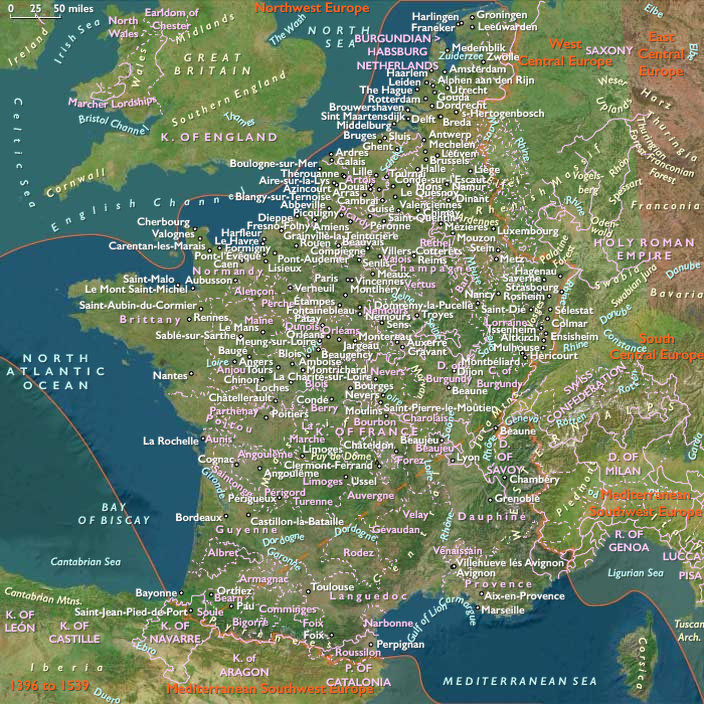
West Europe
View →Subregions