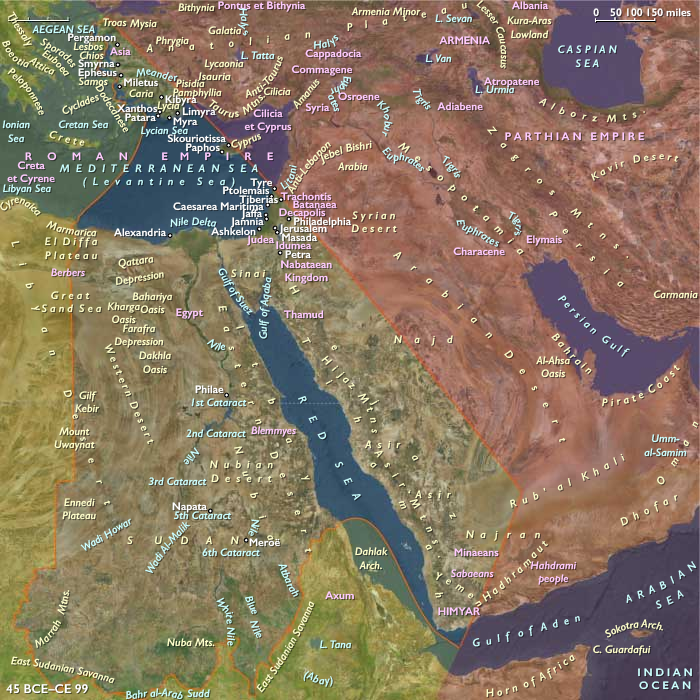
The Zealots, despite early successes in repelling…
May 70 CE
The Zealots, despite early successes in repelling the Roman sieges, have fought among themselves, lacking proper leadership, discipline, training, and preparation for the battles that were to follow.
After three years of bitter fighting, the Roman forces, under the command of Vespasian's son Titus, have reduced Judaea in three campaigns.
Days prior to the siege of Jerusalem, Eleazar ben Simon is betrayed by John of Giscala and killed.
According to Josephus, John had sent a party to the Zealot stronghold in the Temple to offer a sacrifice before the coming festival of Passover, yet when Eleazar and his Zealots opened the gates to permit entry, John's forces slaughtered Eleazar and his officials in order to regain the support of the Zealots.
Shortly after Eleazar's death in the summer of 70, Titus leads the final assault and siege of Jerusalem, the rebel’s capital city, just before the beginning of Passover, surrounding the city with three legions (V Macedonica, XII Fulminata, XV Apollinaris) on the western side and a fourth (X Fretensis) on the Mount of Olives to the east.
He puts pressure on the food and water supplies of the inhabitants by allowing pilgrims to enter the city to celebrate Passover, and then refusing to allow them to go out.
After Jewish sallies kill a number of Roman soldiers, Titus sends Josephus to negotiate with the defenders; this ends with Jews wounding the negotiator with an arrow, and another sally is launched shortly after.
Titus is nearly captured during this sudden attack, but escapes.
The siege of Jerusalem had begun early in the war, but has turned into a stalemate.
Unable to breach the city's defenses, the Roman armies have established a permanent camp just outside the city, digging a trench around the circumference of its walls and building a wall as high as the city walls themselves around Jerusalem.
Anyone caught in the trench attempting to flee the city is captured, crucified, and placed in lines on top of the dirt wall facing into Jerusalem, with as many as five hundred crucifixions occurring in a day.
Titus quickly takes down the first and second wall, but then meets fierce resistance as the factions within Jerusalem realize the necessity of joining forces.
However, Simon and John both uphold their reigns of terror over the citizens, causing many to flee to the Romans.
To counteract these desertions, Simons put every potential betrayer, including some of his previous friends, to death.
Tacitus, a historian of the time, notes that those who were besieged in Jerusalem amounted to no fewer than six hundred thousand, that men and women alike and every age engaged in armed resistance, everyone who could pick up a weapon did, both sexes showed equal determination, preferring death to a life that involved expulsion from their country.
In mid-May, Titus sets to destroying the newly built Third Wall with a ram, breaching it as well as the Second Wall, and turning his attention to the Fortress of Antonia just north of the Temple Mount.
The Romans are then drawn into street fighting with the Zealots, who are then ordered to retreat to the temple to avoid heavy losses.
People
Groups
Topics
Commodities
Subjects
Regions
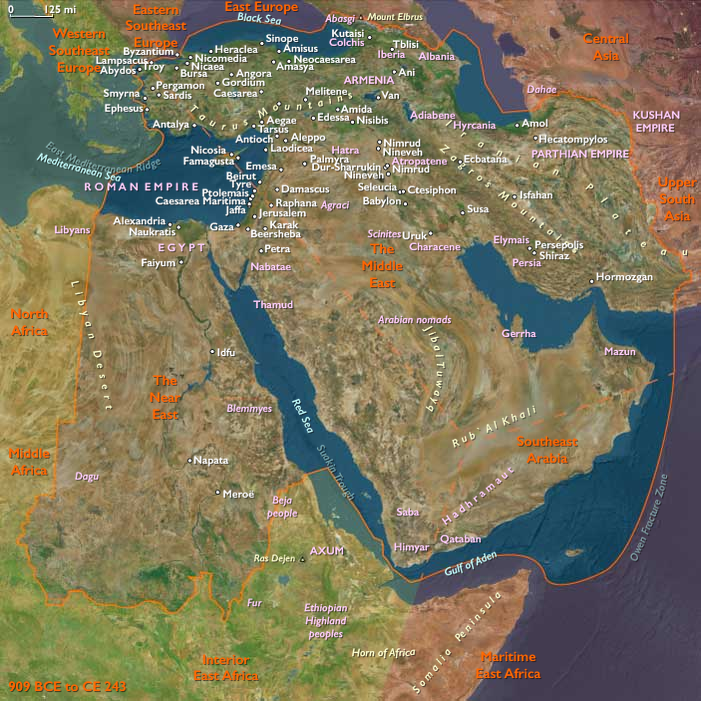
The Near and Middle East
View →Subregions