Thomas De Quincey, the future author of…
November 1819 CE
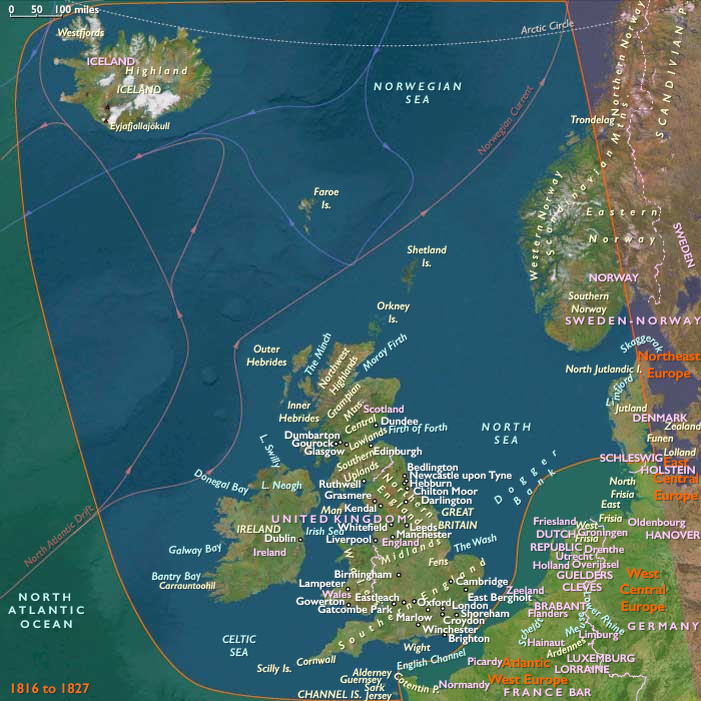
Thomas De Quincey, the future author of Confessions of an English Opium-Eater had become editor of The Westmorland Gazette, a Tory newspaper published in Kendal, in July 1818 after its first editor had been dismissed.
He was unreliable at meeting deadlines, and in June 1819 the proprietors had complained about "their dissatisfaction with the lack of ‘regular communication between the Editor and the Printer’"; he resigns in November 1819.
De Quincey's political sympathies tend towards the right.
He is "a champion of aristocratic privilege," reserves "Jacobin" as his highest term of opprobrium, holds reactionary views on the Peterloo Massacre, on Catholic Emancipation and the enfranchisement of the common people, and yet is also a staunch abolitionist on the issue of slavery.
He had been ready for the University of Oxford aged fifteen in 1801; his scholarship was far in advance of his years.
He had been sent to Manchester Grammar School, in order that after three years' stay he might obtain a scholarship to Brasenose College, Oxford, but he took flight after nineteen months.
His first plan had been to reach William Wordsworth, whose Lyrical Ballads (1798) had consoled him in fits of depression and had awakened in him a deep reverence for the poet, but De Quincey was too timid for that, so he had made his way to Chester, where his mother dwelt, in the hope of seeing a sister.
He had been caught by the older members of the family, but, through the efforts of his uncle, Colonel Penson, had received the promise of a guinea a week to carry out his later project of a solitary tramp through Wales.
De Quincey lived as a wayfarer from July to November, 1802.
Soon losing his guinea by ceasing to keep his family informed of his whereabouts, he had had difficulty making ends meet.
Still apparently fearing pursuit, he had borrowed some money and traveled to London, where he tried to borrow more.
Having failed, he lived close to starvation rather than return to his family.
This deprived period has left a profound mark upon De Quincey's psychology, and upon the writing he will later do; it forms a major and crucial part of the first section of the Confessions of an English Opium-Eater, and will reappear in various forms throughout the vast body of his lifetime literary work.
Discovered by chance by his friends, De Quincey had been brought home and finally allowed to go to Worcester College, Oxford, on a reduced income.
During this time he began to take opium.
He completed his studies, but failed to take the oral examination leading to a degree; he left the university without graduating.
He became an acquaintance of Samuel Taylor Coleridge and William Wordsworth, having already sought out Charles Lamb in London.
His acquaintance with Wordsworth had led to his settling in 1809 at Grasmere, in the Lake District.
His home for the next ten years will be Dove Cottage, which Wordsworth had occupied and which is now a popular tourist attraction.
De Quincey was married in 1816, and soon after, having no money left, he took up literary work in earnest.
His wife Margaret will bear him eight children before her death in 1837.
Five, however, will predeceased their father; three of De Quincey's daughters will survive him.
De Quincey is to be oppressed by debt for most of his adult life; along with his opium addiction, debt is one of the primary constraints of his existence.
He pursues journalism as the one way available to him to pay his bills; and without financial need it is an open question how much writing he would ever have done.
By his own testimony, De Quincey first used opium in 1804 to relieve his neuralgia; he used it for pleasure, but no more than weekly, through 1812.
It was in 1813 that he first commenced daily usage, in response to illness and his grief over the death of Wordsworth's young daughter Catherine.
In the periods of 1813–16 and 1817–19 his daily dose was very high, and resulted in the sufferings recounted in the final sections of his Confessions.
People
Commodities
Subjects
Regions
North Europe
View →Subregions