
The market in Europe and America for …
Years: 1684 - 1827
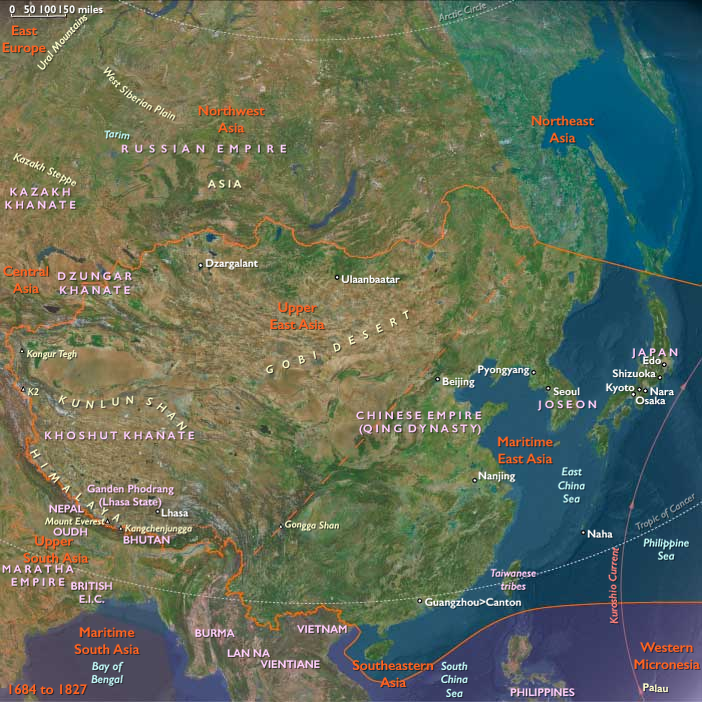
The market in Europe and America for tea, a new drink in the West, has expanded greatly during the eighteenth century.
Additionally, there is a continuing demand for Chinese silk and porcelain, but China, still in its preindustrial stage, wants little that the West has to offer, causing the Westerners, mostly British, to incur an unfavorable balance of trade.
To remedy the situation, the foreigners develop a third-party trade, exchanging their merchandise in India and Southeast Asia for raw materials and semi-processed goods, which finds a ready market in Guangzhou.
Raw cotton and opium from India have become the staple British imports into China by the early nineteenth century, in spite of the fact that opium is prohibited entry by imperial decree.
The opium traffic is made possible through the connivance of profit-seeking merchants and a corrupt bureaucracy.
Locations
Groups
- Chinese (Han) people
- Papal States (Republic of St. Peter)
- Neo-Confucianism
- Christians, Roman Catholic
- Jesuits, or Order of the Society of Jesus
- France, (Bourbon) Kingdom of
- Manchus
- Portugal, Bragança Kingdom of
- Chinese Empire, Qing (Manchu) Dynasty
- Macau, Portuguese colony of
- Spain, Bourbon Kingdom of
- Britain, Kingdom of Great
- Russian Empire
Topics
- Colonization of Asia, Spanish
- Colonization of Asia, Portuguese
- Colonization of Asia, French
- Colonization of Asia, British
Commodoties
Subjects
Regions
Subregions

Years: 1684 - 1827
Locations
Groups
- Chinese (Han) people
- Papal States (Republic of St. Peter)
- Neo-Confucianism
- Christians, Roman Catholic
- Jesuits, or Order of the Society of Jesus
- France, (Bourbon) Kingdom of
- Manchus
- Portugal, Bragança Kingdom of
- Chinese Empire, Qing (Manchu) Dynasty
- Macau, Portuguese colony of
- Spain, Bourbon Kingdom of
- Britain, Kingdom of Great
- Russian Empire
Topics
- Colonization of Asia, Spanish
- Colonization of Asia, Portuguese
- Colonization of Asia, French
- Colonization of Asia, British
Commodoties
Subjects
Regions
Subregions