
The eleventh-century taifas, weakened by their …
Years: 1108 - 1251
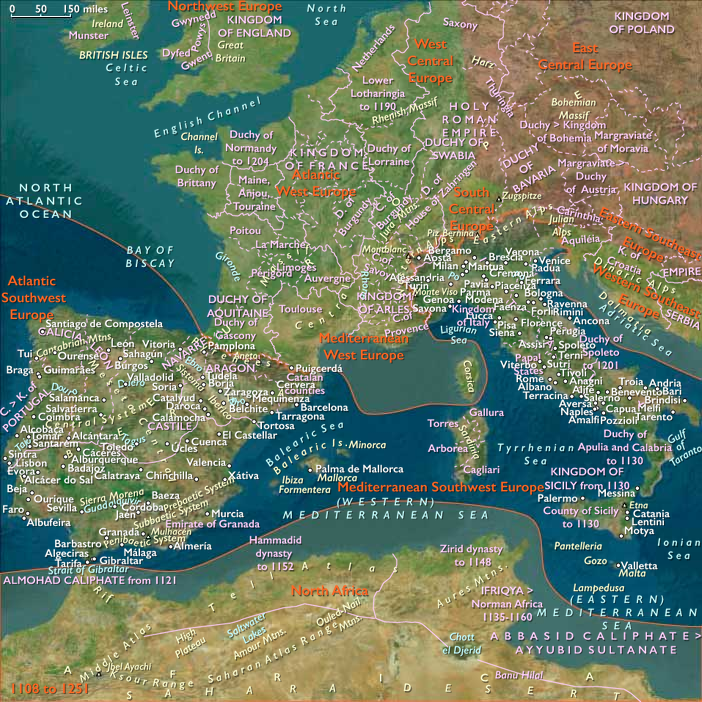
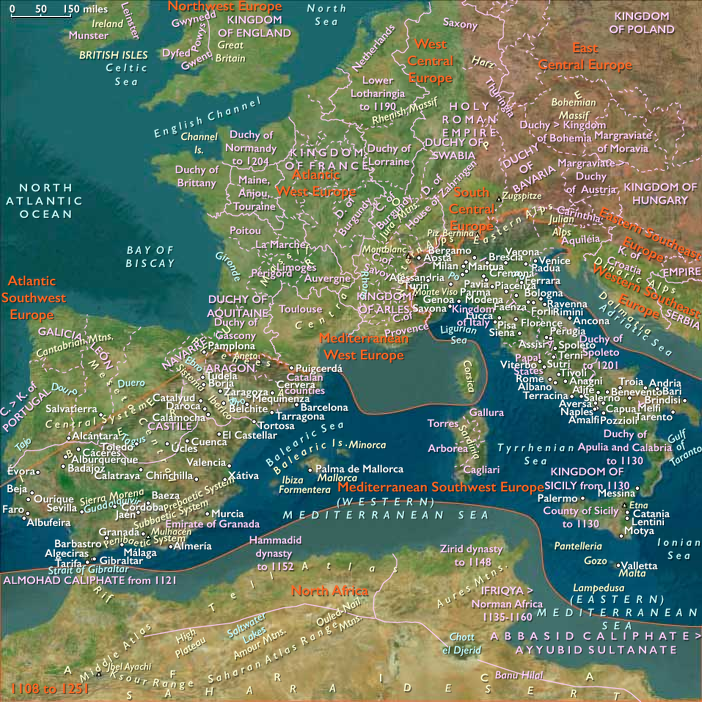
The eleventh-century taifas, weakened by their disunity, had fallen piecemeal to the Castilians, who had reason to anticipate the completion of the Reconquest.
When Toledo was lost in 1085, the alarmed amirs had appealed for aid to the Almoravids, a militant Berber party of strict Muslims, who in a few years had won control of the Maghreb (northwest Africa).
The Almoravids had incorporated all of Al Andalus, except Zaragoza, into their North African empire.
They had attempted to stimulate a religious revival based on their own evangelical brand of Islam.
In Spain, however, their movement had soon lost its missionary fervor.
The Almoravid state has fallen apart by the mid-twelfth century under pressure from another religious group, the Almohads, who extend their control from Morocco to Spain and make Seville their capital.
The Almohads share the crusading instincts of the Almoravids and pose an even greater military threat to the Christian states, but their expansion is stopped decisively in the epic battle of Las Navas de Tolosa (1212), a watershed in the history of the Reconquest.
Muslim strength ebbs hereafter.
Ferdinand III takes Seville in 1248, reducing Al Andalus to the emirate of Granada, which had bought its safety by betraying the Almohads' Spanish capital.
Granada remains a Muslim state, but as a dependency of Castile.
Locations
People
Groups
- Islam
- Barcelona, County of
- León, Kingdom of
- Christians, Roman Catholic
- Almoravid dynasty
- Castile, Kingdom of
- Aragón, Kingdom of
- Almohad Caliphate
- Portugal, Burgundian (Alfonsine) Kingdom of
- Castile, Crown of
- Granada, Emirate of, or Nasrid Kingdom of
- Valencia, Kingdom of
Topics
Subjects
Regions
Subregions
Years: 1108 - 1251
Locations
People
Groups
- Islam
- Barcelona, County of
- León, Kingdom of
- Christians, Roman Catholic
- Almoravid dynasty
- Castile, Kingdom of
- Aragón, Kingdom of
- Almohad Caliphate
- Portugal, Burgundian (Alfonsine) Kingdom of
- Castile, Crown of
- Granada, Emirate of, or Nasrid Kingdom of
- Valencia, Kingdom of
Topics
Subjects
Regions
Subregions