
An expedition of Cambro-Norman knights with an…
1108 CE to 1251 CE
An expedition of Cambro-Norman knights with an army of about six hundred lands at Bannow Strand in present-day County Wexford on May 1, 1169.
It is led by Richard de Clare, called Strongbow due to his prowess as an archer.
The invasion, which coincides with a period of renewed Norman expansion, is at the invitation of Dermot Mac Murrough, the king of Leinster.
In 1166, Mac Murrough had fled to Anjou, France, following a war involving Tighearnán Ua Ruairc, of Breifne, and sought the assistance of the Angevin king, Henry II, in recapturing his kingdom.
In 1171, Henry arrives in Ireland in order to review the general progress of the expedition.
He wants to re-exert royal authority over the invasion, which is expanding beyond his control.
Henry successfully re-imposes his authority over Strongbow and the Cambro-Norman warlords and persuades many of the Irish kings to accept him as their overlord, an arrangement confirmed in the 1175 Treaty of Windsor.
The invasion is legitimized by the provisions of the Papal Bull Laudabiliter, issued by Adrian IV in 1155.
The bull had encouraged Henry to take control in Ireland in order to oversee the financial and administrative reorganization of the Irish Church and its integration into the Roman Church system.
Some restructuring had already begun at the ecclesiastical level following the Synod of Kells in 1152.
There has been significant controversy regarding the authenticity of Laudabiliter, and there is no general agreement as to whether the bull was genuine or a forgery.
In 1172, the new pope, Alexander III, further encourages Henry to advance the integration of the Irish Church with Rome.
Henry is authorized to impose a tithe of one penny per hearth as an annual contribution.
This church levy, called Peter's Pence, is extant in Ireland as a voluntary donation.
In turn, Henry accepts the title of Lord of Ireland, which Henry confers on his younger son, John Lackland, in 1185.
When Henry's successor dies unexpectedly in 1199, John inherits the crown of England and retains the Lordship of Ireland.
People
Groups
Regions
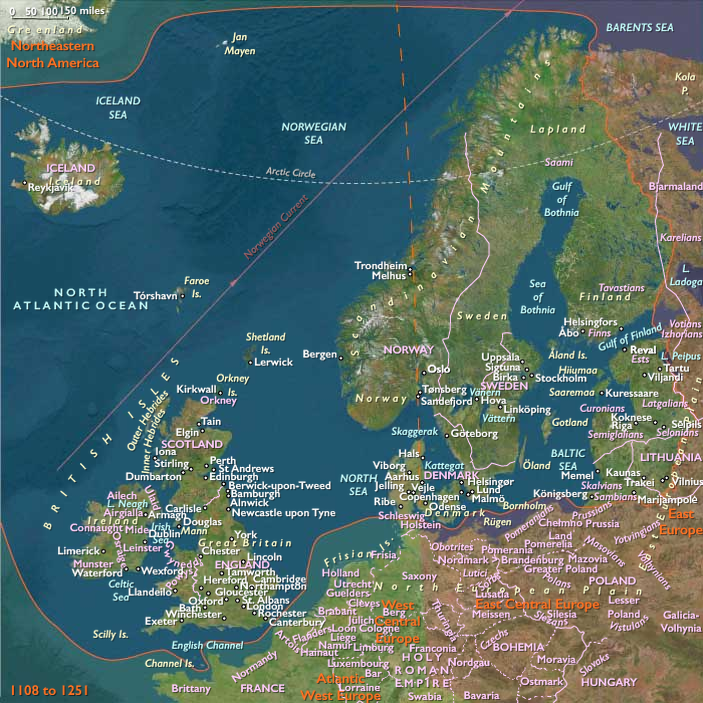
North Europe
View →Subregions
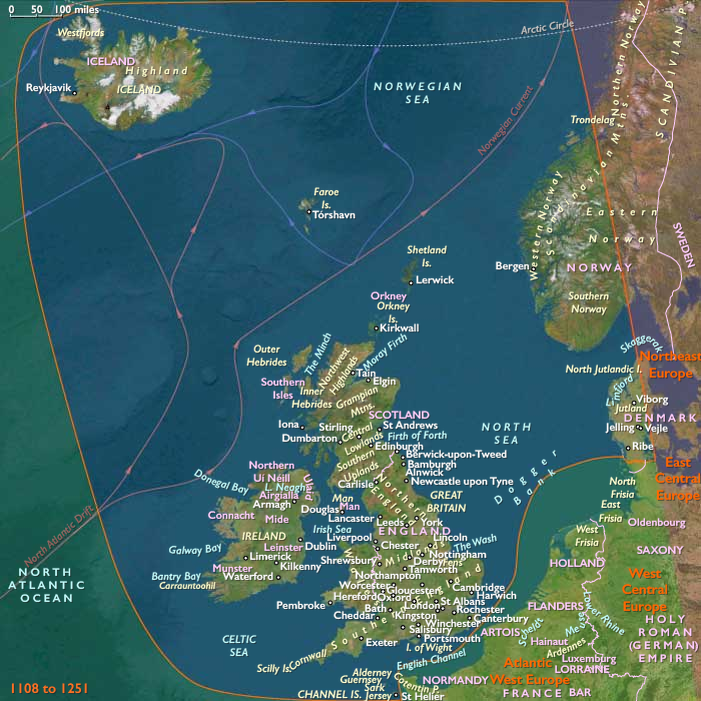
Northwest Europe
View →Related Events
Showing 8 events out of 8 total
Central Europe (1108 – 1251 CE): Imperial Reform, Urban Expansion, and the Ostsiedlung
Between 1108 and 1251 CE, Central Europe—the heartland of the Holy Roman Empire and its eastern marches—entered an era of extraordinary growth. The Medieval Warm Period brought demographic expansion and agricultural innovation, while political fragmentation fostered new towns, laws, and civic institutions.
From the Rhineland cathedrals and Alpine passes to the plains of Poland and Hungary, Europe’s central belt fused feudal lordship, ecclesiastical reform, and the eastward movement of settlers into one of the most dynamic transformations of the medieval world.
Geographic and Environmental Context
Central Europe stretched from the Rhine to the Vistula and from the Baltic coast to the Alpine valleys and Pannonian plain, encompassing:
-
The Rhineland heartlands of Cologne, Mainz, and Strasbourg;
-
The Alpine crossroads of Tyrol, Zürich, and Geneva;
-
The eastern plains of Silesia, Poland, Bohemia, Moravia, and Hungary.
This was a continent within a continent—a network of fertile valleys, wooded uplands, and trade arteries defined by the Rhine, Elbe, Oder, Vistula, and Danube. Forest clearance and settlement transformed once-marginal lands into the agrarian and urban centers of late medieval Europe.
Climate and Environmental Shifts
The Medieval Warm Period (c. 950–1250) provided long growing seasons, enabling population growth and the spread of viticulture and grain farming north and east.
Favorable weather encouraged three-field rotation, iron ploughs, and horse collars, which revolutionized yields.
Localized floods along the Rhine and Danube enriched soils even as they reshaped towns and dikes.
The forests of Silesia, the Carpathians, and Bavaria yielded timber, salt, and silver—the mineral backbone of Central Europe’s economy.
Political and Institutional Developments
The Imperial Core:
The Holy Roman Empire, though politically fragmented, remained Europe’s constitutional and spiritual axis.
The Hohenstaufen emperors (1138–1254) sought to balance imperial unity with the autonomy of princes and cities.
Archbishops of Mainz, Trier, and Cologne, as imperial electors, embodied this duality of sacred and secular authority.
East Central Kingdoms:
-
Poland (Piast dynasty): The Testament of Bolesław III (1138) divided the realm among dukes, initiating two centuries of fragmentation. Kraków remained the senior duchy, while Silesia and Pomerania invited German settlers under Magdeburg Law, integrating Poland into the Ostsiedlung.
-
Bohemia and Moravia (Přemyslids): Secured hereditary kingship through the Golden Bull of Sicily (1212); Prague emerged as a royal and cultural capital, with silver mining at Kutná Hora enriching the crown.
-
Hungary (Árpád dynasty): The Golden Bull of 1222 codified noble rights; after the Mongol invasion (1241–42), Béla IV rebuilt the kingdom with stone fortifications and foreign settlers, initiating a second wave of colonization and urbanization.
Alpine and South Central Principalities:
Feudal fragmentation defined the Alps: counts of Tyrol, bishops of Geneva, and abbots of Einsiedeln and St. Gallcontrolled passes and tolls.
Urban communes in Zürich and Geneva asserted autonomy; local assemblies in Alpine valleys laid early foundations for Swiss communal governance.
The Rhineland Electorates:
Cologne, Mainz, and Trier dominated the political and spiritual life of the Empire.
Imperial cities such as Strasbourg, Worms, Speyer, and Basel gained privileges, fostering the growth of guilds, markets, and civic culture.
This west–east continuum—imperial in form, feudal in structure, and civic in aspiration—defined Central Europe’s political pluralism.
Economy and Trade
Agrarian Expansion:
Forest clearance and colonization extended cultivation across Silesia, Brandenburg, Bohemia, and Hungary. Heavy ploughs, crop rotation, and watermills drove rural productivity.
Mining and Industry:
Silver at Kutná Hora and Jihlava, salt at Wieliczka, and iron in the Alps and Swabia financed courts and monasteries.
Cistercian abbeys coordinated land reclamation and proto-industrial production.
Trade and Urban Growth:
-
Rhineland: The Rhine served as Europe’s commercial artery, connecting Cologne, Mainz, Strasbourg, and Basel to Flanders and Italy.
-
Alpine routes: Brenner and St. Gotthard passes moved Italian silk and spices north, returning with German metals and wool.
-
Eastern trade: The Oder–Elbe–Danube corridors linked Kraków, Wrocław, Prague, and Buda to Baltic and Adriatic markets.
German urban law (Magdeburg, Lübeck) standardized administration, embedding civic governance across Central Europe.
Urban and Technological Development
Cities expanded rapidly. Cologne, with over 40,000 inhabitants, ranked among Europe’s largest; Cologne Cathedral(begun 1248) inaugurated the Gothic age north of the Alps.
Stone castles, bridges, and Romanesque monasteries transformed the landscape; later Gothic cathedrals rose in Strasbourg, Prague, and Bamberg.
Watermills and guild industries powered textiles, glassmaking, and metalwork.
The Ostsiedlung infused new technology and law across Slavic lands, blending German civic models with local traditions.
Belief and Symbolism
Catholic Christianity unified the region’s culture and law.
-
The archbishoprics of Gniezno, Esztergom, and Prague became national spiritual centers.
-
The Cistercians, Dominicans, and Franciscans spread reform and education, while monasteries became agents of colonization and literacy.
-
Royal sanctity—seen in cults of St. Elizabeth of Hungary and St. Wenceslaus—legitimized dynastic rule.
Pilgrimage and relic cults (notably the Three Kings of Cologne) bound devotion to geography, turning the Rhine and Danube into sacred corridors.
Movement and Interaction Corridors
-
Rhine River: North–south trade spine from Basel to the North Sea.
-
Danube River: Crossed by the Hungarian plain and Bohemian frontier.
-
Elbe–Oder–Vistula basins: Arteries of the Ostsiedlung and grain export.
-
Alpine passes: Brenner and St. Gotthard linking Italy with Germany and Burgundy.
-
Pilgrimage and crusade routes: Swabian knights joined Crusades; Rhineland ports provisioned Mediterranean fleets.
These routes knit the region into Christendom’s spiritual, commercial, and military systems.
Adaptation and Resilience
-
Multipolar politics—Piast duchies, Přemyslid Bohemia, Árpád Hungary—prevented systemic collapse and encouraged local autonomy.
-
Alpine communes and imperial cities institutionalized cooperation and self-defense.
-
Ecclesiastical reform reinforced continuity amid dynastic change.
-
After the Mongol invasion, Hungary’s reconstruction and the eastward settlement drive demonstrated unparalleled resilience.
Fragmentation became an engine of innovation, not decline.
Long-Term Significance
By 1251 CE, Central Europe stood as the pivot of medieval Christendom:
-
The Empire’s Rhineland heartlands led in urbanization, cathedral culture, and commerce.
-
The Alpine passes bound Italy, Germany, and Burgundy into one economic zone.
-
The eastern kingdoms—Poland, Bohemia, and Hungary—had absorbed German colonists and Western institutions, laying the foundations of modern Central Europe.
Fragmented yet interconnected, the region’s plural order and settlement revolution made it Europe’s engine of transformation and resilience.
East Central Europe (1108 – 1251 CE): Piast Fragmentation, Přemyslid Kingship, Árpád Reforms, and the Ostsiedlung
Geographic and Environmental Context
East Central Europe includes the greater part of Germany east of 10°E, Poland, Czechia (Bohemia and Moravia), Slovakia, and Hungary.
-
A vast corridor of plains and uplands—the Elbe, Oder, Vistula, and Danube basins—connected the Baltic to the Carpathians and the Pannonian Plain.
-
Forest clearance and settlement expansion tied the German imperial east to the kingdoms of Poland, Bohemia, and Hungary.
Climate and Environmental Shifts
-
The Medieval Warm Period favored population growth, higher cereal yields, and the spread of viticulture and orchards into sheltered valleys.
-
Floods and periodic droughts punctuated stability, but improved ploughs and crop rotations spread resilience.
Societies and Political Developments
-
Germany east of 10°E: Fragmented imperial principalities encouraged the founding of towns and the granting of civic laws (e.g., Magdeburg Law), attracting settlers and merchants.
-
Poland (Piast dynasty): The Testament of Bolesław III (1138) divided the realm among dukes, initiating a period of long-lasting fragmentation. Kraków served as the notional senior capital, while Silesia and Pomerania drew intense German colonization.
-
Bohemia and Moravia (Přemyslids): Elevated to hereditary kingship with the Golden Bull of Sicily (1212)under Přemysl Otakar I. Prague and Moravian centers like Brno and Olomouc flourished.
-
Hungary (Árpád dynasty): The Golden Bull of 1222 limited royal power and confirmed noble rights. The Mongol invasion (1241–1242) devastated the kingdom, forcing Béla IV into a massive rebuilding effort with stone castles and settlement incentives.
-
Slovakia (Upper Hungary): Integrated into Hungarian mining and defense networks.
Economy and Trade
-
Agrarian expansion: heavy plough, three-field system, and mass clearances extended farmland.
-
Mining: silver at Jihlava and Kutná Hora; salt at Wieliczka.
-
Trade corridors: Oder–Elbe–Danube routes moved grain, timber, and salt to the Baltic and Rhineland; Kraków, Wrocław, Prague, Pressburg, and Buda–Pest acted as hubs.
-
German urban law (Magdeburg, Lübeck) standardized town governance.
Subsistence and Technology
-
Watermills, collar harnesses, and improved ploughs boosted productivity.
-
Romanesque fortresses and Gothic cathedrals reshaped urban skylines.
-
Castles spread across Hungary and Bohemia, especially after Mongol devastation.
Movement and Interaction Corridors
-
The Ostsiedlung carried German-speaking peasants and artisans into Silesia, Pomerania, Brandenburg, and Bohemia.
-
Cistercian monasteries coordinated land clearance and settlement.
-
Mongol invasion briefly severed Carpathian corridors but reforms re-opened them.
Belief and Symbolism
-
Latin Christianity unified political culture: archbishoprics in Gniezno, Esztergom, and Prague guided ecclesiastical governance.
-
Cistercians, Dominicans, Franciscans spread reform, preaching, and literacy.
-
Cults of royal saints (e.g., St. Elizabeth of Hungary) tied dynastic legitimacy to sanctity.
Adaptation and Resilience
-
Multipolar politics (Piast duchies, Přemyslid Bohemia, Árpád Hungary) created redundancy.
-
Hungary’s reconstruction after the Mongols demonstrated adaptive resilience, with stone fortifications and immigrant resettlement.
-
Town networks spread risk through market integration.
Long-Term Significance
By 1251 CE, East Central Europe had become a densely networked agrarian and urban region: fragmented Piast duchies, a hereditary Bohemian kingdom, and a restructured Hungary coexisted within the framework of German colonization and urban law. This laid the institutional and demographic foundations for its later medieval flowering.
East Central Europe (1192–1203 CE): Přemyslid Restoration under Ottokar I, Emergence of Andrew II in Hungary, Continued Polish Decentralization, and Austria’s Ascendant Babenberg Dynasty
Between 1192 and 1203 CE, East Central Europe—including modern-day Poland, Czechia, Slovakia, Hungary, and eastern regions of Germany and Austria east of 10°E and north of the defined southeastern boundary—experienced critical political transitions, dynastic realignments, and continued territorial consolidation. Bohemia saw renewed Přemyslid strength under Ottokar I, Hungary navigated succession struggles leading toward the ascendancy of Andrew II, Poland remained politically fragmented with strong regional principalities, and Austria continued its growth and stabilization under the prominent Babenberg dynasty. This era was pivotal in establishing lasting political frameworks, economic prosperity, and enduring cultural traditions across the region.
Political and Military Developments
Přemyslid Restoration under Ottokar I in Bohemia
-
In 1197, Ottokar I Přemysl (r. 1197–1230) secured power, bringing renewed stability and reinvigorating Přemyslid authority after prolonged dynastic strife. His effective governance restored Bohemia’s regional influence and solidified its alliance with the Holy Roman Empire.
-
Ottokar’s political acumen laid foundations for future Bohemian royal autonomy, leading eventually to his hereditary royal title recognition in 1198 by Philip of Swabia, bolstering the Přemyslid dynasty’s long-term prominence.
Hungarian Succession Struggles and Rise of Andrew II
-
Hungary entered a period of complex succession disputes after Béla III’s death (1196). His sons, Emeric (1196–1204) and Andrew II (1205–1235), contended for power, causing brief internal instability.
-
Emeric, ruling from 1196, attempted to stabilize royal power but faced challenges from his ambitious younger brother Andrew, whose eventual ascendancy in the following era (1205) would profoundly impact Hungarian politics.
Persistent Polish Decentralization and Regional Autonomy
-
Poland continued its fragmented political landscape, divided among powerful Piast principalities such as Silesia under Duke Henry I the Bearded, Greater Poland, Masovia, and Lesser Poland. Rivalry among these territories persisted, further decentralizing political authority and strengthening local aristocratic rule.
Austria’s Stability and Expansion under Leopold V and Frederick I
-
Under Duke Leopold V (r. 1177–1194) and his successor, Frederick I (r. 1195–1198), the Austrian Babenberg dynasty further solidified territorial cohesion, political stability, and regional influence within the Holy Roman Empire.
-
Austria’s expansion and strengthening of ducal authority prepared the foundation for greater autonomy and influence throughout the medieval period.
Imperial Transition after Frederick Barbarossa’s Death
-
The death of Emperor Frederick Barbarossa (1190) during the Third Crusade shifted imperial dynamics, temporarily affecting the political balance in East Central Europe. His successor, Henry VI (r. 1190–1197), and the subsequent imperial interregnum significantly influenced regional politics, alliances, and dynastic stability.
Economic and Technological Developments
Continued Economic Expansion and Urban Prosperity
-
Economic growth remained robust, supported by vibrant trade networks connecting regional economies with Baltic, Byzantine, Western European, and Mediterranean markets. Major urban centers like Prague, Vienna, Esztergom, Kraków, and Wrocław expanded as prosperous commercial hubs.
Agricultural Productivity and Technological Advancements
-
Continued adoption of advanced agricultural practices, including improved plowing techniques and systematic crop rotation, increased agricultural productivity. These innovations supported urban growth, population expansion, and regional prosperity.
Cultural and Artistic Developments
Bohemian Cultural Revival under Ottokar I
-
Ottokar I strongly supported ecclesiastical institutions, architectural projects, and manuscript production, significantly contributing to Bohemia’s cultural flourishing and reestablishing Prague as an influential intellectual and artistic center.
Hungarian Ecclesiastical and Cultural Continuity
-
Despite internal succession disputes, Hungary maintained robust cultural and religious activities. Ecclesiastical institutions, monasteries, and scholarly communities flourished, ensuring continuity and resilience in Hungarian cultural life.
Cultural Stability in Fragmented Poland
-
Polish cultural continuity remained resilient amid political fragmentation. Monasteries and ecclesiastical institutions continued scholarly and artistic traditions, preserving regional cultural and religious identities.
Settlement and Urban Development
Urban Consolidation and Expansion in Bohemia
-
Under Ottokar I, Bohemian towns such as Prague significantly expanded, enhancing fortifications, administrative structures, and economic infrastructure. This urban growth supported Přemyslid centralization and regional prominence.
Hungarian Urban Development Despite Instability
-
Hungarian urban centers, notably Esztergom and Székesfehérvár, maintained growth and infrastructure development, despite succession disputes, reflecting continued economic prosperity and strong local governance structures.
Austrian Territorial Cohesion and Urban Growth
-
Austria’s urban centers, especially Vienna, flourished under Babenberg rule, consolidating territorial cohesion, economic vitality, and regional administrative authority, reinforcing Austria’s long-term significance within East Central Europe.
Social and Religious Developments
Strengthened Ecclesiastical Structures and Religious Identity
-
Ecclesiastical institutions expanded and strengthened throughout the region, shaping governance, education, and cultural identities. Monasteries, bishoprics, and religious orders played vital roles in societal cohesion, education, and cultural preservation.
Aristocratic Dominance and Dynastic Stability
-
Aristocratic governance and dynastic authority continued to shape regional politics significantly. Bohemia’s Přemyslid restoration under Ottokar I, Austria’s Babenberg stability, and Hungary’s aristocratic power structures highlighted the pivotal role of nobility. Poland’s regional aristocratic autonomy deepened amid persistent fragmentation.
Long-Term Consequences and Historical Significance
The era 1192–1203 CE critically shaped East Central Europe’s political landscape, economic vitality, and cultural identity. The restoration of Přemyslid authority in Bohemia under Ottokar I, Hungary’s succession struggles leading toward Andrew II’s significant future rule, Austria’s territorial and political strengthening, and Poland’s persistent decentralization deeply influenced regional trajectories. These developments laid enduring foundations for the distinct political structures, economic patterns, and cultural identities characterizing East Central Europe throughout the medieval period and beyond.
The early years of Ottokar, a younger son of King Vladislav II of Bohemia, had passed amid the anarchy which prevailed everywhere in the country.
After several struggles in which he had taken part, he had been recognized as ruler of Bohemia by Holy Roman Emperor Henry VI in 1192.
He was, however, soon overthrown for joining a conspiracy of German princes to bring down the Hohenstaufen monarchy.
In 1197, Ottokar had forced his brother, Duke Vladislaus III Henry, to abandon Bohemia to him and to content himself with Moravia.
Taking advantage of the German civil war between the Hohenstaufen claimant Philip of Swabia and the Welf candidate Otto IV, Ottokar declares himself hereditary King of Bohemia in 1198.
This title is supported by Philip of Swabia, who needs Czech military support against Otto.
East Central Europe (1204–1215 CE): Andrew II’s Hungarian Ascendancy, Bohemian Royal Consolidation under Ottokar I, Polish Regional Power under Henry the Bearded, and Austria’s Stability under Leopold VI
Between 1204 and 1215 CE, East Central Europe—including modern-day Poland, Czechia, Slovakia, Hungary, and eastern regions of Germany and Austria east of 10°E and north of the defined southeastern boundary—experienced significant political realignments, territorial consolidation, and cultural developments. Hungary entered a vibrant era under King Andrew II, Bohemia solidified Přemyslid royal authority under Ottokar I, Poland’s fragmentation continued but saw growing regional strength under Henry the Bearded in Silesia, and Austria prospered under Leopold VI of the Babenberg dynasty. These developments significantly influenced regional stability, economic expansion, and cultural flourishing.
Political and Military Developments
Hungarian Stability and Expansion under Andrew II
-
In 1205, following King Emeric’s death, his brother Andrew II (r. 1205–1235) ascended Hungary’s throne, ushering in a politically active and culturally vibrant reign. Andrew pursued ambitious foreign and domestic policies, seeking greater political influence across East Central Europe and actively engaging in Crusades.
-
His governance significantly strengthened Hungary’s regional standing, despite occasional internal disputes and aristocratic challenges.
Bohemian Royal Authority Strengthened under Ottokar I
-
King Ottokar I Přemysl (r. 1197–1230) reinforced royal authority, stabilizing Bohemia after previous dynastic conflicts. His strong leadership earned recognition of hereditary royal status from the Holy Roman Empire in the Golden Bull of Sicily (1212), enhancing Přemyslid autonomy and political prestige.
-
Ottokar’s reign marked significant administrative reform, territorial consolidation, and increased Bohemian political influence within imperial affairs.
Polish Fragmentation and Silesian Power under Henry the Bearded
-
Poland’s political fragmentation persisted with principalities operating autonomously. The most prominent was Silesia under Duke Henry I the Bearded (r. 1201–1238), who consolidated power, enhanced economic prosperity, and fostered diplomatic alliances.
-
Henry’s leadership elevated Silesia as the strongest of Poland’s regional duchies, significantly influencing broader Polish and Central European politics.
Austrian Stability and Prosperity under Leopold VI
-
Duke Leopold VI of Austria (r. 1198–1230) ensured political stability, territorial security, and economic prosperity within Austria. His rule strengthened urban centers, fortified regional influence, and reinforced Austria’s prominence in the Holy Roman Empire.
-
Leopold VI actively supported crusading efforts, fostering diplomatic relations across Europe and enhancing Austria’s international prestige.
Imperial Authority under Otto IV and Frederick II
-
The period featured contested imperial succession between Otto IV (r. 1198–1215) and Frederick II (r. 1212–1250), affecting regional politics. East Central European rulers navigated shifting imperial alliances, notably Bohemia under Ottokar I, whose support for Frederick II strengthened his position and royal autonomy.
Economic and Technological Developments
Prosperous Regional Economies and Expanded Trade
-
Economic prosperity continued through robust trade networks connecting Baltic, Western Europe, and Mediterranean markets. Major urban centers—Prague, Vienna, Esztergom, Kraków, and Wrocław—thrived commercially, becoming vital hubs of regional trade.
Agricultural Innovations and Population Growth
-
Agricultural productivity increased due to widespread adoption of advanced techniques, such as improved plows, crop rotation, and land management practices, supporting significant urbanization and population expansion.
Cultural and Artistic Developments
Hungarian Cultural and Artistic Flourishing under Andrew II
-
Andrew II patronized extensive ecclesiastical foundations, artistic endeavors, and intellectual developments, greatly enhancing Hungarian cultural life. Manuscript production, ecclesiastical architecture, and scholarly activities flourished, influenced by Western European and Byzantine traditions.
Bohemian Intellectual and Cultural Revival under Ottokar I
-
Bohemia’s cultural prominence significantly increased, particularly in Prague, driven by royal patronage of monastic scholarship, manuscript illumination, and architectural projects. Prague became an influential cultural and intellectual center within Central Europe.
Silesian Cultural and Economic Vitality under Henry the Bearded
-
Duke Henry the Bearded fostered cultural and economic vitality in Silesia, promoting monasteries, urban development, and artistic patronage. His support solidified Silesia’s role as a prominent cultural and commercial region within fragmented Poland.
Settlement and Urban Development
Urban Expansion in Hungary under Andrew II
-
Hungarian urban centers, notably Esztergom and Buda, expanded significantly, benefiting from improved fortifications, administrative organization, and flourishing commerce. This urban development reflected Andrew’s effective governance and economic policies.
Bohemian Town Consolidation and Growth
-
Under Ottokar I, Prague and other Bohemian urban centers experienced notable growth, infrastructure improvements, and commercial expansion. Prague’s prominence as a regional economic and administrative center was significantly enhanced.
Austrian Urban Prosperity and Infrastructure Development
-
Austria’s towns, particularly Vienna, experienced considerable prosperity under Leopold VI, supported by infrastructure enhancements, fortified settlements, and growing regional trade connections, reinforcing Austria’s economic strength and political influence.
Social and Religious Developments
Expansion and Strengthening of Ecclesiastical Structures
-
Ecclesiastical institutions expanded significantly, shaping regional governance, education, and cultural identities. Monasteries and bishoprics played critical roles in societal cohesion, intellectual development, and cultural continuity across East Central Europe.
Dynastic and Aristocratic Governance Structures
-
Aristocratic authority and dynastic leadership remained pivotal. Hungarian royal strength under Andrew II, Přemyslid consolidation in Bohemia, Austrian stability under Leopold VI, and Silesian prominence under Henry the Bearded emphasized the critical role of nobility and dynastic influence in regional governance.
Long-Term Consequences and Historical Significance
The era 1204–1215 CE represented a decisive period of regional consolidation and political realignment in East Central Europe. Andrew II’s reign solidified Hungarian regional prominence, Ottokar I secured lasting Přemyslid royal authority and autonomy in Bohemia, Henry the Bearded elevated Silesia within fragmented Poland, and Austria prospered under Leopold VI’s strong rule. These developments significantly shaped regional political identities, economic patterns, and cultural traditions, profoundly influencing East Central Europe’s medieval trajectory and future historical developments.
The increasingly powerful Kingdom of Bohemia now functions as an independent state although it remains a dominant force within the Holy Roman Empire.
Its ruler, Ottokar, taking advantage of the German civil war between the Hohenstaufen claimant Philip of Swabia and the Welf candidate Otto IV, had declared himself King of Bohemia.
This title was supported by Philip of Swabia who needed Czech military support against Otto (1198).
In 1200, with Otto IV in the ascendancy, to had abandoned his pact with Philip and declared for the Welf faction.
Both Otto and Pope Innocent III had subsequently accepted Ottokar as hereditary King of Bohemia.
Philip's consequent invasion of Bohemia was successful.
Ottokar, having been compelled to pay a fine, again ranged himself among Philip's partisans and still later was among the supporters of the young king, Frederick II.
In 1212, Frederick grants to Bohemia the Golden Bull of Sicily, which document recognizes Ottokar and his heirs as Kings of Bohemia.
The King is no longer subject to appointment by the Emperor, and is only required to attend Diets close to the Bohemian border.
Although a subject of the Holy Roman Empire, the Bohemian King is to be the leading electoral prince of the empire and to furnish all subsequent Emperors with a bodyguard of three hundred knights when they go to Rome for their coronation.
Ottokar's reign is also notable for the start of German immigration into Bohemia and the growth of towns in what have until this point been forest lands.
East Central Europe (1216–1227 CE): Golden Bull of Hungary, Bohemian Consolidation, Polish Regional Rivalries, and Babenberg Influence in Austria
Between 1216 and 1227 CE, East Central Europe—encompassing modern-day Poland, Czechia, Slovakia, Hungary, and the eastern regions of Germany and Austria east of 10°E and north of the defined southeastern boundary—witnessed pivotal political and institutional developments. Hungary under Andrew II saw profound social and political change through the Golden Bull of 1222, Bohemia further solidified royal authority under Ottokar I Přemysl, Polish territories experienced intensified regional rivalry, and Austria flourished culturally and politically under Duke Leopold VI of the Babenberg dynasty. Collectively, these events significantly shaped regional governance, social structures, and cultural dynamics.
Political and Military Developments
Hungary’s Golden Bull and Aristocratic Power under Andrew II
-
In 1222, King Andrew II (r. 1205–1235) issued the Golden Bull of Hungary, a landmark charter limiting royal power, guaranteeing noble privileges, and establishing foundational political rights. This document significantly reshaped Hungarian governance by solidifying aristocratic authority and curbing royal absolutism, echoing England’s Magna Carta (1215).
-
Andrew’s rule, though marked by occasional internal conflict, significantly expanded Hungarian regional influence, notably in frontier regions such as Transylvania and along the Adriatic coast.
Consolidation of Bohemian Royal Authority under Ottokar I
-
Under Ottokar I Přemysl (r. 1197–1230), Bohemia saw significant political stability and institutional development. The Golden Bull of Sicily (1212) continued to define his reign, confirming hereditary royal authority and enhancing Přemyslid autonomy within the Holy Roman Empire.
-
Ottokar’s effective governance and diplomatic skill solidified Bohemian territorial integrity and political stability, elevating Prague as a crucial regional political and cultural hub.
Intensified Polish Regional Rivalries and Silesian Strength
-
Poland remained deeply fragmented, with autonomous Piast duchies increasingly competing for dominance. Henry I the Bearded of Silesia (r. 1201–1238) emerged prominently, expanding influence over neighboring territories and elevating Silesia as a major power center within fragmented Poland.
-
Despite Henry’s successes, regional rivalry and persistent dynastic disputes among Polish duchies continued to limit centralized royal authority.
Austria’s Continued Prosperity under Leopold VI
-
Duke Leopold VI of Austria (r. 1198–1230) maintained stability, prosperity, and cultural vibrancy within Austria. His reign was characterized by effective administration, territorial security, economic flourishing, and active participation in European crusading politics.
-
Leopold significantly strengthened Austria’s territorial integrity, enhancing Vienna’s political prominence within East Central Europe.
Imperial Influence of Frederick II
-
Emperor Frederick II (r. 1212–1250) expanded his political influence across East Central Europe, notably affecting Bohemia, Hungary, and Austria. Regional rulers navigated shifting alliances, with imperial relations significantly impacting regional stability and governance.
Economic and Technological Developments
Regional Economic Expansion and Commercial Vitality
-
East Central Europe experienced robust economic expansion driven by thriving trade networks connecting Baltic, Mediterranean, Byzantine, and Western European markets. Major urban centers, including Prague, Vienna, Esztergom, Kraków, and Wrocław, flourished as prosperous trade hubs.
Agricultural Productivity and Technological Advancements
-
Continued adoption of advanced agricultural techniques—improved plowing methods, systematic crop rotation, and enhanced livestock management—significantly increased productivity, supporting urbanization, population growth, and economic prosperity.
Cultural and Artistic Developments
Cultural Flourishing in Hungary under Andrew II
-
Andrew II strongly supported ecclesiastical and cultural institutions, fostering extensive manuscript production, architectural projects, and scholarly activities. The artistic and intellectual vibrancy of Hungary notably increased, influenced by Western European and Byzantine traditions.
Bohemian Cultural and Ecclesiastical Vitality under Ottokar I
-
Bohemia, particularly Prague, experienced a cultural revival through royal patronage of monasteries, manuscript illumination, architectural development, and scholarly activities, establishing it as a significant intellectual and cultural center.
Silesian Cultural and Artistic Prominence under Henry the Bearded
-
Silesia under Henry I the Bearded emerged as a leading cultural center within fragmented Poland, marked by substantial monastic foundations, artistic patronage, manuscript production, and urban development, significantly influencing broader Polish culture.
Settlement and Urban Development
Hungarian Urban Growth under Andrew II
-
Hungarian towns such as Esztergom, Székesfehérvár, and Buda continued to expand significantly, supported by stable governance, fortified infrastructure, thriving commerce, and active royal patronage.
Bohemian Urban Consolidation and Expansion
-
Under Ottokar I, Prague and other Bohemian cities saw significant infrastructure improvements, commercial expansion, and strengthened administrative structures, reinforcing their roles as vital regional economic and political hubs.
Austrian Urban Prosperity under Leopold VI
-
Austria’s urban centers, notably Vienna, flourished economically and politically under Leopold VI’s effective governance, enhanced fortifications, administrative efficiency, and expanded trade networks, significantly influencing regional economic stability.
Social and Religious Developments
Ecclesiastical Institutional Expansion and Influence
-
The region experienced extensive ecclesiastical institutional growth, shaping social organization, governance, and education. Monasteries, bishoprics, and religious orders played central roles in regional cultural continuity, intellectual development, and societal cohesion.
Aristocratic Dominance and Dynastic Governance
-
Aristocratic power continued to influence governance significantly. The Golden Bull in Hungary explicitly strengthened noble rights and power. Bohemia under Ottokar, Austria under Leopold, and Silesia under Henry highlighted the pivotal role of dynastic and aristocratic leadership in regional governance structures.
Long-Term Consequences and Historical Significance
The era 1216–1227 CE significantly influenced East Central Europe’s political institutions, economic prosperity, and cultural vitality. Hungary’s Golden Bull of 1222 established lasting legal precedents that profoundly shaped Hungarian politics. Bohemia’s consolidation under Ottokar I, Silesia’s regional prominence under Henry the Bearded amid persistent Polish fragmentation, and Austria’s stable prosperity under Leopold VI significantly impacted regional stability, governance, and identity. Collectively, these developments formed enduring foundations for the political, economic, and cultural landscapes characterizing East Central Europe throughout the subsequent medieval period.
Wenceslaus had been crowned in February 1228 as co-ruler of the Kingdom of Bohemia with his father, Ottokar I.
On December 15, 1230, Ottokar dies and Wenceslaus succeeds him as the senior King of Bohemia.