West Polynesia (1252–1395 CE): Engineered Landscapes and…
1252 CE to 1395 CE
West Polynesia (1252–1395 CE): Engineered Landscapes and the Consolidation of Territorial Chiefdoms
Geographic Parameters
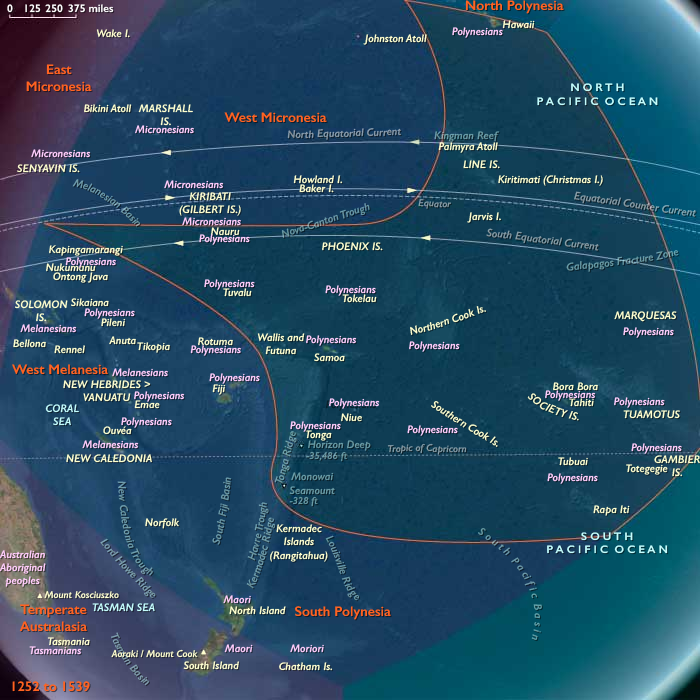
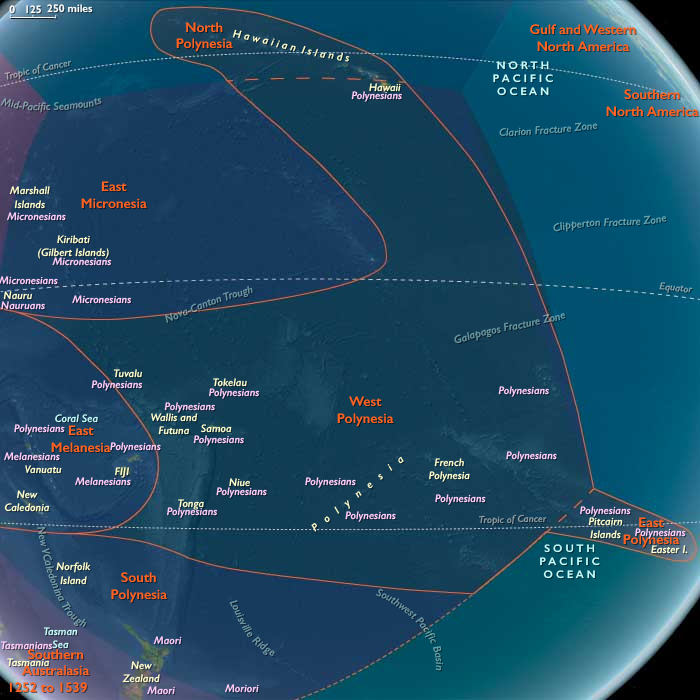
The subregion continued to encompass Hawaiʻi Island, the western archipelagos of Tonga and Samoa, the Cooks, Tuvalu and Tokelau, and the islands of French Polynesia. High islands supported increasingly differentiated windward, leeward, valley, upland, and coastal production zones. Atolls remained organized around lagoons, reef passages, freshwater depressions, and managed tree crops.
Environmental Continuity
Rainfall variability increased in parts of the Pacific toward the end of the period, while cyclones and droughts periodically damaged settlements and food systems. Communities responded by intensifying existing production rather than depending upon a single crop or environment. Wet valleys, dry slopes, orchards, fishponds, reefs, and offshore fisheries formed interdependent portfolios of resources.
Human Adaptation
The major transformation was the enlargement and coordination of engineered productive landscapes. Hawaiian communities expanded dryland field systems in leeward districts and constructed or improved irrigation works and coastal fishponds. Society and Cook Island valleys supported increasingly organized taro terraces and arboricultural zones. Marquesan populations intensified breadfruit production, dryland cultivation, and settlement within confined valleys.
In Tonga and Samoa, agricultural lands, lagoons, and reefs supported populous communities and large ceremonial redistributions. Atoll inhabitants maintained pulaka pits, freshwater lenses, coconut groves, and lagoon fisheries through detailed local knowledge and collective labor.
Economic Organization
Agricultural and marine surplus increasingly supported specialist crafts, chiefs, navigators, priests, and large gatherings. Fine mats, barkcloth, feathers, pearl shell, basalt tools, carved objects, cordage, and preserved foods moved within established exchange circuits. Chiefly redistribution remained more important than impersonal trade.
The Tongan maritime sphere continued to connect western islands through kinship and tribute, although its intensity varied. Samoa remained both a participant and an independent center of political and cultural influence. Society Island marae affiliations linked local chiefdoms, while the Cooks and neighboring islands occupied intermediate positions in several overlapping networks.
Institutions and Settlement
Chiefly institutions became more territorial. Authority increasingly depended on the organization of defined districts containing fields, groves, streams, fishponds, reefs, and settlements. On Hawaiʻi Island, aliʻi lineages mobilized labor across expanding agricultural systems and linked sacred status to control of land and water.
In the Society Islands, marae became more clearly associated with chiefly genealogies and alliances. Taputapuātea gained increasing importance within the Raʻiātea-centered sacred landscape, although its connections should be understood as historically changing rather than as a single permanent federation spanning all Polynesia.
Marquesan tohua and meʻae complexes structured valley ceremonies, feasting, and lineage competition. Samoan councils continued to distribute authority among villages, titles, and orator groups, while Tonga retained the strongest dynastic hierarchy in the subregion.
Belief and Knowledge
Sacred restrictions helped regulate planting cycles, harvests, fisheries, and access to chiefly or ritual spaces. Ceremonies converted food and labor into visible statements of rank, ancestry, and reciprocal obligation. Navigational knowledge continued to connect western and central archipelagos, but regular voyages between Hawaiʻi and the southern islands appear to have diminished.
Political Development
The principal new system was the territorial chiefdom: an authority increasingly grounded in the coordinated management of whole districts rather than chiefly precedence alone. This development was especially important on Hawaiʻi Island and in the high-island valleys of central Polynesia.
Tongan maritime influence remained substantial but did not produce a uniform political commonwealth. Samoan, Society Island, Cook Island, Marquesan, and Hawaiian chiefdoms followed increasingly distinct trajectories.
Legacy of the Age
By 1395 CE, West Polynesian political authority had become closely tied to engineered agricultural and aquatic landscapes. Chiefs could mobilize larger populations because fields, irrigation works, orchards, fishponds, and reefs generated dependable surpluses. These productive systems created the material basis for the larger territorial polities and intensified ritual institutions of the following centuries.
Images

West Polynesia in the Late Medieval (Lower) age
Groups
Commodities
Subjects
Regions
Polynesia
View →Subregions