West Polynesia (1396–1539 CE): Regional Differentiation and…
1396 CE to 1539 CE
West Polynesia (1396–1539 CE): Regional Differentiation and the Maturation of Island Political Systems
Geographic Parameters
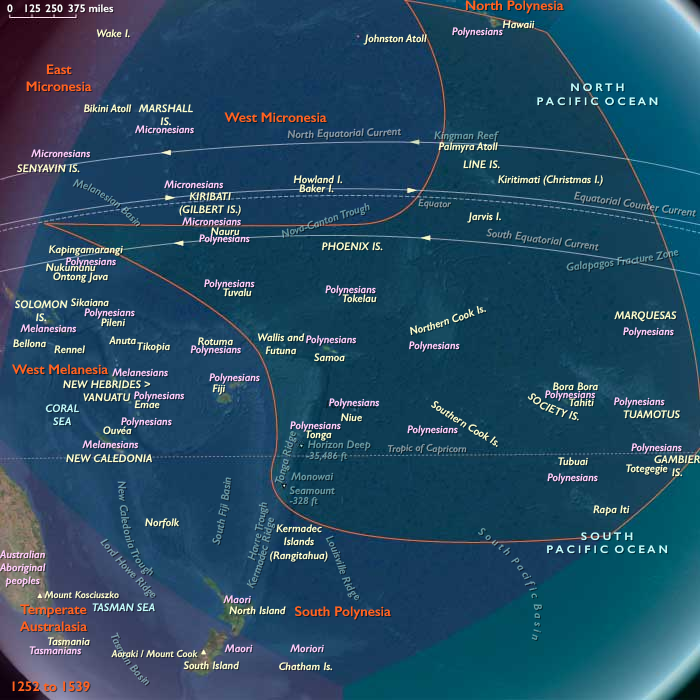
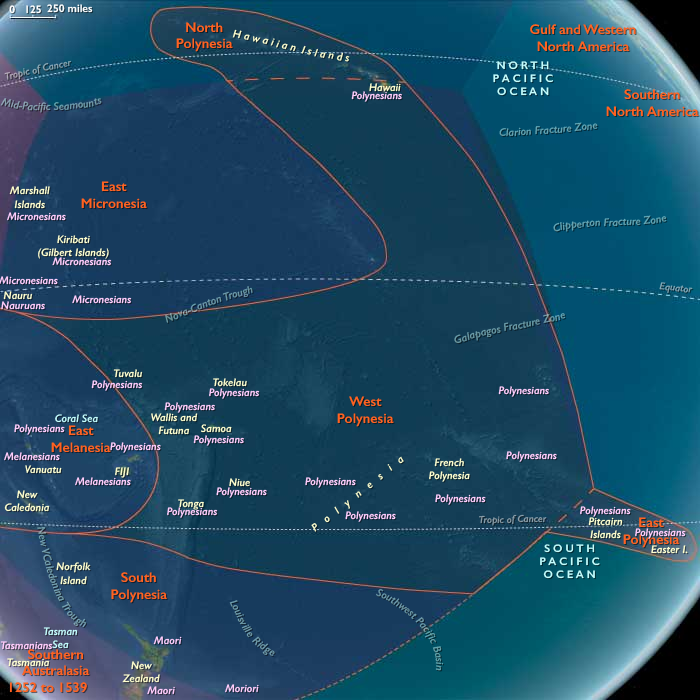
West Polynesia remained an oceanic constellation rather than a single political region. Tonga and Samoa maintained dense western connections; the Cook and Society Islands occupied central corridors; the Marquesas and Tuamotus developed around distinct valley and atoll environments; and Hawaiʻi Island increasingly belonged to a self-contained northern political system.
Environmental Continuity
Cyclones, droughts, rainfall variability, volcanic activity, and local resource depletion challenged communities unevenly. Intensified cultivation increased productivity but also required fallow management, erosion control, maintenance of irrigation works, and protection of tree crops. Forests remained extensive in uplands and less accessible valleys, while reefs and lagoons continued to provide essential ecological continuity.
Human Adaptation
Hawaiian dryland field systems expanded across portions of Kona and Kohala, while irrigated taro and coastal aquaculture supported other districts. In the Society Islands and Cooks, settlement became increasingly organized along valley floors and coastal plains. Marquesan communities developed dense breadfruit landscapes, terraces, household compounds, and ceremonial precincts in separate valleys.
Tonga and Samoa maintained productive mosaics of root crops, tree crops, lagoons, and offshore fishing. Atoll societies relied upon careful management of groundwater, pulaka pits, coconut, pandanus, and marine resources.
Economic Organization
Production was increasingly organized through district and lineage obligations. Chiefs gathered food, mats, barkcloth, feathers, pigs, fish, and labor for ceremonies, construction, warfare, and diplomacy. Craft specialists produced canoes, stone tools, carved objects, tattooing instruments, cordage, and ceremonial regalia.
Inter-island voyaging continued strongly within western and central regional corridors, but the Polynesian world was not uniformly integrated. Hawaiian long-distance connections with the south declined, and individual archipelagos developed increasingly distinct political, linguistic, and ceremonial traditions.
Institutions and Settlement
The principal transformation of the age was regional institutional differentiation. Tonga preserved a sacred dynasty while political and military functions became increasingly divided among multiple elite lines. Samoa refined its system of distributed titles, village councils, oratory, and ceremonial precedence. Society Island chiefdoms strengthened marae affiliations and competitive alliances. Marquesan valleys developed powerful local lineages centered on tohua and meʻae complexes.
On Hawaiʻi Island, territorial districts became more clearly ordered under competing aliʻi. Sacred sites, tribute obligations, agricultural labor, and military service connected households to ranked political structures. Ritual institutions became more elaborate, but they remained dependent on the cultivation and fisheries that sustained them.
Belief and Cultural Expression
Genealogical chants, dance, tattooing, kava ceremonies, barkcloth, featherwork, fine mats, carved images, and sacred architecture expressed increasingly distinctive regional identities. These traditions shared broad Polynesian foundations but developed local forms corresponding to different political and environmental histories.
Marae and heiau acted as centers of lineage memory, agricultural ritual, warfare, healing, and chiefly investiture. Sacred restrictions continued to regulate both social rank and access to particular resources.
Political Development
No single hegemonic system defined the whole subregion. The Tuʻi Tonga polity remained prestigious, but western authority was increasingly negotiated among Tongan and Samoan elites. Hawaiian, Society Island, Cook Island, and Marquesan chiefdoms grew more internally focused.
The age therefore represented maturation through differentiation rather than further pan-regional unification. Each archipelago adapted inherited Polynesian institutions to its own scale, ecology, and pattern of settlement.
Legacy of the Age
By 1539 CE, West Polynesia contained several mature and increasingly distinct political worlds. Tonga, Samoa, the Societies, Marquesas, Cooks, atolls, and Hawaiʻi Island shared deep cultural ancestry but no longer formed a single expanding interaction system. Their differentiated institutions would shape both later Indigenous political consolidation and their varied responses to foreign contact.
Images

West Polynesia in the Late Medieval (Upper) age
Groups
Commodities
Subjects
Regions
Polynesia
View →Subregions