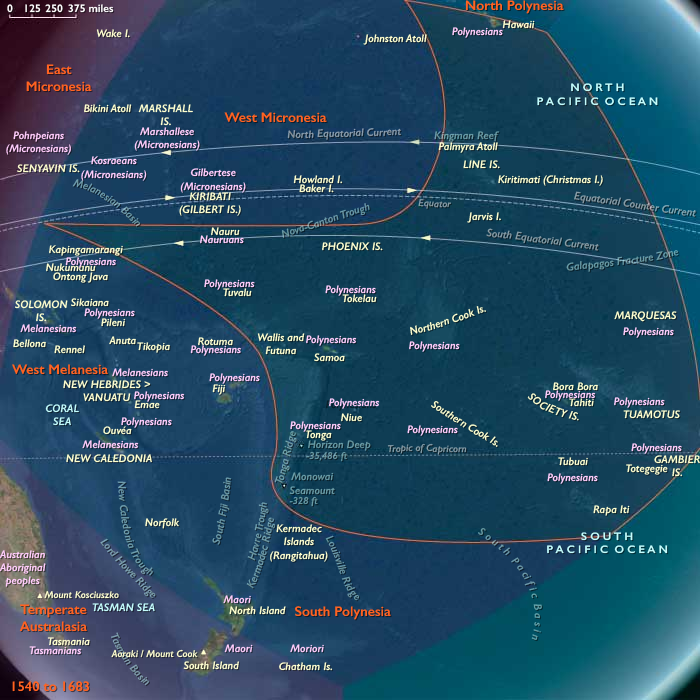
West Polynesia (1540–1683 CE): Political Intensification and…
1540 CE to 1683 CE
West Polynesia (1540–1683 CE): Political Intensification and the Culmination of Independent Island Systems
Geographic Parameters
The region continued to include high volcanic islands with extensive agricultural potential, raised islands and reef-fringed coasts, and low atolls with restricted freshwater and soil. Population, political authority, and productive infrastructure were most concentrated in favorable valleys, plains, sheltered lagoons, and leeward agricultural districts.
Environmental Continuity
Communities continued to face cyclones, droughts, volcanic hazards, landslides, and local shortages. Long-established systems of crop diversity, arboriculture, marine tenure, food preservation, and kin-based redistribution remained the principal means of resilience. Intensive production altered some coastal and lowland districts, but upland forests, rugged interiors, reefs, and open ocean continued to dominate the region’s physical character.
Human Adaptation
On Hawaiʻi Island, large dryland systems supported sweet potatoes, yams, gourds, and other crops across the Kona and Kohala slopes, while irrigated taro remained important in wetter districts. Coastal fishponds and managed fisheries supplemented agriculture. Communities became increasingly numerous and politically organized without forming continuous urban settlement.
Tahiti, Raʻiātea, Rarotonga, and other high islands supported irrigated valleys, breadfruit groves, mixed arboriculture, and coastal fisheries. Marquesan valleys contained dense but environmentally enclosed communities. Samoa and Tonga maintained combinations of taro, yam, breadfruit, coconut, pigs, reef fishing, and pelagic harvests. Tuvalu, Tokelau, and the Tuamotus continued to rely upon atoll-specific production and mobility.
Economic Organization
Chiefly economies reached their greatest independent scale. Surplus supported military retainers, priests, craftsmen, navigators, large ceremonies, and monumental construction. Redistribution through feasts and tribute tied households to political leaders but also transferred food after local failure.
Long-distance voyaging persisted strongly within Tonga, Samoa, Fiji, the Cooks, Societies, and neighboring island groups. Yet most economic life remained local or archipelagic. There was no single continuously operating exchange network spanning the full distance from Tonga to Hawaiʻi.
Institutions and Settlement
The principal new system was intensified competitive state formation. On Hawaiʻi Island, powerful chiefs sought to consolidate multiple districts, using warfare, marriage alliances, ritual authority, and control of productive land. Large heiau and chiefly centers expressed this growing power but remained distributed within agricultural and coastal landscapes.
In Tonga, sacred and secular chiefly functions continued to differentiate, while rival elite lines competed for authority. Samoa retained decentralized but highly structured systems of title, council, oratory, and alliance. In the Society Islands, competing chiefs expanded marae networks and mobilized followers through warfare, feasting, and sacred descent. Marquesan valleys remained politically fragmented but internally hierarchical.
Belief and Cultural Expression
Religious institutions became increasingly intertwined with political competition. Hawaiian worship associated major heiau with agriculture, healing, chiefly legitimacy, and warfare. Society Island marae supported the authority of powerful lineages and priestly specialists. Tongan and Samoan kava ceremonies ordered rank and diplomatic relationships, while Marquesan tattooing and ceremonial spaces expressed ancestry and social standing.
Sacred systems also regulated production. Seasonal restrictions, protected waters, ritual harvests, and the sanctity of particular forests or species linked political and ecological order.
Political Development
Political intensification did not produce regional unification. Instead, larger island polities competed within separate archipelagos. Hawaiʻi Island, Tahiti, Tonga, Samoa, the Cooks, and the Marquesas each generated distinctive balances of hierarchy, lineage, ritual authority, and warfare.
Foreign ships had not yet become a sustained force across most of the subregion. Political change remained overwhelmingly Indigenous, generated through internal demographic growth, agricultural intensification, inter-island rivalry, and institutional development.
Legacy of the Age
By 1683 CE, West Polynesian societies had reached the culmination of their independent political development. Their landscapes supported large populations, skilled specialists, powerful chiefs, and elaborate ritual systems. These societies were neither isolated nor politically static, but their interaction remained organized through Polynesian navigation, genealogy, exchange, and warfare rather than global commerce.
Images

West Polynesia in the Early Modern age
Groups
Commodities
Subjects
Regions
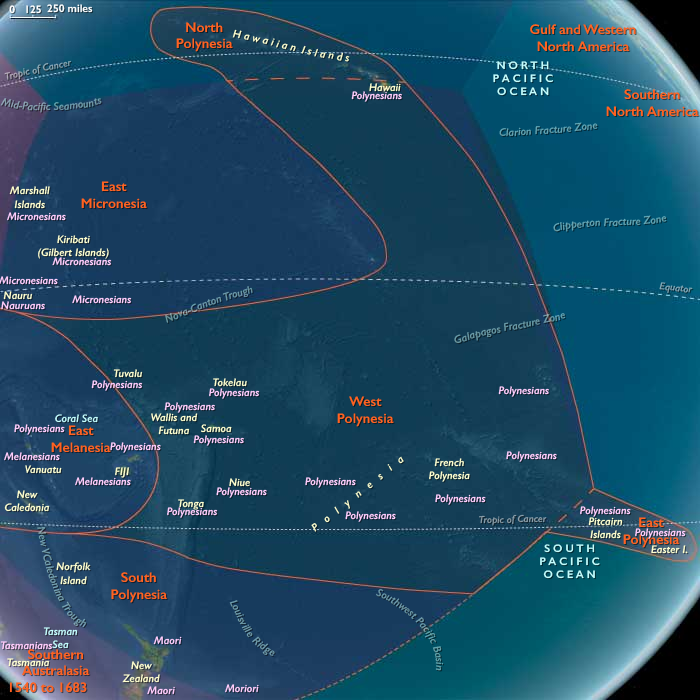
Polynesia
View →Subregions