Event
Western East Antarctica (49,293–28,558 BCE): Late Pleistocene…
Western East Antarctica (49,293–28,558 BCE): Late Pleistocene I — Continental Ice, Katabatic Coasts, and Shifting Shelf Margins
Geographic and Environmental Context
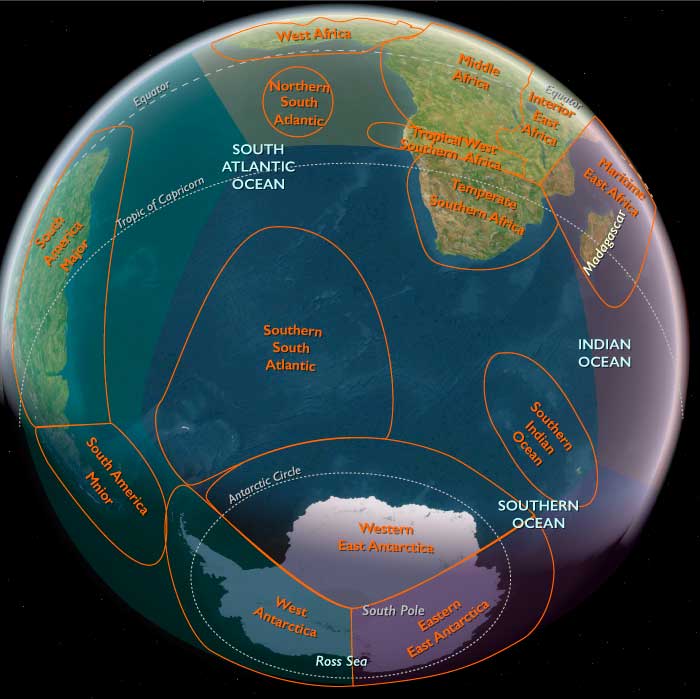
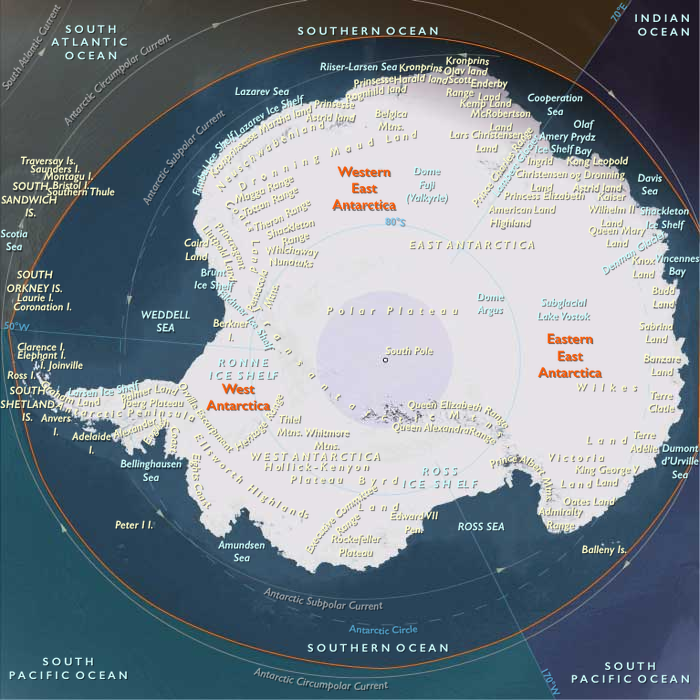
Western East Antarctica comprises the western sectors of the East Antarctic continental margin within the canonical HistoryAtlas division, facing the Atlantic and Indian Ocean sectors of the Southern Ocean.
The landscape was dominated by the immense East Antarctic Ice Sheet, outlet glaciers, nunataks, coastal mountain systems, ice shelves, and deeply incised continental-shelf troughs.
The high continental interior formed an enormous reservoir of ice, while the coast presented a much more fragmented environment of glacier outlets, rocky exposures, embayments, islands, shelf basins, and seasonally open marine water.
Exposed coastal rock and ice-free ground occurred unevenly along the margin. These limited surfaces formed important terrestrial refugia within a landscape otherwise overwhelmingly controlled by ice.
Climate and Environmental Shifts
Marine Isotope Stage 3 conditions were persistently cold but climatically unstable.
Interior ice remained immense, while individual outlet glaciers and coastal ice margins responded more sensitively to changing snowfall, temperature, sea level, wind, and ocean circulation.
Katabatic winds descended from the continental interior toward the coast, redistributing snow and exposing wind-scoured surfaces in some sectors. Sea-ice extent and the persistence of polynyas or seasonal open-water zones also changed through time.
The later maximum-glacial expansion must not be projected wholesale into this interval. Ice thickness, grounding-line position, glacier extent, and coastal exposure varied spatially, and some sectors remained less extensively glaciated than they would become later.
Western East Antarctica during MIS 3 was therefore deeply glacial but not fixed in one maximum configuration.
Human Presence
Western East Antarctica was entirely without humans during this interval.
No Pleistocene population reached the East Antarctic coast, its offshore islands, or the adjoining Southern Ocean margins.
There was no settlement, hunting, introduced fauna, deliberate burning, or other cultural modification of terrestrial or marine ecosystems.
The subregion’s history unfolded entirely through glacial, atmospheric, oceanic, geological, and biological processes.
Baseline Ecology
Terrestrial biological productivity was extremely limited and concentrated in exposed refugial surfaces.
Lichens, algae, microbial communities, and other cold-adapted organisms could persist on exposed rock, gravel, melt-season damp ground, and protected microhabitats where moisture and shelter permitted.
Offshore waters were much richer biologically.
Seasonal sea ice, polynyas, ocean fronts, and areas of open water supported phytoplankton and krill-based food webs that sustained fish, squid, seabirds, seals, whales, and other marine organisms.
The biological center of the region therefore lay along the coast and offshore rather than on the continental interior.
Landscape Dynamics
Glaciers transported debris from the continent toward the coast, carving valleys and shelf troughs and depositing sediment along glacier margins and offshore basins.
Fast-flowing outlet glaciers moved ice through coastal mountain systems toward floating tongues and ice shelves. Grounding lines shifted as glacier thickness, sea level, and ocean conditions changed.
Wind and freeze–thaw processes altered exposed rock, while meltwater and seasonal thaw affected the small areas where liquid water became available.
Icebergs carried continental debris into the Southern Ocean, and marine currents redistributed sediment along the continental margin.
The resulting landscape was an interconnected glacial–oceanic system whose boundaries repeatedly shifted through the eon.
Movement and Connectivity
Connectivity was entirely physical and biological.
Ice flowed from the high East Antarctic interior toward the coast through outlet-glacier systems. Sediment moved with glaciers, meltwater, icebergs, wind, and marine currents.
Katabatic winds linked plateau and coast atmospherically, transporting snow, dust, and salt across exposed surfaces.
The Southern Ocean connected otherwise isolated coastal sectors through currents, seasonal sea ice, and migrating marine life.
Seabirds and marine mammals moved between feeding grounds, breeding areas, polynyas, and more distant subantarctic environments.
Western East Antarctica therefore functioned as part of a much larger Southern Ocean system even though its terrestrial habitats remained highly fragmented.
Environmental Adaptation and Resilience
Life survived through extreme specialization, refugial persistence, and repeated recolonization.
Terrestrial organisms persisted in small ice-free microhabitats protected from the severest conditions. When glaciers advanced or snow cover increased, these habitats contracted; when ice withdrew, newly exposed surfaces could gradually be recolonized.
Marine species responded to changing sea-ice margins and open-water availability by shifting feeding and breeding ranges.
Seabirds and seals moved among suitable coastal and ice-edge habitats as local conditions changed.
Resilience depended not on broad terrestrial continuity but on scattered refugia, dispersal, and the much greater ecological continuity of the surrounding sea.
Transition
By 28,558 BCE, Western East Antarctica remained an ice-dominated but dynamic landscape.
The continental interior still supported the immense East Antarctic Ice Sheet, while coastal outlet glaciers, grounding lines, ice shelves, exposed rock, and sea-ice margins continued to vary from sector to sector.
The colder millennia that followed would enlarge ice in many areas, but the later maximum configuration had not yet been reached uniformly.
At the close of Late Pleistocene I, Western East Antarctica was therefore a world of continental ice, katabatic winds, shifting glacier margins, exposed refugial ground, and productive Southern Ocean waters—entirely nonhuman and governed by the continual interaction of ice, atmosphere, rock, and sea.

-
{# Image navigates to the detail page; the magnifying-glass chip is the only Fancybox lightbox trigger (kept a separate sibling — anchors can't nest). #}
 The African South
World
-
{# Image navigates to the detail page; the magnifying-glass chip is the only Fancybox lightbox trigger (kept a separate sibling — anchors can't nest). #}
 Antarctica
Region
-
{# Image navigates to the detail page; the magnifying-glass chip is the only Fancybox lightbox trigger (kept a separate sibling — anchors can't nest). #}
 Western East Antarctica
Subregion