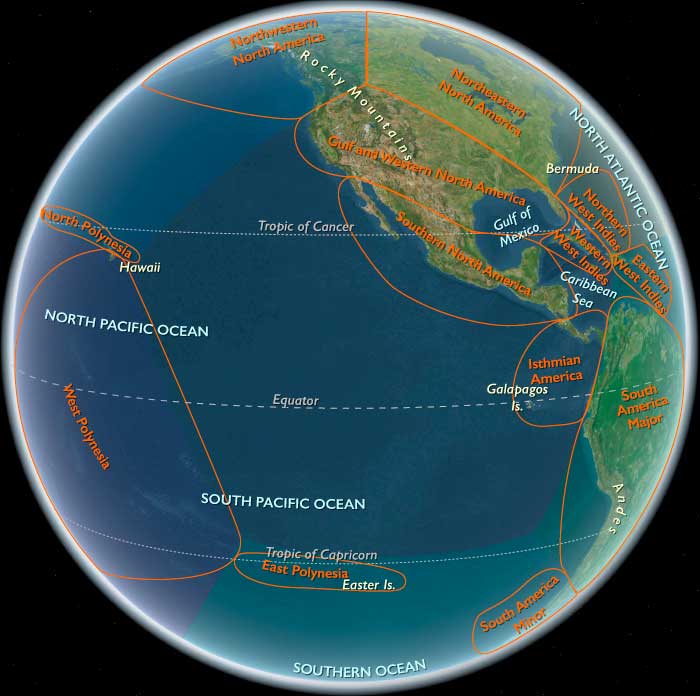
Event
Western West Indies (1828–1971 CE): Emancipation, Export…
Western West Indies (1828–1971 CE): Emancipation, Export Infrastructure, and Political Transformation
Geographic and Environmental Context
The nineteenth and twentieth centuries brought railways, enlarged ports, industrial mills, roads, cities, plantations, small farms, and migration networks into landscapes still strongly shaped by mountains, reefs, hurricanes, and limited cultivable land.
Societies and Political Development
Slavery ended in the British territories during the 1830s. The Cayman Islands had an established slaveholding society by the early nineteenth century, and archival records document both the 1802 population and compensation associated with emancipation.
Jamaican emancipation produced major changes in labor and landholding. Formerly enslaved people expanded independent villages and provision grounds even as plantations continued.
Cuba retained slavery until 1886. Sugar expanded dramatically through railway construction, steam-powered processing, and large centralized mills. After emancipation, the industry reorganized around wage labor, tenant cane growers, and increasingly concentrated centrales.
Cuban wars for independence culminated in the Spanish-American War and formal independence in 1902.
Haiti remained independent, with rural smallholding and coffee production sustaining much of the population despite political conflict and foreign pressure. U.S. occupation from 1915 to 1934 introduced new road, administrative, and labor systems without erasing peasant landholding.
Jamaica achieved independence in 1962. Cuba’s revolution of 1959 reorganized property, agriculture, industry, and foreign relations. The Caymans became a separate British dependency after Jamaican independence. The Bahamas moved toward majority rule and eventual independence.
Productive Landscape and Economy
Cuban cane and tobacco, Jamaican cane and bananas, Haitian coffee and household food production, Bahamian fisheries and maritime commerce, and Cayman seafaring persisted alongside urban growth.
Railways linked Cuban cane fields to centrales and ports and connected Jamaican agricultural districts with Kingston and other export centers.
Movement and Interaction Corridors
Steamships, railways, improved harbors, roads, and eventually aviation transformed movement.
Migration carried Jamaicans and other islanders to Panama, Cuba, Central America, Britain, and the United States. Cayman sailors worked throughout the Caribbean and beyond.
Technology and Material Culture
Steam mills, railway locomotives, telegraph systems, automobiles, electric utilities, concrete construction, refrigeration, mechanized port equipment, and aircraft gradually entered the subregion.
Religion and Cultural Expression
Afro-Caribbean cultural forms remained deeply rooted. Cuban son and rumba, Jamaican mento and later ska and reggae, Haitian religious and artistic traditions, Bahamian Junkanoo, and Cayman maritime crafts developed within increasingly urban and internationally connected societies.
Adaptation and Resilience
Smallholder farming, provision grounds, migration, remittances, informal markets, and flexible maritime labor helped households survive unstable commodity markets and hurricane losses.
Legacy of the Age
By 1971 CE, plantation slavery had disappeared but its landscapes remained visible. Railways, mills, ports, cities, independent smallholders, export farming, migration, and new national political systems had produced a deeply layered modern Caribbean.

-
{# Image navigates to the detail page; the magnifying-glass chip is the only Fancybox lightbox trigger (kept a separate sibling — anchors can't nest). #}
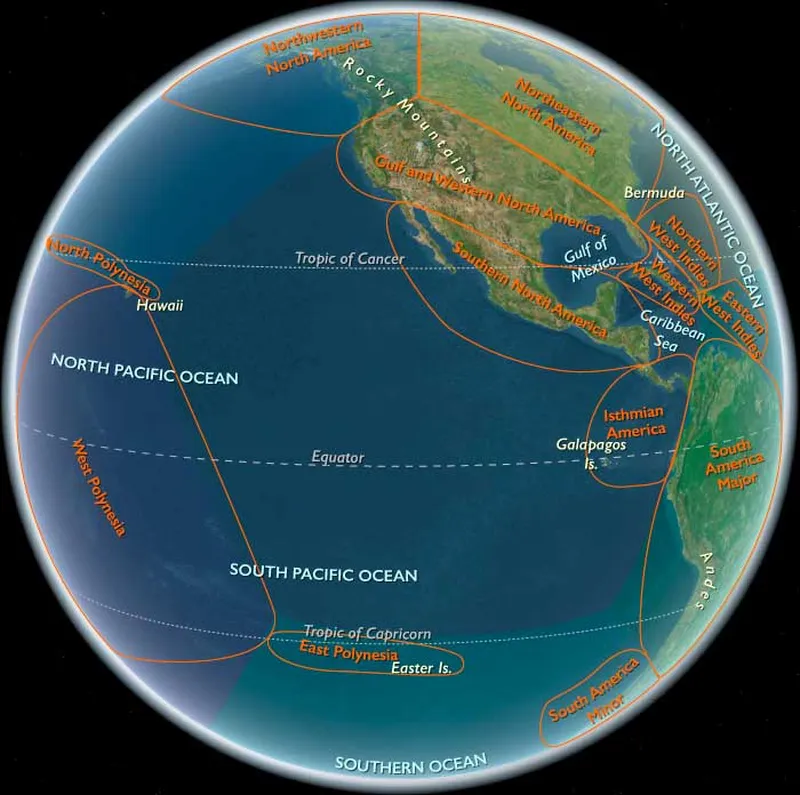 The Far West
World
The Far West
World
-
{# Image navigates to the detail page; the magnifying-glass chip is the only Fancybox lightbox trigger (kept a separate sibling — anchors can't nest). #}
 West Indies
Region
West Indies
Region
-
{# Image navigates to the detail page; the magnifying-glass chip is the only Fancybox lightbox trigger (kept a separate sibling — anchors can't nest). #}
 Western West Indies
Subregion
Western West Indies
Subregion