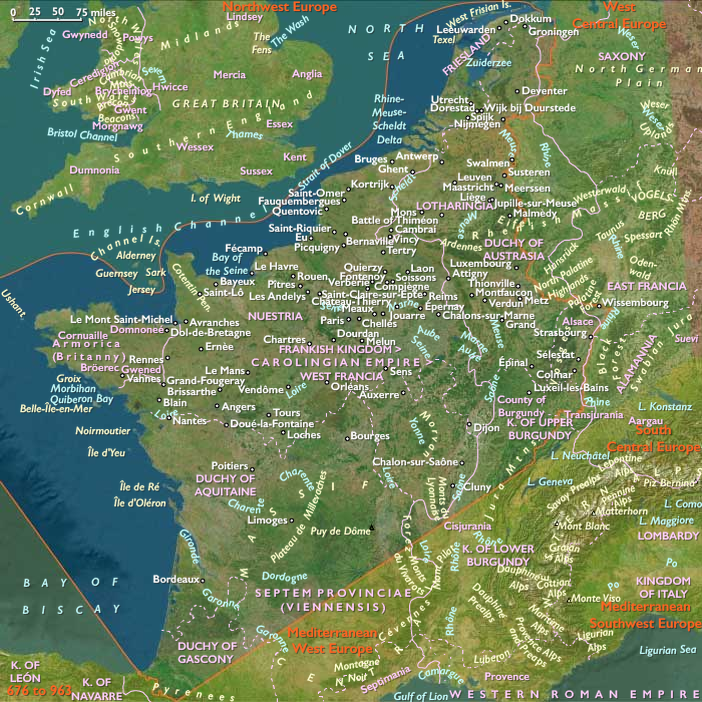
William Longsword’s Marriages and Political Alliances (935–936)…
936 CE
William Longsword’s Marriages and Political Alliances (935–936)
By the mid-930s, William Longsword, Duke of Normandy, consolidates his political influence through two strategic marriages—one arranged for his sister Adela (Gerloc) and another for himself. These marriages strengthen his ties with the powerful nobles of West Francia, marking a shift in Norman diplomacy.
1. The Marriage of Adela (Gerloc) to William III of Poitou (935)
- In 935, William arranges a marriage between his sister, Adela (Gerloc in Norse tradition), and William III, Count of Poitou.
- The marriage is approved by Hugh the Great, Duke of the Franks, indicating William’s growing integration into West Frankish noble politics.
- This alliance links Normandy with Poitou, strengthening William’s relations with southern Francia and enhancing Normandy’s political reach beyond the Seine Valley.
2. William’s Own Marriage to Luitgarde of Vermandois (936)
- In 936, William marries Luitgarde, daughter of Herbert II, Count of Vermandois, one of the most powerful nobles in West Francia.
- Her dowry includes the lands of Longueville, Coudres, and Illiers-l’Évêque, expanding William’s territorial control into the heart of Francia.
- By marrying into the House of Vermandois, William cements an alliance with one of the most influential noble families in the kingdom.
3. A Shift in Loyalty: From Opposition to Alliance
- Unlike his father Rollo, who had opposed Herbert II of Vermandois and King Rudolph, William aligns himself with them.
- William now supports King Rudolph (Raoul) of Burgundy, whereas Rollo had once been loyal to Charles the Simple.
- His new alliance with Herbert II of Vermandois shows a pragmatic shift in Norman politics, as William seeks to strengthen his position within West Francia.
Impact of William’s Political Marriages
-
Integration of Normandy into Frankish Feudal Politics
- These alliances bring Normandy further into the West Frankish noble network, strengthening William’s political legitimacy.
-
Expansion of Norman Influence
- The marriage to Luitgarde of Vermandois gives William lands beyond Normandy, increasing his control over strategic regions.
-
Realignment of Norman Loyalties
- Unlike Rollo, who had opposed Herbert II and King Rudolph, William now supports them, adapting to new political realities in Francia.
Conclusion: William Longsword’s Shift Toward Feudal Nobility
Through these marriages and shifting alliances, William Longsword positions Normandy as an integrated part of West Frankish politics, ensuring continued Norman stability and influence. His ties to powerful noble families, particularly through Vermandois and Poitou, lay the groundwork for Normandy’s future rise as a major feudal power in France.
Locations
People
Groups
Commodities
Subjects
Regions
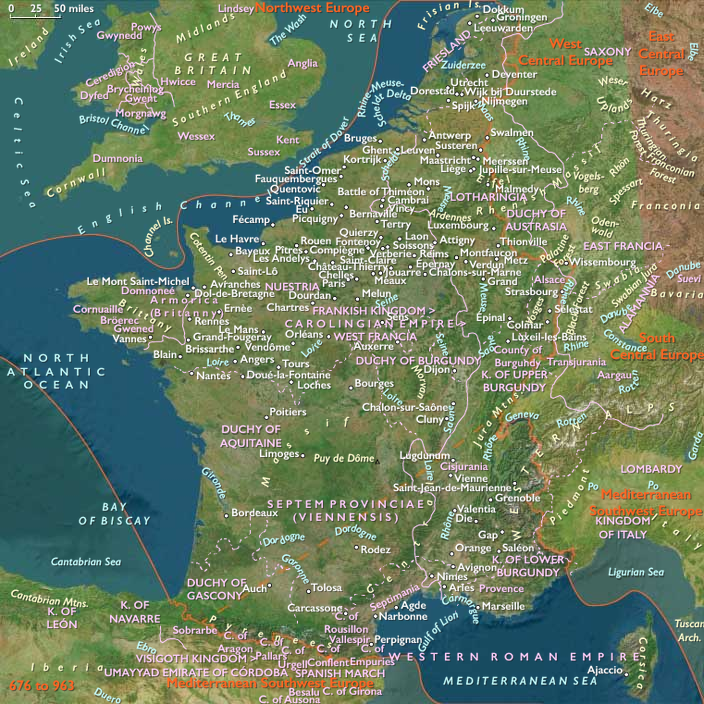
West Europe
View →Subregions