
Zwingli gives his first sermon in Zurich…
1519 CE
Zwingli gives his first sermon in Zurich on January 1, 1519.
Deviating from the prevalent practice of basing a sermon on the Gospel lesson of a particular Sunday, Zwingli, using Erasmus' New Testament as a guide, begins to read through the Gospel of Matthew, giving his interpretation during the sermon, known as the method of lectio continua.
He continues to read and interpret the book on subsequent Sundays until he reaches the end, hen proceeds in the same manner with the Acts of the Apostles, the New Testament epistles, and finally the Old Testament.
His motives for doing this are not clear, but in his sermons he uses exhortation to achieve moral and ecclesiastical improvement which are goals comparable with Erasmian reform.
Zwingli's theological stance is gradually revealed through his sermons.
He attacks moral corruption and in the process he names individuals who are the targets of his denunciations.
Monks are accused of indolence and high living.
In 1519, Zwingli specifically rejects the veneration of saints and calls for the need to distinguish between their true and fictional accounts.
He casts doubts on hellfire, asserts that unbaptized children are not damned, and questions the power of excommunication.
His attack on the claim that tithing is a divine institution, however, has the greatest theological and social impact.
This contradictsthe immediate economic interests of the foundation.
One of the elderly canons who had supported Zwingli's election, Konrad Hofmann, complains about his sermons in a letter.
Some canons support Hofmann, but the opposition never grows very large.
Zwingli insists that he is not an innovator and that the sole basis of his teachings is Scripture.
Within the diocese of Constance, Bernhardin Sanson is offering a special indulgence for contributors to the building of St Peter's in Rome.
When Sanson arrives at the gates of Zurich at the end of January 1519, parishioners prompt Zwingli with questions.
He responds with displeasure that the people are not being properly informed about the conditions of the indulgence and are being induced to part with their money on false pretenses.
This is over a year after Martin Luther published his Ninety-five Theses on October 31, 1517.
The council of Zurich refuses Sanson entry into the city.
As the authorities in Rome are anxious to contain the fire started by Luther, the Bishop of Constance denies any support of Sanson and he is recalled.
Zurich is struck in August 1519 by an outbreak of the plague during which at least one in four persons die.
All of those who could afford it had left the city, but Zwingli remained and continued his pastoral duties.
In September, he caught the disease and nearly died.
He described his preparation for death in a poem, Zwingli's Pestlied, consisting of three parts: the onset of the illness, the closeness to death, and the joy of recovery.
Locations
Groups
Regions
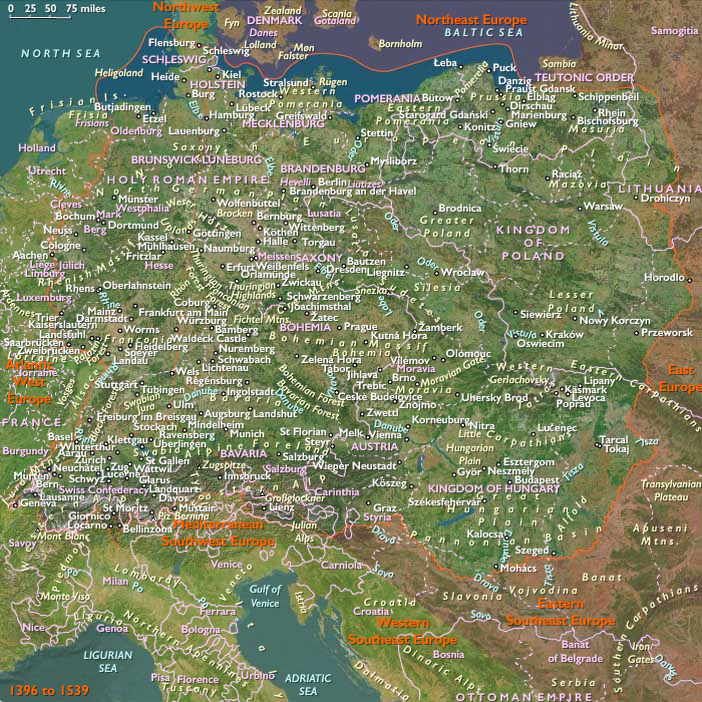
Central Europe
View →Subregions
