
Zwingli's opponents remain in the minority in…
January 1521 CE
Zwingli's opponents remain in the minority in the years following his recovery from the plague.
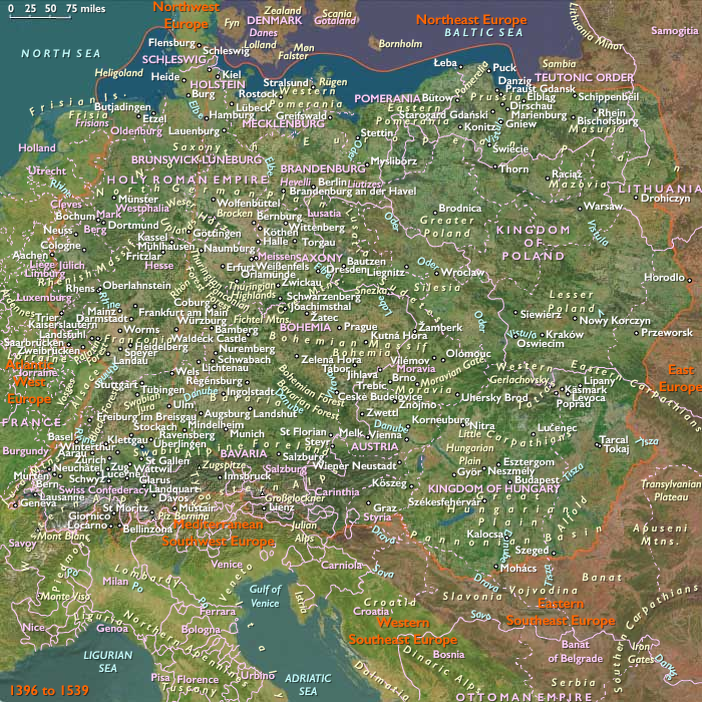
When a vacancy occurrsamong the canons of the Grossmünster, Zwingli is elected to fulfill this vacancy on April 29, 1521.
In becoming a canon, he becomes a full citizen of Zurich.
He also retains his post as the people's priest of the Grossmünster.
Sometime after 1520, Zwingli's theological model begins to evolve into an idiosyncratic form that is neither Erasmian nor Lutheran.
Scholars do not agree on the process of how he developed his own unique model.
One view is that Zwingli was trained as an Erasmian humanist and Luther played a decisive role in changing his theology.
Another view is that Zwingli did not pay much attention to Luther's theology and in fact he considered it as part of the humanist reform movement.
A third view is that Zwingli was not a complete follower of Erasmus, but had diverged from him as early as 1516 and that he independently developed his theology.
Locations
Groups
Regions
Central Europe
View →Subregions
