
Poland, Republic of
Substate | Defunct
1946 CE to 1952 CE
Worlds
The Great Crossroads
View →Related Events
Showing 8 events out of 8 total
North Europe (1828–1971 CE)
Industrial Transformation, Welfare States, and the Balance Between Tradition and Modernity
Geography & Environmental Context
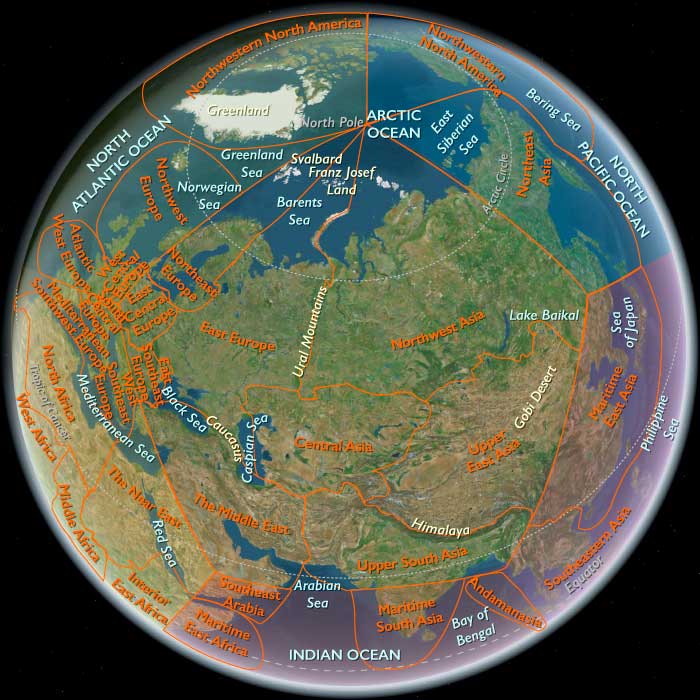
North Europe includes two fixed subregions:
-
Northeast Europe — Sweden, Finland, Lithuania, Latvia, Estonia, eastern Denmark, eastern Norway, and the Russian enclave of Kaliningrad.
-
Northwest Europe — Iceland, Ireland, the United Kingdom, western Norway, and western Denmark.
Anchors include the Baltic Sea, North Sea, and Norwegian Sea, the Scandinavian Mountains, and the North Atlantic islands. Major urban and cultural centers included Stockholm, Helsinki, Copenhagen, Oslo, Reykjavík, Dublin, Belfast, Edinburgh, Glasgow, and London. The subregion’s mix of fjords, forests, and fertile lowlands underpinned both agrarian heritage and maritime expansion.
Climate & Environmental Shifts
A temperate to subarctic climate defined the region. The 19th century brought short agricultural seasons and heavy reliance on fisheries and forestry. Industrial coal use caused early urban pollution in British and Scandinavian cities. The 20th century’s warming trend moderated winters, improving crop yields and extending growing zones in Scandinavia. Hydroelectric dams in Norway, Sweden, and Finland harnessed mountain rivers, while coastal engineering in the Netherlands and Denmark mitigated storm surges.
Subsistence & Settlement
-
Agrarian modernization: Land reforms and cooperative movements in Denmark, Sweden, and Finland raised productivity; dairy and timber industries grew.
-
Industrialization: Britain’s early Industrial Revolution spread to Scandinavia and the Baltics, with shipbuilding, textiles, steel, and engineering as core sectors.
-
Urbanization: By the early 20th century, London, Manchester, and Glasgow ranked among the world’s largest industrial cities; Stockholm, Copenhagen, and Oslo modernized with public housing and electrified transport.
-
Postwar economies: Reconstruction and social-democratic planning in the Nordic countries created prosperous welfare states; Britain transitioned from empire to post-industrial society.
-
Migration: Rural exodus to cities accelerated; Irish emigration to North America and Britain persisted; Baltic populations endured wartime deportations and Soviet resettlements.
Technology & Material Culture
Coal-fired industry, railways, and steam navigation defined the 19th century. British engineers exported rail technology worldwide. The 20th century saw electrification, radio, aviation, and shipbuilding innovation. Architecture evolved from Gothic revival and neoclassicism to functionalism and modernism—exemplified by Stockholm City Hall (1923)and London’s postwar reconstruction. Nordic design—Alvar Aalto, Arne Jacobsen—became globally influential for its simplicity and craftsmanship.
Movement & Interaction Corridors
-
Maritime trade: The North Sea and Baltic remained major arteries linking Britain, Scandinavia, and continental Europe. Liverpool, London, Bergen, and Copenhagen were vital Atlantic ports.
-
Rail and telegraph networks: Integrated interior trade by the 1870s; air corridors in the 20th century linked northern capitals to the world.
-
Colonial and global circuits: Britain’s imperial shipping routes spanned all oceans; Norwegian and Icelandic seafarers joined global fleets.
-
Wartime and Cold War lines: The region formed the northern flank of both world wars and later the NATO–Warsaw Pact divide.
Cultural & Symbolic Expressions
-
Romantic nationalism: Writers and artists—Hans Christian Andersen, Henrik Ibsen, Edvard Grieg, Akseli Gallen-Kallela—revived folklore and national epics.
-
Industrial and imperial culture: Britain’s Victorian Age merged empire, science, and literature—Charles Dickens, George Eliot, Alfred Tennyson, Charles Darwin reflected industrial modernity.
-
20th-century innovation: Modernist movements in design, architecture, and literature flourished in the Nordic world; British and Irish literature—from W. B. Yeats, James Joyce, and Virginia Woolf to Samuel Beckett—reshaped global modernism.
-
Religion and society: Protestantism remained dominant in Scandinavia and Britain; secularism and ecumenism grew by mid-century. Music—from Edward Elgar to Jean Sibelius—bridged nationalism and cosmopolitanism.
Environmental Adaptation & Resilience
Nordic societies pioneered cooperative forestry and sustainable fisheries. Hydroelectric and geothermal power (Iceland) reduced reliance on imported fuel. Welfare-state planning integrated housing, health, and environmental standards. Coastal flood control (e.g., the Delta Plan, Netherlands; Thyborøn Barrier, Denmark) and Arctic research expanded environmental awareness by the 1960s.
Political & Military Shocks
-
Reform and union changes: The Reform Acts in Britain broadened suffrage; Norway’s independence from Sweden (1905) redefined Nordic diplomacy.
-
World War I: Britain, Ireland, and the Nordic countries were affected by blockade and neutrality tensions; Ireland’s Easter Rising (1916) marked the drive for independence.
-
Interwar transformations: Ireland became a Free State (1922); Finland and the Baltics gained independence after the Russian Revolution.
-
World War II: Britain endured the Blitz; Norway and Denmark were occupied by Germany; Finland fought the USSR; Sweden remained neutral; Iceland hosted Allied bases.
-
Postwar reconstruction: Britain dismantled its empire; Scandinavia developed social democracy; Finland balanced between East and West.
-
Cold War alignments: Norway, Denmark, and Britain joined NATO (1949); Sweden and Finland remained neutral; the Baltics were annexed by the USSR.
Transition
Between 1828 and 1971, North Europe evolved from an industrial and maritime heartland of empire into a zone of social democracy, neutrality, and cultural innovation. Britain’s industrial dominance yielded to Nordic welfare models; Ireland and Finland secured independence; the Baltics lost theirs under Soviet rule. War, reconstruction, and integration produced some of the world’s highest living standards. By 1971, North Europe stood as both a bastion of stability and a frontier of modern design, environmental consciousness, and egalitarian governance—its fjords, harbors, and forests emblematic of resilience in a turbulent century.
Northeast Europe (1828–1971 CE): Nordic Neutralities, Baltic Nationhood, and a Sea of Corridors
Geography & Environmental Context
Northeast Europe includes Sweden, Finland, Lithuania, Latvia, Estonia, the Russian enclave of Kaliningrad, and eastern Denmark and eastern Norway (including Copenhagen and Oslo). Anchors span the Baltic Sea littoral—Stockholm’s skerries, the Åland and Estonian archipelagos, the Gulf of Finland and Bothnia, and the Vistula Lagoon/Kaliningrad—together with lake-and-forest interiors (Sweden’s Småland–Norrland, Finland’s Lakeland). Capitals Stockholm, Helsinki, Tallinn, Riga, Vilnius, Copenhagen, and Oslo formed a dense ring of maritime nodes.
Climate & Environmental Shifts
A cool temperate regime brought long winters and short, capricious summers. Crop crises struck periodically—the Finnish Great Famine (1866–68) was the worst—while forest and storm-fell events shaped upland livelihoods. Hydropowerable rivers in Sweden, Finland, and Norway enabled 20th-century electrification. By the late 1960s, Baltic eutrophication and industrial pollution emerged as regional stresses, even as afforestation and wildlife protections expanded.
Subsistence & Settlement
-
19th century countryside: Mixed farms (rye, oats, barley, potatoes) with dairy and forestry incomes; fishing (herring, Baltic cod) fed coasts.
-
Timber & tar to pulp & paper: Sweden and Finland shifted from sawn timber and tar exports to pulp, paper, and engineered wood, spawning mill towns along rivers.
-
Urbanization: Ports and capitals boomed—Stockholm, Helsinki, Copenhagen, Oslo—alongside Baltic hubs Tallinn, Riga, Vilnius; interwar conurbations spread around shipyards and rail junctions. Post-1945, new suburbs and modernist estates housed industrial workforces.
Technology & Material Culture
Railways bound forests to ports; icebreakers kept winter trade moving. Engineering clusters emerged: shipyards in Turku and Helsinki, Swedish steel and machine tools, optics and telecoms, and later vehicle and aircraft industries. Hydropower stations, district heating, and cooperative dairies transformed everyday life; by the 1960s, cars, radios, and televisions were commonplace from Stockholm to Tallinn.
Movement & Interaction Corridors
-
Baltic Sea highways: Ferries and freighters knit Stockholm–Turku–Helsinki, Tallinn–Riga–Klaipėda, and Copenhagen–Malmö; the Øresund remained the gate to the North Sea.
-
Resource flows: Ore and timber moved to Baltic smelters and mills; dairy and fish to urban markets.
-
War and peace lines: In WWII, sea lanes became battle zones; after 1945, NATO (Denmark, Norway), neutral Sweden, and Finland’s treaty constraints created tightly managed but busy frontiers with the Soviet sphere including the annexed Baltic republics.
Cultural & Symbolic Expressions
-
National awakenings: Kalevala publication (1835) in Finland; Song Festivals in Estonia and Latvia; Lithuania’s clandestine press during the press ban (1864–1904) and the knygnešiai (book-smugglers) forged modern identities.
-
Golden ages & modernisms: Sibelius and Nielsen in music; Strindberg, Hamsun, and Sillanpää in letters; Munch (Oslo) and Nordic functionalist architecture; Baltic avant-gardes in interwar Riga, Tallinn, and Kaunas.
-
Welfare imaginaries: Lutheran people’s movements and cooperative traditions fed into 20th-century Nordic welfare models, shaping education, health, and housing.
Environmental Adaptation & Resilience
-
Forestry regimes: Scientific silviculture, replanting, and state forests balanced sawmill demand; log-driving gave way to rail and truck transport.
-
Agrarian modernization: Land consolidation, dairying co-ops, and sugar-beet belts stabilized farm incomes; state grain stores buffered lean years.
-
Cold adaptation: Ice roads, heated district systems, and winterized housing normalized life at high latitudes.
Political & Military Shocks
-
1848–1905 reform wave: Constitutional and social reforms expanded suffrage (notably early in the Nordics) and strengthened parliaments.
-
Independence of the Baltic states (1918): Estonia, Latvia, Lithuania emerged from WWI; interwar authoritarian turns (Ulmanis, Smetona) followed economic shocks.
-
Winter War & Continuation War (1939–44): Finland fought the USSR, ceded Karelia, and resettled evacuees while retaining sovereignty.
-
Baltic occupations (1940, 1944): The three Baltic states were annexed by the USSR; deportations (1941, 1949)and Sovietization transformed society.
-
Denmark & Norway (1940–45): German occupation; resistance, sabotage, and postwar NATO alignment (1949). Sweden remained neutral, a humanitarian and industrial hub.
-
Cold War settlement: Finland’s YYA Treaty (1948) balanced Western trade with Soviet security demands; Nordic Council (1952) deepened regional cooperation; North Sea oil discovery (1969) began to reorient Norway’s economy.
Transition
Between 1828 and 1971, Northeast Europe traveled from rural timber and tar economies through industrialization, welfare-state construction, and Cold War partition. Sweden and the Nordic capitals built neutral or Western-aligned prosperity on forestry, hydropower, and engineering; Finland navigated survival between blocs; the Baltic states experienced independence, then Soviet annexation and profound coercion. By 1971, ferries, cables, and welfare institutions ringed the Baltic, even as an ideological frontier cut across its waters—setting the stage for détente, environmental cleanup, and, decades later, renewed Baltic sovereignty.
Central Europe (1828–1971 CE)
Revolutions, Empires’ Collapse, and Divided Modernities
Geography & Environmental Context
Central Europe includes three subregions:
-
East Central Europe — Germany east of 10°E, Czechia (Bohemia and Moravia), Slovakia, Poland, and Hungary.
-
West Central Europe — Germany west of 10°E, the Rhine-adjacent far northwest of Switzerland (Basel region), and parts of Luxembourg.
-
South Central Europe — western and southern Austria (except Salzburg), Liechtenstein, extreme southwestern Germany, and southeastern Switzerland, including Geneva and Zurich.
Anchors include the Rhine, Danube, and Elbe river systems; the Bohemian Massif, Alps, and Carpathian foothills; and the major cities of Berlin, Vienna, Munich, Warsaw, Budapest, Prague, Zurich, and Basel. The region’s continental climate favored cereals, vineyards, and industry, while its rivers and mountain passes made it Europe’s political and commercial hinge.
Climate & Environmental Shifts
Central Europe’s temperate climate supported intensive agriculture but was prone to seasonal floods and cold winters. Deforestation for coal and iron production expanded through the 19th century, giving way to reforestation and hydropower projects in the 20th. Industrial pollution grew around the Ruhr, Upper Silesia, and Vienna basins. After 1945, massive reconstruction and dam building (e.g., on the Danube and Rhine) reshaped river systems.
Subsistence & Settlement
-
Agrarian reform and industrialization: The 19th century brought enclosure of communal lands, railway expansion, and industrial zones in Saxony, Silesia, and Bohemia. Peasants became factory laborers; textile, iron, and machinery industries transformed cities like Lodz, Prague, and Leipzig.
-
Urban growth: Capitals such as Berlin, Vienna, and Budapest became imperial metropolises, centers of administration, culture, and intellectual life.
-
Postwar economies: After 1945, reconstruction divided trajectories: Western Germany and Switzerland pursued market economies, while Eastern bloc states collectivized agriculture and nationalized industries.
-
Migration: Millions of ethnic Germans, Poles, and Hungarians were displaced by wars and redrawn borders, particularly after World War II.
Technology & Material Culture
-
19th century innovations: Railways (Berlin–Vienna, Leipzig–Prague), telegraphs, and mechanized mills spread industrial modernity. Steelworks in Silesia and the Ruhr and engineering in Zurich and Vienna marked technological leadership.
-
20th century transformation: Electrification, automobiles (Volkswagen, Skoda), and modern architecture (Bauhaus, Werkbund) reshaped landscapes. Socialist-era prefabricated housing and Western modernist reconstruction reflected competing visions of progress.
-
Cultural industries: Printing, publishing, and music (Beethoven, Brahms, Dvořák, Liszt) gave the region global cultural authority that persisted into modern cinema and design.
Movement & Interaction Corridors
-
River routes: The Rhine–Danube corridor remained Europe’s main commercial artery.
-
Rail and road networks: Linked industrial centers to North Sea ports and Balkan markets.
-
Migration corridors: Seasonal labor moved from Poland and Galicia to Germany and Austria; postwar emigration carried intellectuals and refugees westward.
-
Air and Cold War lines: By mid-20th century, the Iron Curtain cut traditional corridors, dividing East Central Europe from West Germany, Austria, and Switzerland.
Cultural & Symbolic Expressions
Central Europe’s identity blended Enlightenment cosmopolitanism, nationalism, and later ideological rivalry.
-
Romantic nationalism: Poets and composers celebrated folk culture—Chopin, Smetana, Petőfi, Heine—fueling independence movements.
-
Modernism: The early 20th century produced Klimt, Kafka, Freud, and Schoenberg, whose works redefined art and thought.
-
Religious and philosophical diversity: Catholic, Protestant, and Jewish traditions coexisted, though the Holocaust annihilated much of Jewish life.
-
Postwar culture: Socialist realism dominated Eastern states, while Western zones embraced modernist abstraction and existentialism.
Environmental Adaptation & Resilience
Rural cooperatives, forest management, and Alpine water engineering stabilized agriculture and power. Urban reconstruction after WWII demanded massive planning and rebuilding; green belts and public transit shaped livable postwar cities. Pollution crises in mining basins spurred early environmental regulation by the 1960s.
Political & Military Shocks
-
Revolutions of 1848: Swept Vienna, Berlin, Budapest, and Prague; liberal constitutions and national aspirations briefly flourished before repression.
-
Unifications: The Austro-Hungarian Compromise (1867) created a dual monarchy; Germany unified under Prussia (1871).
-
World War I: Dissolved empires; Austria-Hungary and Germany collapsed; new states—Poland, Czechoslovakia, Yugoslavia, and Hungary—emerged.
-
Interwar fragility: Economic turmoil and fascist movements rose amid minority tensions.
-
World War II: Nazi expansion and genocide devastated the region; millions perished in camps such as Auschwitz, Theresienstadt, and Dachau.
-
Postwar division: Germany split into FRG and GDR; Eastern Europe entered the Soviet sphere. The Berlin Airlift (1948–49) and Hungarian Uprising (1956) symbolized Cold War polarization.
-
Reconstruction and détente: By the 1960s, West Germany’s “economic miracle” contrasted with Eastern stagnation; Prague Spring (1968) and its suppression revealed limits to reform.
Transition
Between 1828 and 1971, Central Europe transformed from a region of empires and revolutions into the symbolic heart of Europe’s ideological divide. Railways, factories, and universities forged modern society; wars and genocide shattered it; reconstruction and partition redefined it. The Rhine–Danube basin remained Europe’s industrial spine, while Vienna, Berlin, and Warsaw embodied its creative and political ferment. By 1971, Central Europe stood divided yet vital—where memory of empire, trauma of war, and promise of renewal continued to shape the continent’s future.
East Central Europe (1828–1971 CE): Industrial Corridors, Nation-Making, and Ideologies at War
Geography & Environmental Context
East Central Europe comprises the greater part of Germany east of 10°E (Brandenburg, Saxony, Thuringia, Franconia, eastern Bavaria, Silesia), Bohemia and Moravia, and the Austrian heartlands (Vienna, Lower/Upper Austria, Styria, Carinthia), with the Elbe, Oder, and upper Danube as arterial corridors. Urban anchors—Berlin, Leipzig, Dresden, Wrocław (Breslau), Prague, Vienna, Brno, Graz—sat in river basins ringed by the Ore/Sudetenand Alpine forelands.
Climate & Environmental Shifts
A temperate regime brought periodic river floods (Elbe, Oder, Danube) and droughts. The Little Ice Age tail faded by mid-19th century; industrial coal use then altered urban air and river quality. After WWII, flood controls, reforestation, and hydropower (Danube, Enns) expanded; by the 1960s, air and water pollution from lignite and steel complexes became a regional stress.
Subsistence & Settlement
-
Agriculture: Prussian and Austrian reforms (emancipation, consolidation) increased productivity; rye, wheat, barley, potatoes, sugar beet, hops, and vineyards (Danube, Franconia) fed growing cities. Alpine margins specialized in dairy.
-
Urbanization & industry:
-
Silesia, Saxony, Bohemia–Moravia: coal, iron, textiles, glass, and machine building formed a dense industrial crescent (Ruhr’s eastern counterpart).
-
Vienna grew into a metropolis of administration, culture, and food processing; Berlin, Leipzig, Dresden, Prague, Brno became manufacturing and publishing hubs.
-
-
Settlement patterns: Rail belts and factory districts reshaped towns; tenements and workers’ colonies spread; suburban rail (Berlin S-Bahn, Vienna Stadtbahn) prefigured car-age sprawl.
Technology & Material Culture
-
Transport: Railways (1830s–70s) knit Elbe–Oder–Danube basins; post-1918 motor roads, and post-1945 autobahns/highways accelerated internal trade. Danube regulation improved shipping; Elbe canals linked to North Sea ports.
-
Industry & energy: Hard coal, later lignite in Lusatia and North Bohemia, powered steel, chemicals, and electricity. Precision engineering (Saxon machine tools), porcelain (Meissen), glass (Bohemia), optics (Jena) achieved global reputations.
-
Everyday life: From guild crafts to mass goods—printed cottons, bicycles, radios, then TVs—while cooperative housing, the Gemeindebau (Vienna), and interwar modernism redefined domestic space.
Movement & Interaction Corridors
-
Trade & fairs: Leipzig remained a continental fair city; Prague and Vienna connected Danube markets to the Balkans and Adriatic.
-
Labor flows: Rural migrants flooded factory belts; after 1945, expulsions and resettlements (especially from Silesia and the Sudetenland) radically redrew demographics.
-
Knowledge circuits: Universities at Berlin, Jena, Prague, Vienna, Brno, Graz spread science, law, and arts; concert and publishing networks radiated from Vienna and Leipzig.
Cultural & Symbolic Expressions
-
Nations & languages: German, Czech, and Polish communities negotiated identity in multi-ethnic spaces. The Czech National Revival and German liberal nationalism turned folklore and language into politics; Habsburg Vienna staged an imperial cosmopolis of many tongues.
-
Arts: From Biedermeier to Secession and modernism—Vienna’s Ringstrasse culture (Mahler, Klimt), Prague’s Kafka-Hašek literary avant-garde, Leipzig’s music publishers, Dresden’s expressionism.
-
Science & ideas: Berlin and Vienna propelled physics, medicine, and social theory; psychoanalysis (Freud), logical positivism (Vienna Circle), and social democracy (Austro-Marxism) left enduring marks.
Environmental Adaptation & Resilience
-
Agrarian modernization: Potatoes, sugar beet, and scientific husbandry stabilized food supply; cooperative dairies and credit leagues cushioned shocks.
-
Urban public works: Waterworks, sewers, green belts, and workers’ housing in Vienna and Berlin improved health; river levees and hydropower reshaped flood regimes.
-
Postwar reconstruction: Rubble clearance, prefabricated housing (Plattenbau), and reforestation restored war-scarred landscapes; yet lignite and heavy chemicals produced new pollution challenges.
Political & Military Shocks
-
1848 Revolutions: Liberal and national uprisings in Vienna, Berlin, Prague; reforms mixed with repression; serfdom abolished in Habsburg lands.
-
Unification wars & dualism: Prussia’s victories (1866, 1870–71) unified Germany under Berlin; Austria restructured as Austria-Hungary (1867), retaining Vienna’s Danubian role.
-
World War I: Eastern fronts rolled through Galicia/Hungary (adjacent), but political collapse hit here: Austro-Hungarian dissolution (1918); new borders created Czechoslovakia, shifted Silesian districts, and left Vienna capital of a small republic.
-
Interwar strains: Hyperinflation in Austria/Germany; ethnic tensions in the Sudetenland; vibrant but polarized politics.
-
Nazi era & WWII: Annexation of Austria (Anschluss, 1938); Munich dismembered Czechoslovakia; occupation, deportations, and genocide annihilated Jewish communities of Vienna, Prague, and Silesia; cities (Dresden, Berlin, Vienna) heavily bombed.
-
Post-1945 settlements:
-
Germany divided; the GDR took Saxony, Thuringia, parts of Brandenburg; Poland received most of Silesia; the CSRS re-formed and expelled most Sudeten Germans; Austria re-established (State Treaty, 1955) as neutral.
-
Socialist industrialization in the GDR and Czechoslovakia prioritized heavy industry; Vienna became a neutral East–West interface.
-
-
Cold War crises: 1953 East German uprising; 1968 Prague Spring and Warsaw Pact invasion; Berlin a permanent flashpoint.
Transition
From 1828 to 1971, East Central Europe moved from imperial reform and industrial takeoff through unification, world wars, and totalitarian ruptures, into a Cold War checkerboard of socialist states and a neutral Austria. The Elbe–Oder–Danube system powered factories, fairs, and armies; cities like Vienna, Prague, Berlin, Leipzig, Dresden, Wrocław rose, fell, and rebuilt. By 1971, the subregion balanced high urban–industrial capacity and rich cultural capital against the environmental costs of lignite and steel, the wounds of expulsions and genocide, and the constraints of blocs—poised between reform currents and the hard architecture of the Iron Curtain.
After the Second World War, parts of Eastern and Central Europe, including East Germany and eastern parts of Austria, are occupied by the Red Army according to the Potsdam Conference.
Dependent communist governments are installed in the Eastern Bloc satellite states.
East Central Europe (1936–1947 CE): Nazi Expansion, World War II Devastation, the Holocaust, and Soviet Ascendancy
Between 1936 and 1947 CE, East Central Europe—encompassing modern-day Poland, Czechia, Slovakia, Hungary, and those portions of eastern Germany and Austria lying east of 10°E and north of the line running from roughly 48.2°N at 10°E southeastward to the Austro-Slovenian border near 46.7°N, 15.4°E—experienced some of the most catastrophic and transformative events in modern history. Marked by Nazi Germany’s aggressive territorial expansion, the devastating impacts of World War II, the unprecedented human tragedy of the Holocaust, and the subsequent Soviet occupation, this era reshaped the political, cultural, and demographic landscape of the region for generations.
Political and Military Developments
Pre-war Expansion and Annexations (1938–1939)
In March 1938, Nazi Germany annexed Austria in the Anschluss, incorporating it directly into the Third Reich. Subsequently, the Munich Agreement of September 1938 ceded the ethnically German Sudetenland from Czechoslovakia to Germany, severely weakening Czech sovereignty. By March 1939, Germany occupied the remaining Czech territories, forming the Protectorate of Bohemia and Moravia, while Slovakia was established as a nominally independent puppet state allied with Germany.
Outbreak and Course of World War II (1939–1945)
World War II erupted on September 1, 1939, with Germany’s invasion of Poland, quickly followed by a Soviet invasion from the east. Poland was partitioned between Nazi Germany and the Soviet Union, initiating brutal occupations characterized by systematic oppression, forced labor, mass executions, and ruthless exploitation.
The Holocaust and Genocidal Policies (1941–1945)
From 1941, Nazi Germany conducted the Holocaust, the systematic extermination of approximately six million European Jews, including nearly the entirety of Polish and Hungarian Jewry, as well as millions of Romani people, disabled individuals, and Slavic civilians. Infamous extermination camps, such as Auschwitz-Birkenau in occupied Poland, became symbols of this unprecedented atrocity.
Resistance and Liberation (1944–1945)
Significant resistance movements emerged, notably the Polish Home Army (Armia Krajowa), Czechoslovak partisans, and Hungarian underground groups, each actively engaging German forces and conducting sabotage and intelligence operations. Starting in 1944, Soviet armies advanced westward, liberating occupied territories but imposing Soviet-aligned communist regimes as they progressed.
Post-war Territorial Realignments and Population Transfers (1945–1947)
With Germany’s defeat in May 1945, substantial territorial realignments reshaped East Central Europe. Poland’s borders shifted significantly westward, incorporating former German territories such as Silesia, Pomerania, and southern East Prussia. Millions of ethnic Germans were forcibly expelled westward from Poland, Czechoslovakia, and Hungary, dramatically altering the region’s demographic composition.
Soviet Dominance and Communist Regimes (1945–1947)
By 1947, Soviet influence firmly established communist governments in Poland, Hungary, and Czechoslovakia, embedding East Central Europe within the emerging Eastern Bloc and initiating a new era of political repression, ideological control, and alignment with Soviet geopolitical objectives.
Economic and Technological Developments
-
Severe wartime devastation disrupted agriculture, industry, and infrastructure across the region.
-
Post-war reconstruction was heavily influenced by Soviet economic policies, focusing on industrialization, collectivization, and centralized economic planning.
Cultural and Social Developments
-
Wartime atrocities decimated the region’s Jewish communities, intellectuals, and cultural elites, leaving enduring scars and reshaping cultural identities.
-
Post-war communist regimes implemented policies of censorship, ideological control, and the transformation of education and cultural institutions along Soviet models.
Long-Term Consequences and Historical Significance
The era 1936–1947 dramatically altered East Central Europe, profoundly affecting its demographic, political, economic, and cultural trajectories. Nazi aggression, the horrors of the Holocaust, and Soviet occupation laid the groundwork for the region’s subsequent Cold War division, influencing its development for the remainder of the twentieth century and beyond.
If this meets your approval, we can continue to the next era.
The Soviet Union, having become the world's second nuclear power, establishes the Warsaw Pact alliance, and enters into a struggle for global dominance, known as the Cold War, with the rivaling United States and NATO.
After Stalin's death in 1953 and a short period of collective rule, the new leader Nikita Khrushchev denounces Stalin and launches the policy of de-Stalinization, releasing many political prisoners from the Gulag labor camps.
The general easement of repressive policies will become known later as the Khrushchev Thaw.
In 1957, the Soviet Union launches the world's first artificial satellite, Sputnik 1, thus starting the Space Age.
East Central Europe (1948–1959 CE): Communist Consolidation, Stalinist Repression, and Early Cold War Realities
Between 1948 and 1959 CE, East Central Europe—encompassing modern-day Poland, Czechia, Slovakia, Hungary, and those portions of eastern Germany and Austria east of 10°E and north of the line running from roughly 48.2°N at 10°E southeastward to the Austro-Slovenian border near 46.7°N, 15.4°E—was firmly integrated into the Soviet sphere of influence, marking the early stages of the Cold War. This era was defined by the entrenchment of communist rule, widespread Stalinist political repression, forced economic collectivization, and sporadic resistance efforts culminating in dramatic uprisings.
Political and Military Developments
Soviet Satellite States and Stalinization (1948–1953)
By 1948, Soviet-backed communist parties firmly controlled Poland, Hungary, and Czechoslovakia, imposing Stalinist regimes characterized by centralized economic planning, secret police terror, show trials, and suppression of political opposition.
-
In February 1948, the Czechoslovak Communist Party, led by Klement Gottwald, seized total power in the so-called Prague Coup, ending Czechoslovak democracy and establishing a Soviet-style dictatorship.
-
Poland and Hungary similarly experienced intense Stalinist consolidation, with leaders like Bolesław Bierut in Poland and Mátyás Rákosi in Hungary imposing severe repression.
East Germany and the Formation of the GDR (1949)
In October 1949, the Soviet-occupied zone of Germany officially became the German Democratic Republic (GDR), governed by the Socialist Unity Party (SED). Under leader Walter Ulbricht, the GDR aligned firmly with Soviet policies, initiating harsh political repression and strict border controls.
Austrian Neutrality (1955)
In 1955, Austria secured independence and neutrality with the signing of the Austrian State Treaty, resulting in the withdrawal of occupying Allied and Soviet forces. Austria thereby emerged as a neutral buffer state between East and West.
Uprisings and Resistance (1953–1956)
Growing dissatisfaction with Soviet-imposed regimes triggered significant popular resistance:
-
The East German Uprising (June 1953) erupted with mass protests against harsh working conditions and political oppression, violently suppressed by Soviet tanks.
-
The Hungarian Revolution (October–November 1956) represented the most significant rebellion, briefly toppling communist rule and installing reformist leader Imre Nagy, before being crushed by Soviet military intervention, resulting in thousands of casualties and mass emigration.
Economic and Technological Developments
-
Soviet-style central planning imposed extensive industrialization, heavy industry growth, and agricultural collectivization.
-
Economic policies caused severe disruptions, shortages, declining living standards, and widespread dissatisfaction, exacerbating social tensions.
Cultural and Social Developments
-
Communist authorities enforced strict censorship, promoting Soviet-style socialist realism in arts and education.
-
Religious institutions, notably the Catholic Church in Poland and Hungary, became focal points of passive resistance, despite severe restrictions and persecutions.
Settlement and Urban Development
-
Large-scale industrial projects transformed urban landscapes, creating industrial towns and emphasizing socialist-style housing and architecture.
Long-Term Consequences and Historical Significance
This era, defined by Stalinist repression, mass political trials, popular uprisings, and the hardening of Cold War divisions, decisively shaped the trajectory of East Central Europe. It entrenched Soviet control and ideological conformity, but also highlighted the region’s persistent resistance and aspiration for greater political and cultural autonomy, foreshadowing future conflicts and reforms.