Abu-Sa'id Jannabi
founder of the Qarmatian state in Al-Bahrayn
Years: 845 - 914
Abū-Saʿīd Hasan ibn Bahrām Jannābī is the founder of the Qarmatian state in Al-Bahrayn, in the late 9th century CE.
He is a Persian from Jannāba (Ganaveh, currently in Bushehr province).
The exact date of his birth is not known.
He was born between 845 CE and 855 and died in 913 or 914.
In 900, he scores a major victory over an Abbasid army sent to subdue him, led by Al-'Abbas ibn 'Amr al-Ghanawi.
He is succeeded by his son Abū-Tāhir Al-Jannābī.


Related Events
Filter results
Showing 5 events out of 5 total
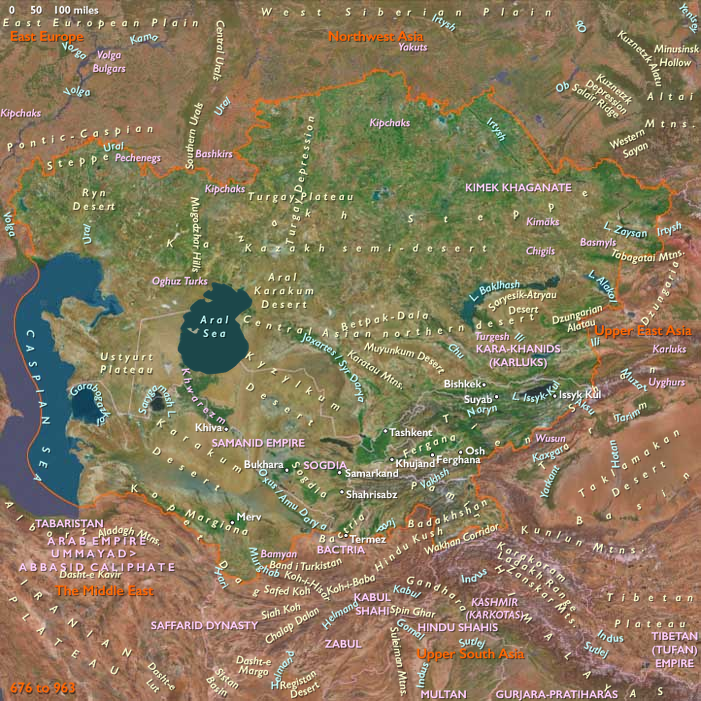
The Middle East: 892–903 CE
Abbasid Consolidation, Regional Revolts, and Cultural Advances
Restoration of Abbasid Authority
In 896 CE, Abbasid Caliph al-Mu'tadid decisively crushes the long-standing Kharijite Rebellion, restoring caliphal authority across the troubled regions. However, despite this victory, the Abbasid Caliphate continues to face significant internal and external challenges.
Rise of the Qarmatians
At the close of the ninth century, Bahrain—encompassing much of eastern Arabia and surrounding islands—falls prey to internal strife exacerbated by disturbances in Abbasid Iraq. Seizing upon these disruptions, the Qarmatians, led by Abu Sa'id al-Hasan al-Jannabi, take control of Bahrain’s capital, Hajr, and the region of al-Hasa in 899 CE. Al-Jannabi establishes a utopian society, positioning al-Hasa as the capital of his revolutionary republic. The Qarmatian state thus emerges as a formidable new power in the region.
Geographical Scholarship and Persian Culture
The Persian geographer Ahmad ibn Rustah composes his significant geographical work, the Book of Precious Records, during this era. Ibn Rustah's meticulous account provides valuable firsthand insights, especially about his hometown of Isfahan, detailing its layout, defenses, and administrative divisions. His writings also encompass broader geographic descriptions, including Europe and Inner Asia, making him an indispensable source for otherwise poorly documented regions. Ibn Rustah's notable observation of a Caucasian king who pragmatically worships with Muslims, Jews, and Christians highlights the region's religious diversity and political pragmatism.
Emergence and Identity of the Kurds
The term "Kurd" appears increasingly in early Islamic sources, primarily referencing pastoral nomadic lifestyles rather than defining a distinct linguistic or ethnic group. Early Persian and Arabic texts describe "Kurds" as an amalgamation of various Iranian and Iranicized nomadic tribes, often highlighting their nomadic and pastoral traits rather than linguistic unity.
Medical Advances and Cultural Contributions
The renowned Persian physician Agha Bakr Muhammad ibn Zakariya al-Razi (also known as al-Razi, 845–930 CE), who maintains a laboratory and medical school in Baghdad, significantly advances medical knowledge. In his manual, Man la Yahduruhu Al-Tabib, al-Razi notably advocates the use of opium for anesthesia and the treatment of melancholy, reflecting both practical medical innovations and the continuing legacy of classical medical traditions.
Jewish Mysticism and Philosophical Developments
The prominent Jewish philosopher and scholar Saadia ben Joseph al-Fayyumi, known as Saadia Gaon, heads the Talmudic academy of Sura. Saadia engages in extensive theological and philosophical debates, notably confronting the Karaites over their challenges to Judaic tradition. His significant literary contributions include commentaries on mystical texts like the Sefer Yetzira (Book of Creation), foundational in the development of Jewish cosmology and mysticism. Saadia’s writings profoundly influence Jewish mystical thought, particularly regarding the sefirot, which conceptualize humanity as a microcosm of creation.
Linguistic Shifts in Iranian Languages
This period witnesses significant linguistic transitions, with the flexible word order characteristic of Middle Iranian languages gradually evolving into the more rigid word order structures of Modern Iranian languages. This shift marks an essential phase in the historical development of the Iranian linguistic tradition.
Various Shī‘ī groups organize in secret opposition to the Abbasid Caliphate.
Among them are the supporters of the proto-Isma'ili community, of whom the most prominent group are called the Mubarakiyyah.
According to the Isma'ili school of thought, Imam Jaʿfar al-Ṣadiq (702–765) designated his second son, Isma'il ibn Jafar, born in 721, as heir to the Imamate.
However, Ismā‘īl predeceased his father in 755.
Some claimed he had gone into hiding, but the proto-Isma'ili group accepted his death and therefore accordingly recognized Isma'il’s eldest son, Muḥammad ibn Isma'il (746–809), as Imām.
He remained in contact with the Mubarakiyyah group, most of whom resided in Kufah.
The split among the Mubarakiyyah came with the death of Muḥammad ibn Isma'ili in about 813 CE.
The majority of the group denied his death; they recognized him as the Mahdi.
The minority believed in his death and will eventually emerge in later times as the Faṭimid Isma'ili, the precursors to all modern groups.
The majority Isma'ili missionary movement has settled in Salamiyah (in present-day Syria) and has had great success in Khuzestan (southwestern Persia), where the Isma'ili leader al-Husayn al-Ahwazi had converted the Kūfan man Ḥamdan in 874 CE, who had taken the name Qarmaṭ after his new faith.
Qarmaṭ and his theologian brother-in-law ‘Abdān have prepares southern Iraq for the coming of the Mahdi by creating a military and religious stronghold.
Other such locations have grown up in Yemen, in Bahrain in 899 CE and in North Africa.
These attract many new Shī‘ī followers due to their activist and messianic teachings.
This new proto-Qarmaṭi movement continues to spread into Greater Iran and into Transoxiana.
A change in leadership in Salamiyah in 899 leads to a split in the movement.
The minority Isma'ilis, whose leader has taken control of the Salamiyah center, begin to proclaim their teachings—that Imam Muḥammad has died, and that the new leader in Salamiyah is in fact his descendant come out of hiding.
Qarmaṭ and his brother-in-law oppose this and openly break with the Salamiyyids; when ‘Abdān is assassinated, he goes into hiding and subsequently repents.
Qarmaṭ becomes a missionary of the new Imam, Ubayd Allah al-Mahdi Billah, who will found the Fatimid Caliphate in North Africa in 909.
Nonetheless, the dissident group retains the name Qarmaṭī.
Their greatest stronghold remains in Bahrain, which at this period includes much of eastern Arabia as well as the islands that comprise the present state.
Bahrain is under Abbasid control at the end of the ninth century, but a slave rebellion in Basra disrupts the power of Baghdad.
The Qarmaṭians seize their opportunity under their leader, Abu-Saʿid Jannabi, who captures Bahrain’s capital Hajr and al-Hasa in 899, which he makes the capital of his republic.
Once in control of the state he seeks to set up a utopian society.
The Qarmatians are alleged to oppose many of the teachings of the Prophet Muhammad, and they encourage social equality for nomads, townspeople, and peasants.
Al-'Abbas ibn 'Amr al-Ghanawi, who was likely born in the Diyar Mudar district of al-Jazira, had embarked on a military career in the service of the Abbasids and is first recorded as one of the officers in charge of an expedition sent against unruly Arab tribes in Iraq In the following year he had been appointed by the caliph al-Mu'tadid as governor of al-Bahrain and al-Yamamah and tasked with driving the Qarmatians led by Abu Sa'id Jannabi out of the region.
Since the Qarmatians have already successfully occupied much of al-Bahrain, including al-Qatif, al-'Abbas had assembled an army of regular soldiers, Bedouin fighters and volunteers before departing from al-Basra for the province.
Shortly after their departure, al-'Abbas and his army meet the Qarmatians and engage them in battle.
The first day of fighting ends in a standstill, but in the evening the Bedouins and volunteers abandon the campaign and return to al-Basra.
The following morning, the two armies resume fighting, and al-'Abbas's depleted forces are routed; he and seven hundred of his men are compelled to surrender.
The day after the battle, Abu Sa'id orders that the captured soldiers all be put to death; al-'Abbas alone is spared and is eventually released, with instructions to warn al-Mu'tadid of the futility in opposing the Qarmatians.
He returns to Iraq and is rewarded by al-Mu'tadid for his efforts.
The Middle East: 904–915 CE
Fragmentation of Abbasid Authority and the Rise of Regional Powers
From 904 to 915 CE, the Abbasid Caliphate faces an accelerating decline of central authority, evident through the growing autonomy and influence of ambitious provincial governors and military commanders. The Abbasid caliphs, increasingly confined to ceremonial roles in Baghdad, see their practical power diminish significantly.
Emergence of Local Dynasties
Local and regional dynasties solidify their control throughout the empire. The Saffarids, having displaced the Tahirids in eastern Iran, consolidate their power by 873 and assert continued dominance during this period. Additionally, Mesopotamia sees the rise of various regional rulers, further fragmenting the caliphate’s once-unified territories.
Revolt and Rebellion
In Bahrain, which encompasses significant portions of eastern Arabia, the Qarmatians under Abu Sa'id al-Hasan al-Jannabi fortify their hold following their earlier capture of the capital Hajr and al-Hasa in 899 CE. Al-Jannabi continues to establish his revolutionary republic based on utopian ideals, significantly disrupting Abbasid control in the region.
Intellectual and Cultural Flourishing
Despite political fragmentation, intellectual and cultural advancements persist. The Persian geographer Ahmad ibn Rustah compiles his detailed geographic compendium, the Book of Precious Records, providing valuable first-hand descriptions of his native Isfahan and insights into regions as distant as Europe and Inner Asia.
The esteemed Persian physician Agha Bakr Muhammad ibn Zakariya al-Razi (al-Razi) continues to advance medical knowledge from his school in Baghdad, advocating opium use in anesthesia and melancholy treatment, reflecting continued innovation within Islamic medical traditions.
Religious and Linguistic Transformations
The Jewish philosopher and theologian Saadia Gaon remains active as head of the Talmudic academy of Sura, vigorously debating religious interpretations and authoring significant commentaries, notably on mystical texts such as the Sefer Yetzira. These writings greatly influence Jewish mystical thought, especially regarding the concept of the sefirot.
Linguistically, the transition from Middle Iranian languages to Modern Iranian continues, marked by a shift toward more rigid grammatical structures and syntax.
Kurdish Identity and Cultural Shifts
The identity of the "Kurds" becomes clearer in early Islamic sources, though still primarily described by their nomadic and pastoral lifestyle rather than as a distinct linguistic group. They emerge as a significant presence in the social and political dynamics of the region.
Thus, this era encapsulates both the fragmentation of Abbasid political authority and ongoing cultural and intellectual vitality across the Middle East.
The Middle East: 916–927 CE
Abbasid Decline and Regional Assertion
From 916 to 927 CE, the fragmentation of the Abbasid Caliphate deepens as central authority wanes further, giving rise to increasingly independent regional dynasties and power centers.
Consolidation of Independent Dynasties
In eastern Iran, the Samanids strengthen their rule and influence, promoting Persian culture and language and marking a significant shift away from Abbasid political and cultural dominance. Their capital, Bukhara, flourishes as a major intellectual and cultural center.
Continued Influence of the Qarmatians
The Qarmatians, maintaining their stronghold in Bahrain under the leadership of Abu Sa'id al-Hasan al-Jannabi, continue to challenge Abbasid control. Their radical, egalitarian beliefs remain influential, and their raids increasingly threaten trade routes and pilgrimage paths, posing a significant threat to the weakened Abbasid administration.
Cultural and Scientific Advances
Despite political instability, the intellectual and scientific climate remains vibrant. Agha Bakr Muhammad ibn Zakariya al-Razi (al-Razi) continues his groundbreaking medical and pharmaceutical research in Baghdad, contributing significantly to Islamic medicine and influencing medical practice throughout the medieval world.
Theological and philosophical discourse thrives with figures like Saadia Gaon, who continues his influential leadership at the Talmudic academy of Sura, engaging vigorously in religious scholarship and debate.
Kurdish Socio-Political Evolution
The identity of the Kurds continues to evolve, with their presence increasingly recognized across northern Mesopotamia and adjacent mountainous regions. Though still primarily identified by their pastoral nomadism, Kurdish groups begin to emerge more distinctly within the complex mosaic of Middle Eastern societies.
Linguistic Evolution
The transition from Middle Iranian to Modern Iranian languages progresses, reflecting broader cultural and social shifts within Persian-speaking communities, and laying the groundwork for the linguistic identities that will dominate the region for centuries.
This period, therefore, marks a critical juncture where decentralized power structures solidify, shaping the cultural and political landscapes of the Middle East well beyond the weakening grasp of the Abbasid Caliphate.