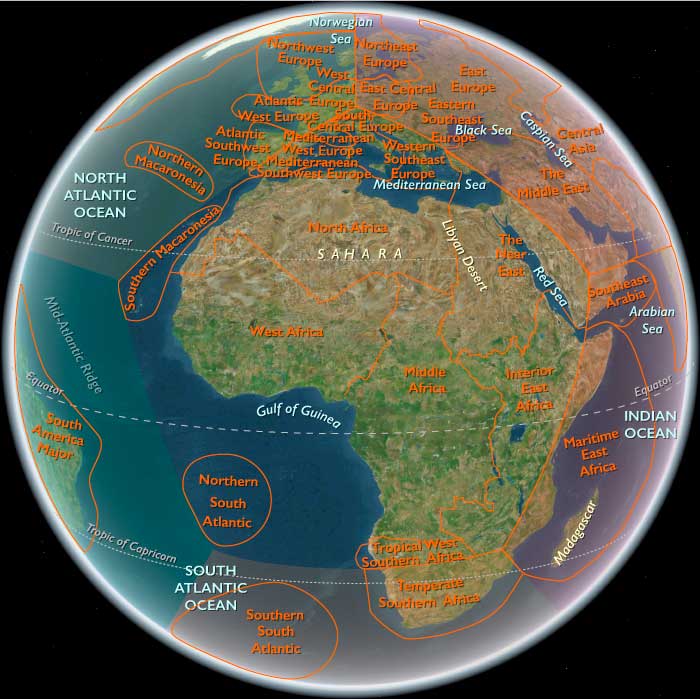
Adhemar of Le Puy
papal legate and one of the principal figures of the First Crusade
Years: 1055 - 1098
Adhemar (also known as Adémar, Aimar, or Aelarz) de Monteil (died 1 August 1098), one of the principal figures of the First Crusade, was bishop of Puy-en-Velay from before 1087.


Related Events
Filter results
Showing 10 events out of 55 total
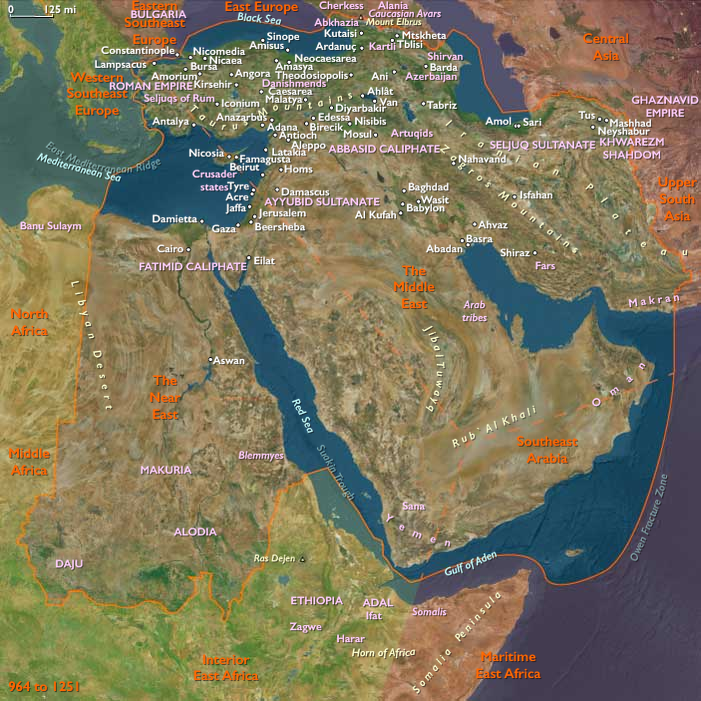
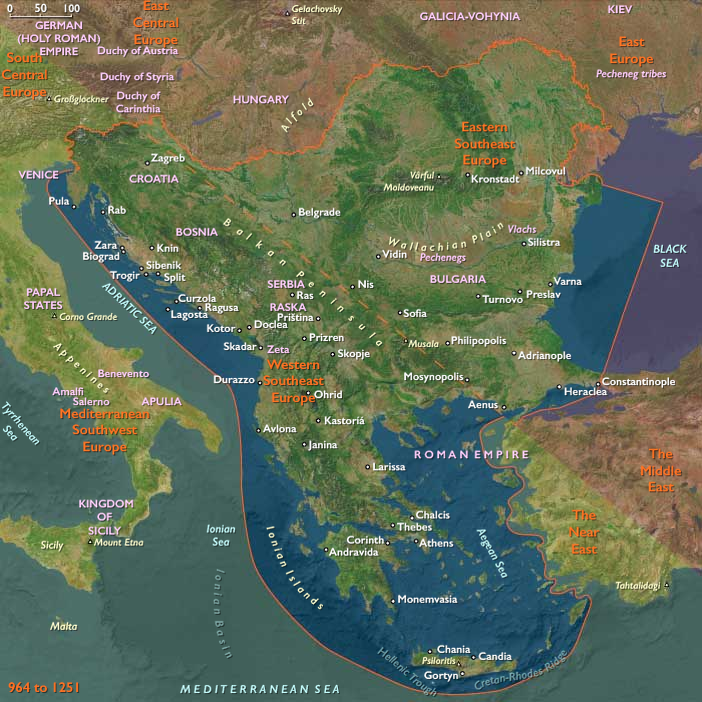
Pope Urban II, at the Council of Piacenza, had received the envoys of Alexios I Komnenos, the emperor in Constantinople, sent to the west in early 1095 to request military assistance against the Seljuq Turks.
In November of this year, Urban calls the Council of Clermont to discuss the matter further.
In convoking the council, Urban urges the bishops and abbots, whom he addresses directly, to bring with them the prominent lords in their provinces.
Attended by nearly three hundred clerics from throughout France, the Council lasts from November 19 to November 28.
Urban discusses Cluniac reforms of the Church, and also extends the excommunication of Philip I of France for his adulterous remarriage to Bertrade of Montfort.
On November 27, Urban speaks for the first time about the problems in the east.
He promotes Western Christians' fight against the Muslims who had occupied the Holy Land and are attacking the Eastern Roman Empire, exhorting Christians to aid the Christian East and to halt the desecration of the holy places; he emphasizes the moral duty of preserving the "Peace of God" at home.
Here, amid a crowd of thousands who have come to hear his words, he urges all present to take up arms under the banner of the Cross and launch a holy war to recover Jerusalem and the east from the 'infidel' Muslims.
Indulgences are to be granted to all those who take part in the great enterprise.
Many promise to carry out the Pope's command, and word of the Crusade will soon spread across western Europe.
Appealing for volunteers to set out for Jerusalem, he offers the incentive of remission of ecclesiastical penances, or plenary indulgences.
On the last day of the council, Urban II appoints Bishop Adhemar of Le Puy and Count Raymond IV of Toulouse to lead the crusade to the Holy Land.
The Great Famine and Plague of 1097: A Crisis in France and the First Crusade
The year 1097 was marked by widespread famine and plague, with reports suggesting 100,000 deaths in France and 50,000 in Palestine and Egypt. Though historical sources on this crisis are limited, it is clear that the First Crusade was severely affected, with the epidemic claiming the lives of many crusaders, including the papal legate Adhemar of Le Puy.
Famine and Plague in France (1097)
- Some sources claim 100,000 people perished in France due to famine and disease, though detailed records are scarce.
- The causes likely included:
- Poor harvests leading to widespread food shortages.
- Weakened infrastructure as many nobles, knights, and peasants had departed on the First Crusade, reducing agricultural labor.
- Outbreaks of disease, worsened by malnutrition and crowded conditions in cities.
- The crisis may have weakened France’s ability to continue supporting the Crusade with provisions and reinforcements.
Famine and Plague in the Near East (1097)
- The Crusaders in Palestine and Egypt also suffered from famine and outbreaks of disease, with some sources estimating 50,000 dead.
- The conditions in the Levant were worsened by:
- Sieges and military campaigns, which disrupted supply lines and created starvation conditions.
- Extreme heat and unsanitary conditions, leading to the spread of infectious diseases.
- Weakened immune systems among crusaders due to malnutrition and exhaustion.
The Death of Adhemar of Le Puy and Its Impact
- Adhemar of Le Puy, the papal legate and spiritual leader of the First Crusade, died from illness on August 1, 1098, during the siege of Antioch.
- His death deeply affected the Crusaders, as he had been a unifying figure, helping to settle disputes among rival commanders.
- Without Adhemar, the Crusader leadership became more divided, contributing to internal conflicts among the Crusading lords.
Consequences of the 1097 Famine and Plague
- The high mortality rates in both France and the Near East created logistical and military challenges for the Crusaders.
- Weakened forces and disease-ravaged armies slowed the progress of the First Crusade, increasing the hardships faced during sieges and battles.
- The death of Adhemar of Le Puy left the Crusaders without strong spiritual leadership, forcing them to rely more on secular lords for direction.
Though sources are limited, the famine and plague of 1097 was a major crisis that affected both Western Europe and the Crusader armies, shaping the course of the First Crusade and straining the resources of the Christian kingdoms.
…Euchaita and …
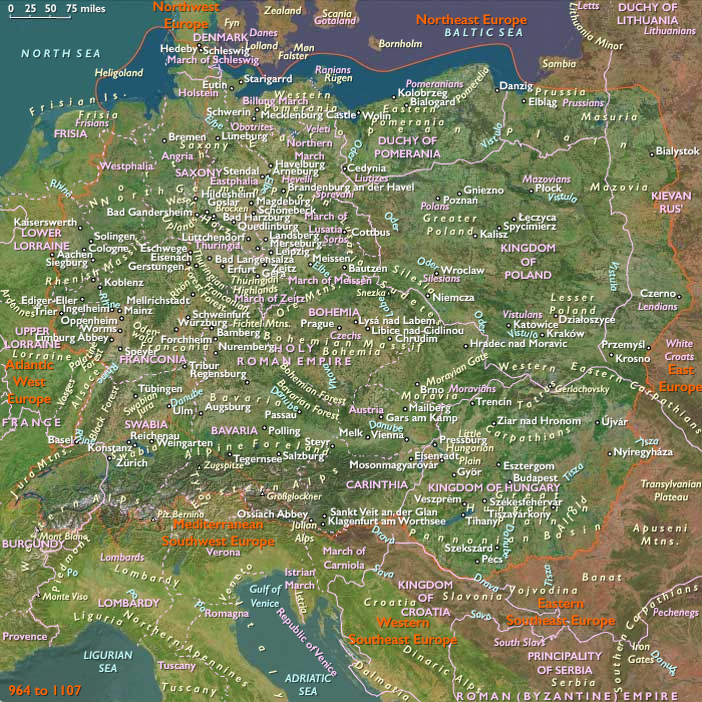
Jewish communities in the Rhineland (north of the main departure areas at Neuss, Wevelinghoven, Altenahr, Xanten and Moers) had been attacked in June and July 1095, but the leadership and membership of these crusader groups was not chronicled.
Some Jews have dispersed eastward to escape the persecution.
On top of the general Catholic suspicion of Jews at this time, when the thousands of French members of the People's Crusade arrive at the Rhine, they have run out of provisions.
To restock their supplies, they begin to plunder Jewish food and property while attempting to force them to convert to Catholicism.
In general, the crusader mobs do not fear any retribution as the local courts do not have the jurisdiction to pursue them past their locality nor the ability to identify and prosecute individuals out of the mob.
The pleas of the clergy are ignored on similar grounds (no cases against individuals are brought forward for excommunication) and the mob believes that anyone preaching mercy to the Jews is only doing so because they had succumbed to Jewish bribery.
Not all crusaders who have run out of supplies resort to murder; some, like Peter the Hermit, use extortion instead.
While no sources claim he preached against the Jews, he carries a letter with him from the Jews of France to the community at Trier.
The letter urges them to supply provisions to Peter and his men.
The Solomon bar Simson Chronicle records that they were so terrified by Peter’s appearance at the gates that they readily agreed to supply his needs.
Whatever Peter's own position on the Jews is, men claiming to follow after him feel free to massacre Jews on their own initiative, to pillage their possessions.
Bishop Egelbert of Trier, after being attacked by a mob on April 10, 1096, and threatened with death, offers to save all Jews who are willing to be baptized.
Most Jews choose to drown themselves instead.
Philip I’s Marital Scandal, Excommunication, and the Role of Hugh of Vermandois in the First Crusade (1092–1096)
By 1092, Philip I of France had become entangled in a scandalous affair that led to his excommunication and further complicated his relationship with Pope Urban II. His brother, Hugh of Vermandois, however, emerged as a key figure in the First Crusade, despite Philip’s own inability to participate due to his excommunication. Meanwhile, the Crusade triggered widespread anti-Jewish violence in France and the Rhineland, as religious fervor and millenarian expectations fueled persecution.
Philip I’s Marital Scandal and Excommunication (1092–1095)
- Philip married Bertha of Holland in 1072, and she bore him the necessary heir, Louis VI.
- However, in 1092, Philip fell in love with Bertrade de Montfort, who was already married to Fulk IV of Anjou.
- Philip repudiated Bertha (claiming she was “too fat”) and married Bertrade on May 15, 1092, despite her existing marriage.
- In 1094, Hugh, Archbishop of Lyon, excommunicated Philip for adultery and bigamy.
- At the Council of Clermont in November 1095, Pope Urban II renewed the excommunication, formally severing Philip from the Church.
Philip’s Position on the First Crusade and Hugh of Vermandois’ Role (1096)
- Because of his excommunication, Philip was unable to join the First Crusade, despite its origination at the Council of Clermont in his own kingdom.
- However, Philip’s brother, Hugh of Vermandois, became a leading participant in the Crusade, possibly to restore the family’s standing with the Church.
- In early 1096, Philip and Hugh discussed the Crusade, but Philip remained politically distant due to his conflict with the pope.
- Hugh was reportedly influenced to take the cross after witnessing a lunar eclipse on February 11, 1096, which he interpreted as a divine sign.
- Unlike other Crusader leaders who traveled by land, Hugh’s army departed France in the summer of 1096, crossed into Italy, and sailed across the Adriatic to reach the Byzantine Empire.
Jewish Persecutions in France and the Rhineland (1096)
- The Crusade triggered widespread anti-Jewish violence, beginning in France before spreading to the Rhineland.
- Sigebert of Gembloux wrote that Crusaders believed Jewish communities should convert before the war for the Lord began.
- The first outbreaks of violence occurred in France, where Crusaders attacked Jewish communities in Rouen, Paris, and other cities.
- A contemporary chronicle from Mainz describes how the Jews of France, fearing for their safety, sent letters to the Jewish communities along the Rhine, warning them of impending danger.
- The Jewish leaders in Mainz responded with a call for fasting and prayer, recognizing the grave threat posed by the Crusaders.
Significance and Consequences
- Philip’s excommunication prevented him from playing a major role in the First Crusade, but his brother Hugh of Vermandois ensured Capetian representation in the campaign.
- The anti-Jewish violence of 1096 marked one of the first large-scale massacres of European Jews, setting a precedent for future Crusader attacks on Jewish communities.
- Philip’s marital scandal and subsequent fallout with the papacy weakened his political authority, but he remained King of France, eventually reconciling with the Church years later.
Although Philip I himself could not join the First Crusade, his brother Hugh of Vermandois played a prominent role, while the Crusade’s religious fervor fueled devastating Jewish persecutions across France and Germany.
The largest of these “peoples’ crusades,” and the one most involved in attacking Jews, is that led by Count Emicho of Leiningen, on his way to join the Crusade led by Peter the Hermit.
Setting off in the early summer of 1096, an army of around ten thousand men, women and children proceed through the Rhine valley, towards the Main River and then to the Danube.
Emicho is joined by William the Carpenter and Drogo of Nesle, among others from the Rhineland, eastern France, Lorraine, Flanders and even England.
Emperor Henry IV, absent in southern Italy, had ordered the Jews to be protected when he learned of Emicho's intent.
After some Jews were killed at Metz in May, John, Bishop of Speyer had given shelter to the Jewish inhabitants.
Still, eleven Jews of Speyer are slain on May 3 by Emicho’s crusaders.
Count Emico attacks the synagogue at Speyer, but the Bishop of Speyer calls out his army, and the crusaders depart.
The Bishop of Worms also attempts to shelter Jews, but the crusaders break in to his episcopal palace and kill the Jews inside on May 18, regardless of age or sex.
Kalonymus Ben Meshullam, head of the Jewish community of Mainz, is said to have sent a messenger to King Henry IV in Italy, in consequence of which the king promulgated an order throughout his realm to the effect that the Jews were not to be molested.
However, he, together with fifty-three others, who had taken refuge in the palace of Bishop Adalbert of Worms from the Crusaders, put themselves to death rather than fall into the hands of the enemy during the Worms massacre.
At least eight hundred Jews are massacred in Worms when they refuse Catholic baptism.
One Jew, Simcha bar Isaac Hakohen, on May 25 pretends to submit to baptism.
As he enters the church, he attacks the priest, and is "torn to bits" by the crowd.
News of Emicho's crusade spreads quickly, and he is prevented from entering Mainz on May 25 by Bishop Ruthard.
Emicho also takes an offering of gold raised by the Jews of Mainz in hope to gain his favor and their safety.
Bishop Ruthard tries to protect the Jews by hiding them in his lightly fortified palace.
Nevertheless Emicho does not prevent his followers from entering the city on May 27 and a massacre follows.
Many among the Christian business class (the burghers) in Mainz, have working ties with Jews and give them shelter from the mobs (as the burghers in Prague also do).
The Mainz burghers join with the militia of the bishop and the burgrave (the town's military governor) in fighting off the first waves of crusaders.
This stand has to be abandoned when crusaders continue to arrive in ever greater numbers,and the militia of the bishop together with the bishop himself flees and leaves the Jews to be slaughtered by the crusaders Despite the example of the burghers, many ordinary citizens in Mainz and other the towns are caught up in the frenzy and joined in the persecution and pillaging.
Mainz is the site of the greatest violence, with at least eleven hundred Jews and (possibly more) being killed by troops under Clarambaud and Thomas.
The idea of suicide, normally abhorrent, is considered acceptable or even preferable under these circumstances.
One man, named Isaac, is forcefully converted, together with his two daughters and a friend called Uriah, but later, wracked with guilt, kills his family and burns himself alive in his house.
Another woman, Rachel, kills her four children with her own hands so that they will not be cruelly killed by the crusaders.
Emicho arrives on May 29 at Cologne, where most Jews had already left or were hiding in Christian houses.
The Bishop later escorts them to towns under his protection.
In Cologne, other smaller bands of crusaders meet Emicho, and they leave with quite a lot of money taken from the Jews here.
Emicho continues towards Hungary, soon joined by some Swabians.
The Jewish population of Eller is subjected to a massacre—the second massacre here in a month—on June 27, 1096, in which fifty Jews die.