Al-Mansur
2nd Abbasid Caliph
Years: 714 - 775
Al-Mansur or Abu Ja'far Abdallah ibn Muhammad al-Mansur (95 AH – 158 AH (714 AD – 775)) is the second Abbasid Caliph from 754 to 775 ).
He is generally regarded as the real founder of the Abbasid Caliphate.
Related Events
Filter results
Showing 10 events out of 25 total
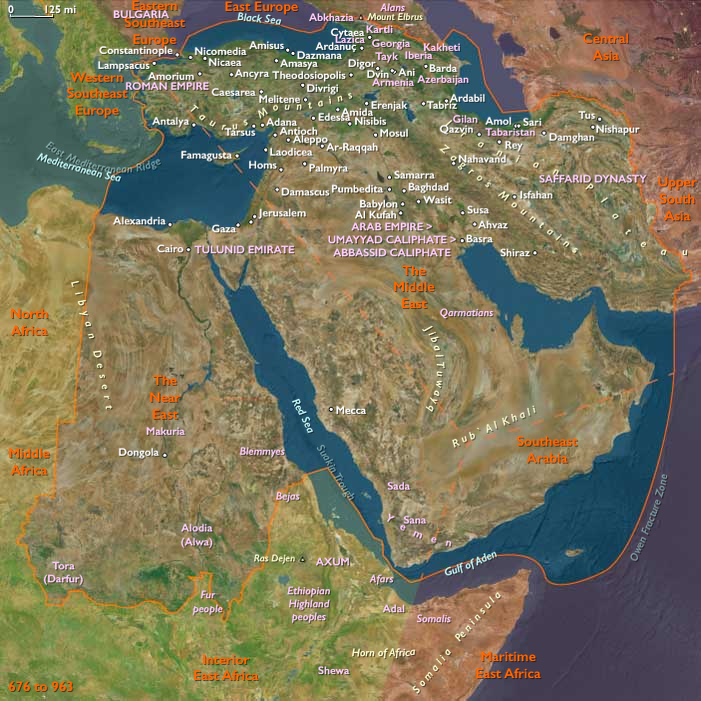
Near East (909 BCE – 819 CE) Early Iron and Antiquity — Greeks of Ionia, Levantine Tyre, Roman–Byzantine Egypt, Arabia’s Caravans
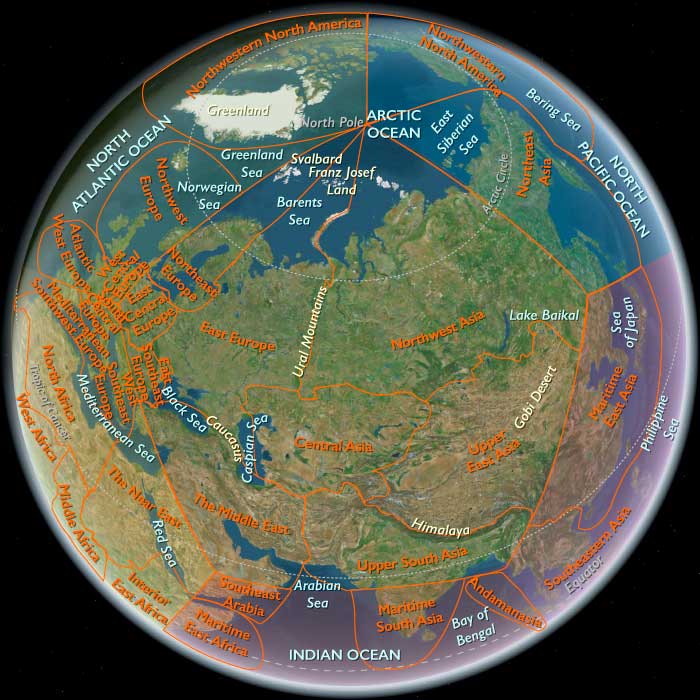
Geographic and Environmental Context
The Near East includes Egypt, Sudan, Israel, most of Jordan, western Saudi Arabia, western Yemen, southwestern Cyprus, and western Turkey (Aeolis, Ionia, Doris, Lydia, Caria, Lycia, Troas) plus Tyre (extreme SW Lebanon).-
Anchors: the Nile Valley and Delta; Sinai–Negev–Arabah; the southern Levant (with Tyre as the sole Levantine node in this subregion); Hejaz–Asir–Tihāma on the Red Sea; Yemen’s western uplands/coast; southwestern Cyprus; western Anatolian littoral (Smyrna–Ephesus–Miletus–Halicarnassus–Xanthos; Troad).
Climate & Environment
-
Nile’s late antique variability; Aegean storms seasonal; Arabian aridity persistent but terraces/cisterns mitigated.
Societies & Political Developments
-
Western Anatolia Greek city-states (Ionia–Aeolia–Doria, with Troad): Miletus, Ephesus, Smyrna, etc.
-
Tyre (sole Near-Eastern Levantine node here) dominated Phoenician seafaring.
-
Egypt (Ptolemaic → Roman → Byzantine): Nile granary and Christianizing hub.
-
Arabian west: caravan kingdoms and Hejaz–Asir oases; western Yemen incense terraces and caravan polities.
-
Southwestern Cyprus embedded in Hellenistic–Roman maritime circuits.
Economy & Trade
-
Grain–papyrus–linen from the Nile; olive–wine Aegean; incense–myrrh from Yemen; Red Sea lanes linked to Aden–Berenike nodes (outside core but connected).
-
Tyre exported craft goods and purple dye.
Technology & Material Culture
-
Iron agriculture and tools; triremes and merchant galleys; advanced terracing, cisterns; lighthouse/harbor works.
Belief & Symbolism
-
Egyptian polytheism → Christianity (Alexandria); Greek civic cults; Tyrian traditions; Arabian deities; monasticism along Nile/Desert.
Adaptation & Resilience
-
Canal maintenance buffered Nile shocks; terraces/cisterns stabilized Arabian farming; Aegean coastal redundancy protected shipping routes.
Transition
By 819 CE, the Near East was a multi-corridor world of Nile granaries, Ionia’s city-coasts, Tyre’s Phoenician legacy, and Arabian incense roads — a foundation for the medieval dynamics ahead (Ayyubids in Syria/Egypt next door, Abbasids beyond, and the Ionian–Anatolian littoral under Byzantine/Nicaean arcs).
Middle East (909 BCE – 819 CE) Early Iron and Antiquity — Urartu, Achaemenids, Parthians, Sasanian Frontiers
Geographic and Environmental Context
The Middle East includes Iraq, Iran, Syria, Armenia, Georgia, Azerbaijan, eastern Jordan, most of Turkey’s central/eastern uplands (including Cilicia), eastern Saudi Arabia, northern Oman, Qatar, Bahrain, the UAE, northeastern Cyprus, and all but the southernmost Lebanon.-
Anchors: the Tigris–Euphrates alluvium and marshes; the Zagros (Luristan, Fars), Alborz, Caucasus (Armenia–Georgia–Azerbaijan); northern Syrian plains and Cilicia; Khuzestan and Fars lowlands; the Arabian/Persian Gulf littoral (al-Ahsa–Qatar–Bahrain–UAE–northern Oman); northeastern Cyprus and the Lebanon coastal elbow (north).
Climate & Environment
-
Continental variability; oases survived by canal upkeep; Gulf fisheries stable; Caucasus snows fed headwaters.
Societies & Political Developments
-
Urartu (9th–6th c. BCE) fortified Armenian highlands;
-
Achaemenid Persia (6th–4th c. BCE) organized satrapies across Iran, Armenia, Syria uplands, Cilicia; Royal Road linked Susa–Sardis through our zone.
-
Hellenistic Seleucids, then Parthians (3rd c. BCE–3rd c. CE) and Sasanians (3rd–7th c. CE) ruled Iran–Mesopotamia; oases prospered under qanat/karez and canal regimes.
-
Transcaucasus (Armenia, Iberia/Georgia, Albania/Azerbaijan) oscillated between Iranian and Roman/Byzantine influence; northeastern Cyprus joined Hellenistic–Roman networks.
-
Arabian Gulf littoral hosted pearling/fishing and entrepôts (al-Ahsa–Qatif–Bahrain).
Economy & Trade
-
Irrigated cereals, dates, cotton, wine; transhumant pastoralism; Gulf pearls and dates.
-
Long-haul Silk Road and Royal Road flows; qanat irrigation expanded in Iran.
Technology & Material Culture
-
Iron plowshares, tools, and weapons; fortifications; qanat engineering; road stations (caravanserais earlier variants).
-
Arts: Urartian bronzes; Achaemenid stonework; Sasanian silver; Armenian and Georgian ecclesiastical arts (late).
Belief & Symbolism
-
Zoroastrianism, Armenian/Georgian Christianity, local cults; Jewish and early Christian communities in oases/ports; syncretism in frontier cities.
Adaptation & Resilience
-
Canal/qanat redundancy, pasture–oasis integration, distributed entrepôts (northeastern Cyprus, Gulf) hedged war and drought.
Transition
By 819 CE, the Middle East was a layered highland–oasis–Gulf system under Sasanian–Byzantine frontiers giving way to Islamic polities.
Baghdad is able to feed its enormous population and to export large quantities of grain because the political administration had realized the importance of controlling the flows of the Tigris and the Euphrates rivers.
The Abbasids reconstruct the city's canals, dikes, and reservoirs, and drain the swamps around Baghdad, freeing the city of malaria.
Harun ar Rashid, the caliph of the Arabian Nights, actively supports intellectual pursuits, but the great flowering of Arabic culture that is credited to the Abbasids reaches its apogee during the reign of his son, Al Mamun (813-33).
After the death of Harun ar Rashid, his sons, Amin and Al Mamun, quarrel over the succession to the caliphate.
Their dispute soon erupt into civil war.
Amin is backed by the Iraqis, while Al Mamun has the support of the Iranians.
Al Mamun also has the support of the garrison at Khorasan and thus is able to take Baghdad in 813.
The Abbasids, although Sunni Muslims, hope that by astute and stern rule they will be able to contain Shia resentment at yet another Sunni dynasty.
The Iranians, many of whom are Shias, hope that Al Mamun will make his capital in their own country, possibly at Merv.
Al Mamun, however, eventually realizes that the Iraqi Shias will never countenance the loss of prestige and economic power if they no longer have the capital.
He decides to center his rule in Baghdad.
The Iranians, disappointed, began to break away from Abbasid control.
The second Abbasid caliph, Al Mansur (754-75), decides to build a new capital, surrounded by round walls, near the site of the Sassanid village of Baghdad.
Within fifty years the population outgrows the city walls as people throng to the capital to become part of the Abbasids' enormous bureaucracy or to engage in trade.
Baghdad becomes a vast emporium of trade linking Asia and the Mediterranean.
Baghdad during the reign of its first seven caliphs becomes a center of power where Arab and Iranian cultures mingle to produce a blaze of philosophical, scientific, and literary glory.
This era is remembered throughout the Arab world, and by Iraqis in particular, as the pinnacle of the Islamic past.
Al-Mansur, the brother of Abu al-'Abbas as-Saffah, plays an important part in wiping out the last remnants of Umayyad resistance.
During his brother's caliphate, he leads an army to Mesopotamia, where he receives the submission of a governor after informing him of the death of the last Umayyad caliph.
In Iraq itself, the last Umayyad governor has taken refuge with his army in a garrison town.
Promised a safe-conduct by al-Mansur and the Caliph, he surrenders the town, only to be executed with a number of his followers.
Abu al-'Abbas as-Saffah dies in 754, after only five years as caliph; the main burden of establishing the 'Abbasid caliphate thus falls upon his brother Abu Jafar al-Mansur.
Al-Mansur becomes the second caliph of the Abbasid dynasty and leader of the Asian and eastern Mediterranean Muslim community.
The Abbasid rulers reassert the theocratic concept of the caliphate and continuity with orthodox Islam as the foundation for unity and authority in the empire.
Abbasid leadership also renders Islam and the fruits of power accessible to non-Arabs; Iranians become prominent in the new caliphal government and administration.
Al-Mansur faces opposition, however, from Iran and from the Shiite Muslim sect.
Al-Mansur is largely responsible for cutting the 'Abbasids free from the movement that has brought them to power, and is involved in the murder of several leading personalities in that movement.
A danger to al-Mansur's caliphate comes from a number of revolts by ambitious army commanders.
The most serious of these is the revolt in 754 of al-Mansur's uncle, 'Abd Allah, who thinks he has better claims to the caliphate than his nephew.
The danger is only averted with the help of Abu Muslim.
Although the 'Abbasid's enthronement was largely due to Abu Muslim's military victories and political prowess, they have quickly become leery of a vassal with so much power and popularity.
With the accession of the morbidly suspicious al-Mansur, Abu Muslim's downfall is sealed.
After having Abu Muslim quell an uprising led by a rebellious uncle, al-Mansur strips away the governorship of Khorasan from him.
When Abu Muslim arrives at court, al-Mansur has him treacherously put to death, thus eliminating a potential rival for the throne.
The unavenged death of Abu Muslim, already a legendary hero to the population, inspires many later uprisings and revolts.
A number of revolts break out in caliphal territory in which some of the pre-Islamic religions of Iran are involved.
These are perhaps in reaction to the 'Abbasids' policy of disassociation from their “extremist” supporters.
In 755 in Khorasan, a certain Sunpadh, described as a magi (here probably meaning a follower of the Mazdakite heresy, not an orthodox Zoroastrian), revolts, demanding vengeance for the murdered Abu Muslim, his close friend.
Sunpadh also preaches a syncretism melding Islam and Zoroastrianism.
In combination with his unusual and heretical vow to advance towards the Hejaz and raze the Ka’aba, this leads to the belief that he was in fact a Zoroastrian, rather than a Muslim.
The enraged Sunpadh swears to march on Mecca and destroy the Kaaba.
Sunpadh further preaches that "Abu Muslim has not died, and when Mansur meant to slay him, he chanted God's great name, turned into a white dove and flew away. Now he is standing with Mahdi and Mazdak in a castle of copper and they shall emerge by and by."
His doctrine receives wide support among Persian Shi'i Muslims, Zoroastrians and Mazdakites and revolts occurre in Ray, Herat and Sistan.
Within only seventy days, Sunpadh's forces are however defeated by one of Caliph al-Mansur's generals, Juhar ibn Murad.
Sunpadh then flees to Khurshid of Tabaristan, but there he is murdered by one of Khurshid's cousins, because he had failed to show the man proper respect.
Ibn al-Muqaffa, though a resident of Basra, was originally from the town of Jur (or Gur, Firuzabad, Fars) in the Iranian province of Fars.
Born of Persian parents about 720, he converts to Islam as an adult and perfects his Arabic so that his translations into that language from Pahlavi (Middle Persian) become models of elegant Arabic prose.
His father had been a state official in charge of taxes under the Umayyads, and after being accused and convicted of embezzling some of the money entrusted to him, was punished by the ruler by having his hand crushed, hence the name Muqaffa (shrivelled hand).
His book of animal fables, “Kalila and Dimna,” stems from the Sanskrit “Fables of Bidpai” and the Pahlavi “Panchatantra.” Al-Muqaffa also gains renown for his “Great Book of Manners” on the ethics of rulers and courtiers.
Al-Muqaffa’s translations lead to a new refinement in Arabic prose called “adab,” often interspersed with poetry and featuring rhymed prose (“saj'“), the style of the Koran.
He paves the way for later innovators who will bring literary fiction to Arabic literature.
Ibn al-Muqaffa is also an accomplished scholar of Middle Persian, and is the author of several moral fables.
Ibn al-Muqaffa is burned at the stake around 756 or 757 by the order of the second Abbasid caliph Abu Ja`far al-Mansur reportedly for heresy, in particular for attempting to import Zoroastrian ideas into Islam.
There is evidence, though, that his murder may have been prompted by the caliph's resentment at the terms and language that Ibn al-Muqaffa had used in drawing up a guarantee of safe passage for the caliph's rebellious uncle, Abdullah ibn Ali; the caliph found that document profoundly disrespectful to himself, and it is believed Ibn al-Muqaffa paid with his life for the affront to al-Mansur.
Khurshid was born in 734/735, the son of Dadhburzmihr or Dadmihr (died 740) and grandson of Farrukhan the Great (died around 728), the first ruler (ispahbadh) of the Dabuyid dynasty from whose reign coins are known.
According to the traditional account, the Dabuyids had established themselves as the quasi-independent rulers of Tabaristan in the 640s, during the tumults of the Muslim conquest of Persia and the collapse of the Sassanid Empire.
They owed only the payment tribute and nominal vassalage to the Arab Caliphate, and managed, despite repeated Muslim attempts at invasion, to maintain their autonomy by exploiting the inaccessible terrain of their country.
A more recent interpretation of the sources by P. Pourshariati, however, supports that Farrukhan was the one who actually established the family's rule over Tabaristan, sometime in the 670s.
Khurshid of Tabaristan had succeeded his father at the age of only six, and for eight years the regency had been exercised by his uncle Farrukhan-i Kuchak ("Farrukhan the Little").
When Khurshid came of age, Farrukhan's own sons had refused to recognize his claim and tried to usurp the throne.
Their plot was allegedly betrayed to Khurshid by an enslaved girl, Varmja Haraviya.
With the help of the sons of his cousin Jushnas, Khurshid had managed to defeat and imprison Farrukhan's sons and later took Varmja Haraviya as his wife, while the sons of Jushnas were given high positions in the state.
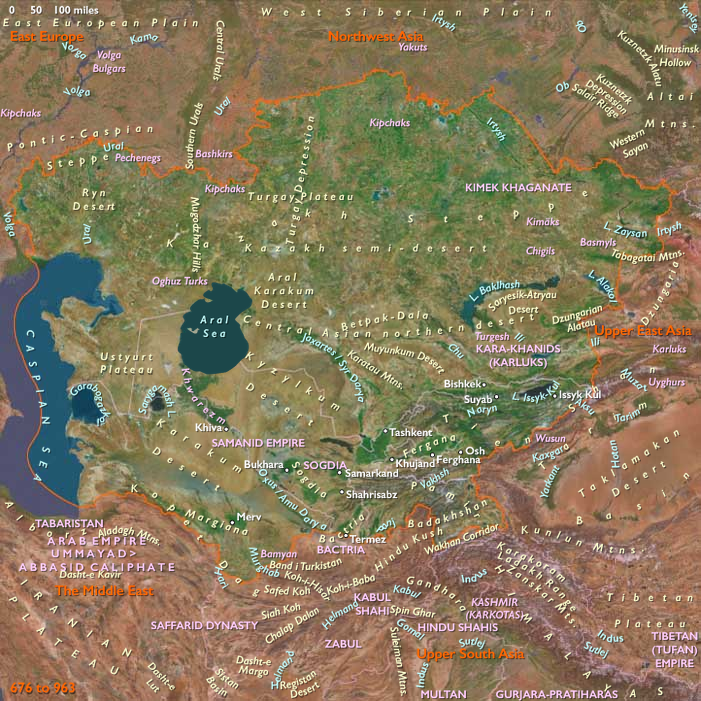
The historian Ibn Isfandiyar gives a vivid description of the prosperity of Tabaristan at this time, which is a major center for textile production (including silk), and which trades with the Turks of Central Asia, probably via the Caspian Sea.
Khurshid is said to have contributed to this prosperity by building numerous bazaars and caravanserais.
Khurshid has also tried to consolidate and even extend his royal power, and had used the turmoil within the Umayyad Caliphate during the Third Islamic Civil War to this effect, rebelling against Caliph Marwan II (r. 744–750), and even sending an embassy to the Tang court in 746, which recognized him ("king Hu-lu-ban") as a vassal prince.
During the Abbasid Revolution, however, he had been forced to submit to the Abbasid armies under Abu Muslim.
As one of Abu Muslim's vassals, he had supported the latter in his quarrel with the Caliph al-Mansur.
After the Caliph had Abu Muslim murdered in 755, Khurshid had supported the anti-Abbasid rebellion of Sunbadh, who had entrusted part of Abu Muslim's treasure to Khurshid's keeping.
When Sunbadh's revolt was defeated, Sunbadh had fled to Tabaristan, but had been killed there by one of Khurshid's cousins, ostensibly because he had failed to show the man proper respect.
It is possible, however, that the murder was instigated by Khurshid, in the hope of acquiring the remainder of Abu Muslim's treasure.
Al-Mansur sends his son and heir, al-Mahdi, to recover the treasure of Abu Muslim.
Khurshid denies having it, and al-Mansur tries to unseat Khurshid by crowning one of his cousins as ispahbadh.
This did not have the desired effect of challenging the loyalty of Khurshid's subjects, but Khurshid had eventually been forced to accommodate the Abbasids by accepting an increase in the annual tribute, which brought it to the level paid to the Sassanids.
Soon after, nevertheless, Khurshid takes advantage of the rebellion of Abd al-Jabar ibn Abd al-Rahman, the governor of Khurasan, to once again throw off allegiance to the Caliphate.
Al-Mansur sends an army into Tabaristan, with the intention of completely subduing the country and making it a province.
Khurshid flees to the fortress of al-Tak in the mountains, where he is besieged in 759–760.
Although Khurshid himself escapes to nearby Daylam, the fortress eventually falls, and with it his family falls into the hands of the Abbasids and brought to Kufa.
The Middle East: 760–771 CE
The Alid Revolt and Abbasid Consolidation
Rise of the Alid Opposition
In 762 CE, the Abbasid Caliphate faces a significant challenge to its legitimacy from the Hasanid branch of the Alids, descendants of Hasan ibn Ali, the grandson of the Prophet Muhammad. Angered by Abbasid oppression and asserting their own superior lineage, the Hasanid brothers Muhammad ibn Abdallah, known as "the Pure Soul," and his brother Ibrahim ibn Abdallah, ignite rebellions in different regions of the caliphate.
The Revolt in the Hejaz and Iraq
Muhammad "the Pure Soul" leads the uprising from Medina, declaring himself the legitimate ruler in September 762 CE. His brother Ibrahim simultaneously raises the standard of rebellion in Basra (modern-day Iraq) in November. However, the revolt suffers from a critical lack of coordination between the two fronts, undermining their potential effectiveness.
Abbasid Response and Military Defeat
The Abbasid Caliph, al-Mansur, swiftly reacts. He dispatches forces first against Muhammad's rebellion, which is rapidly contained and crushed within mere weeks. With the Hejaz firmly back under control, al-Mansur then focuses his resources on the southern Iraqi front.
Battle of Bakhamra and Aftermath
Although Ibrahim initially enjoys some success, his army becomes fractured due to internal disagreements, primarily among different Shia factions with conflicting visions for the rebellion's political future. This disunity severely weakens the rebellion, culminating in a decisive Abbasid victory at the Battle of Bakhamra in January 763 CE, during which Ibrahim sustains fatal injuries.
Impact on Abbasid Authority
While this defeat temporarily quells open resistance from the Hasanid Alids, it does not end Alid unrest permanently. Nevertheless, the Abbasid Caliphate emerges from this conflict significantly strengthened, solidifying its political authority and reasserting its dominance over rival claimants to the Islamic community’s leadership.