Anthemius
Western Roman Emperor
Years: 420 - 472
Procopius Anthemius (c. 420 – 11 July 472) is Western Roman Emperor from 467 to 472.
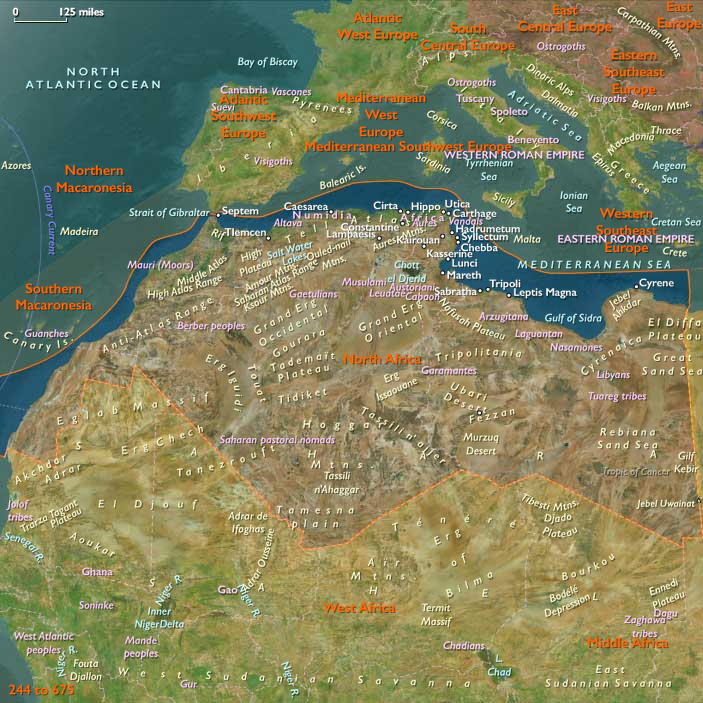
Perhaps the last capable Western Roman Emperor, Anthemius attempts to solve the two primary military challenges facing the remains of the Western Roman Empire: the resurgent Visigoths, under Euric, whose domain straddles the Pyrenees; and the unvanquished Vandals, under Geiseric, in undisputed control of North Africa.
Anthemius is killed by Ricimer, his own general of Gothic descent, who contests power with him.
Related Events
Filter results
Showing 10 events out of 21 total
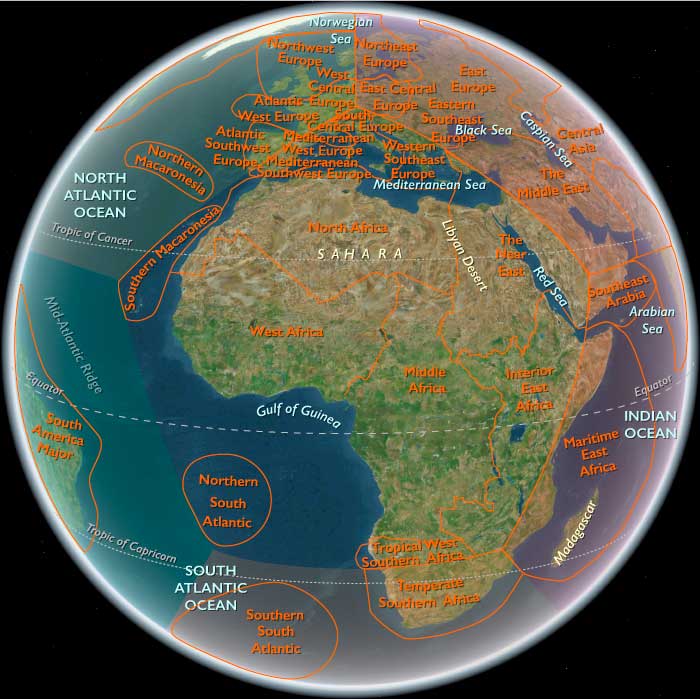
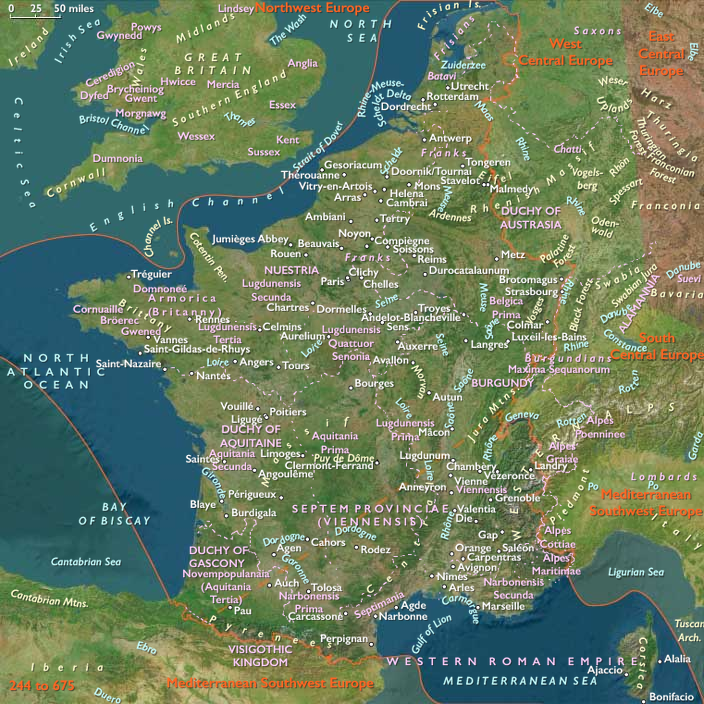
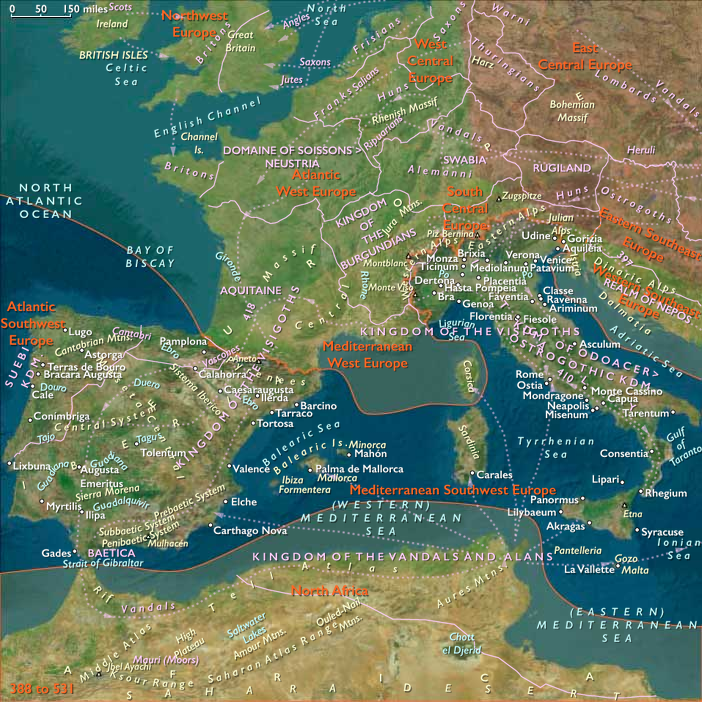
Mediterranean Southwest Europe (388–531 CE): Imperial Decline, Barbarian Ascendancy, and Cultural Transformation
The age 388–531 CE in Mediterranean Southwest Europe encompasses profound shifts, including the final decline of Western Roman imperial authority, the rise of Germanic kingdoms, and significant religious and cultural transformations. These events deeply influence the historical trajectory of the region, laying the foundations of medieval Europe.
Division and Decline of the Roman Empire (388–411 CE)
In 395 CE, the Roman Empire definitively splits into Western and Eastern halves, marking a turning point. The Western Empire, weakened by internal strife and external invasions, progressively dissolves. Emperor Honorius (r. 395–423 CE) struggles against invasions, commissioning his sister, Galla Placidia, and her husband, the Visigothic king Ataulf, to stabilize Iberia. Their efforts partially restore order, with the Visigoths settling permanently in Spain, subduing the Suevi, and pushing the Vandals into North Africa.
Visigothic Kingdom and Ecclesiastical Authority (412–447 CE)
The Visigoths, highly Romanized, establish their capital at Toledo by 484 CE, governing in the emperor's name as imperial patricians. Despite their relatively small numbers—approximately 300,000 among four million Hispano-Romans—their elite status significantly shapes regional politics.
Ecclesiastical institutions, especially the Council of Bishops, emerge as stabilizing forces amid declining civil governance. Bishops, possessing both civil and religious authority, effectively maintain order, reinforcing Christianity’s growing influence as a social and political force.
Ostrogothic Ascendancy and Cultural Flourishing (448–459 CE)
In Italy, Ostrogothic king Theodoric the Great emerges as a dominant figure, leading his Goths against Odoacer in 489 CE and establishing the Ostrogothic Kingdom by 493 CE. Theodoric's rule blends Roman administrative practices with Gothic leadership, ushering in stability and cultural revival, exemplified by artistic masterpieces like the mosaics in Ravenna’s mausoleum of Galla Placidia.
Late Imperial Decline, Visigothic Expansion, and Vandal Incursions (460–471 CE)
Between 456 and 460 CE, Vandals under Genseric briefly occupy coastal cities in Corsica and Sardinia, an occupation formalized by Emperor Majorian. Roman authority, weakened under emperors Majorian and Anthemius, struggles to maintain territorial integrity, but General Marcellinus, possibly supported by Pope Hilarius, regains control of these territories by 466 CE.
Simultaneously, Visigoths under King Euric consolidate power in southern Gaul and Iberia, gradually dismantling Roman administrative structures and paving the way toward medieval feudalism. Amid political upheaval, Christianity remains a powerful stabilizing and cultural force.
The Fall of Western Rome and Renewed Vandal Expansion (472–483 CE)
In 476 CE, the Western Roman Empire formally collapses with the deposition of Emperor Romulus Augustulus by the Germanic chieftain Odoacer. Concurrently, Visigothic King Euric expands his dominion, firmly establishing the Visigothic Kingdom across southern Gaul and Iberia.
Between 474 and 482 CE, Sardinia again falls under Vandal rule, possibly led by Huneric. Their control secures maritime trade routes between North Africa and the Mediterranean. Sardinian cities, notably Olbia, suffer destructive raids, reflecting the island’s strategic importance.
Theodoric’s Conquest, Ostrogothic Kingdom, and Vandal Administration (484–495 CE)
From 489 CE, Theodoric leads the Ostrogoths into Italy, defeating Odoacer by 493 CE and establishing the Ostrogothic Kingdom centered at Ravenna. Concurrently, Vandals maintain a structured administrative system in Sardinia, overseen by a praeses from Caralis, supported by procurators and tax officials. The territory is divided among crown lands and Vandal warriors, though local Sardinian-Roman landowners retain estates through payments, and Barbagia maintains semi-autonomous status.
Visigothic Consolidation and Frankish Rivalry (496–507 CE)
Under Alaric II, the Visigoths enact the Breviary of Alaric (506 CE), codifying Roman law for their subjects. However, rising tensions with the Franks culminate in Alaric’s defeat and death at the Battle of Vouillé (507 CE), forcing Visigoths into a defensive position within Iberia.
Stabilization and Reorganization (508–531 CE)
After Vouillé, the Visigothic Kingdom under Amalaric stabilizes, solidifying power in Iberia. In Italy, Theodoric’s Ostrogothic Kingdom experiences continued stability, economic prosperity, and cultural vitality, reflected in architectural achievements like the Basilica of Sant’Apollinare Nuovo and Theodoric’s Mausoleum.
Cultural and Economic Continuity
Despite fragmentation, local economies adapt successfully, with robust agricultural production and active regional trade. Christianity shapes cultural norms, education, and artistic expression, preserving Roman traditions within evolving medieval contexts.
Germanic Influence and Legacy
The Suevi maintain a modest kingdom in northwestern Iberia, while the Vandals, despite limited numbers, imprint their legacy on southern Spain (Andalusia) and Sardinia, influencing regional names and historical memory.
Legacy of the Age
The era 388–531 CE signifies a critical transformation from classical Roman civilization to early medieval Europe. Visigothic and Ostrogothic kingdoms, empowered ecclesiastical structures, and cultural adaptations profoundly shape the region’s future identity. This period's enduring legacies include Roman-derived legal systems, ecclesiastical dominance, linguistic shifts (Romance languages), and foundational medieval political structures.
Empress Pulcheria, who has commissioned many new churches in Constantinople during her reign, dies of natural causes in July 453.
Her death leaves Flavius Aspar (magister militum) as the dominant influence on her husband, Marcian.
Anthemius marries Marcia Euphemia, daughter of Marcian, and is elevated to the rank of comes.
He is sent to the Danubian frontier to rebuilt the border defenses, left in bad condition after Attila's death in 453.
Mediterranean Southwest Europe (460–471 CE): Late Imperial Decline and Visigothic Expansion
The era 460–471 CE in Mediterranean Southwest Europe is characterized by deepening imperial decline, increasing Visigothic territorial ambitions, and the ongoing shift from Roman central authority toward regional governance under barbarian rule.
Visigothic Power under King Theodoric II and Euric
During this period, the Visigoths under King Theodoric II (r. 453–466 CE) and subsequently King Euric (r. 466–484 CE) significantly expand their influence in southern Gaul and much of Iberia. Euric, particularly ambitious and politically adept, consolidates Visigothic authority, aggressively pushing Roman administrative structures to the periphery and establishing what will soon emerge as a fully autonomous Visigothic kingdom.
Vandal Occupation of Corsica and Sardinia
Between about 456 and 460 CE, the Vandals under Genseric briefly occupy coastal cities in Corsica and Sardinia, an occupation formalized through an agreement with the Roman emperor Majorian. However, this presence is short-lived: in 466 CE, the Roman general Marcellinus, possibly encouraged by Pope Hilarius, successfully regains control of these territories. These events illustrate the ongoing Roman efforts and struggles to maintain territorial integrity amidst escalating barbarian pressures.
Roman Imperial Weakness and Fragmentation
The Western Roman Empire, under emperors such as Majorian (r. 457–461 CE) and Anthemius (r. 467–472 CE), increasingly struggles with internal factionalism, military revolts, and external threats. Despite valiant efforts to reassert imperial authority and reclaim lost territories, their reigns are marked by limited success and persistent instability.
Economic and Social Transitions
Economically, the region undergoes significant transitions as imperial taxation and monetary systems collapse, replaced gradually by localized economies under barbarian and regional aristocratic control. This shift results in a more fragmented socio-economic landscape, laying the foundation for medieval feudal structures.
Christian Ecclesiastical Strength and Cultural Continuity
Amid political and economic upheaval, the Church remains an essential stabilizing institution. Bishops and local religious leaders assume greater authority, influencing both local governance and broader cultural traditions. Artistic expressions continue to reflect Christian themes, demonstrating the lasting vitality and resilience of Mediterranean Southwest Europe's cultural traditions.
Artistic and Architectural Legacy
Cities such as Ravenna continue to produce significant architectural and artistic works, notably exquisite mosaics and ecclesiastical buildings reflecting a blend of Roman and early medieval artistic styles. These achievements underscore the ongoing cultural vibrancy and sophisticated craftsmanship of the period.
Legacy of the Era
The era 460–471 CE further accelerates the transformation of Roman authority into localized, predominantly Visigothic rule. This period significantly shapes the region's political structure, economic practices, and cultural identity, marking a definitive step toward the medieval world and away from classical Roman traditions.
King Theodoric II is killed by his younger brother Euric, who succeeds him on the throne.
Upon becoming king, Euric defeats several other Visigothic kings and chieftains in a series of civil wars and soon became the first ruler of a truly unified Visigothic nation.
Euric sends an embassy to the Eastern Roman Empire for recognition of the Visigoth sovereignty, and forms an alliance with the Suebi and the Vandals.
With his capital at Toulouse, Euric inherits a large portion of the Visigothic possessions in the Aquitaine region of Gaul, an area that has been under Visigothic control since 415.
Euric conquers Hispania and the harbor city of Marseille in southern Gaul, adding them to the existing Visigothic Kingdom.
Ricimer has maintained his power during the past several years despite serious threats to his position from Aegidius in Soissons and from Marcellinus, who rules a virtually independent state in Dalmatia.
Leo, emperor in the East, who had recognized Majorian as emperor in the West, had withheld recognition of Severus, who reigned as titular Western emperor for a little more than two years before dying on August 15, 465.
Nearly two years pass before the installation of Anthemius, the son-in-law of the Eastern emperor Marcian, on April 12, 467.
Appointed to his office by Marcian's successor, Leo, who wants help in attacking the Vandals in North Africa, Anthemius is accepted by Ricimer with the stipulation that his daughter, Alypia, marry him.
To the Eastern Empire, Anthemius is the first legitimate emperor since the death of Valentinian III in 455.
King Genseric extends his pirate raids in the Mediterranean Sea in summer 467.
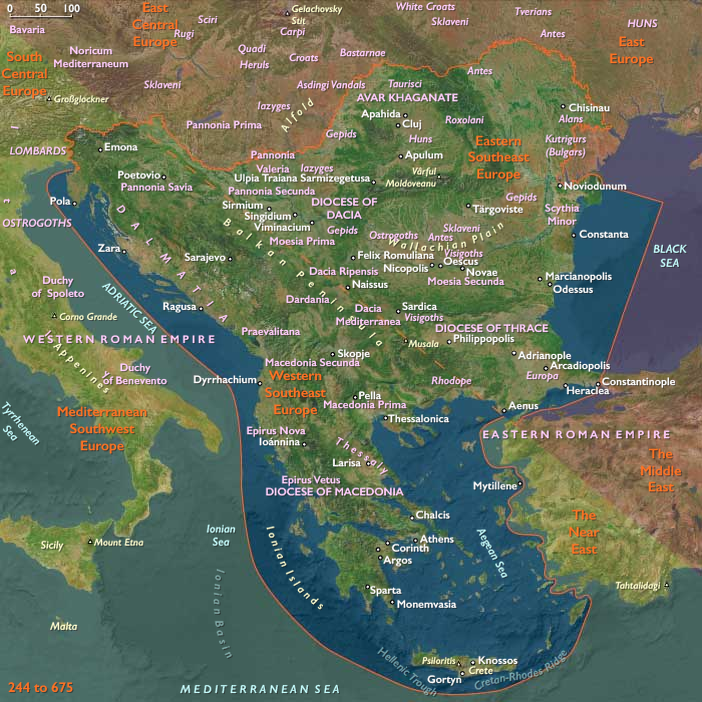
The Vandals sack Illyricum, the Peloponnese and other parts of Greece, enslaving the inhabitants.
Leo I joins forces with the Western Empire to suppress the Vandal menace.
Basiliscus, likely of Balkan origin, is the brother of Aelia Verina, wife of Leo I.
It has been argued that Basiliscus was uncle to the chieftain of the Heruli, Odoacer.
This link is based on the interpretation of a fragment by John of Antioch (209.1), which states that Odoacer and Armatus, Basiliscus' nephew, were brothers.
However, not all scholars accept this interpretation, since sources do not say anything about the foreign origin of Basiliscus.
It is known that Basiliscus had a wife, Zenonis, and at least one son, Marcus.
Basiliscus' military career had started under Leo I, when the Emperor conferred upon his brother-in-law the dignities of dux, or commander-in-chief, in Thrace.
In this country, Basiliscus had led a successful military campaign against the Bulgars in 463.
Succeeding Rusticius as magister militum per Thracias in 464, he had had several successes against the Goths and Huns (466 or 467).
Basiliscus's value had risen in Leo's consideration.
Verina's intercession in favor of her brother has helped Basiliscus' military and political career, with the conferral of the consulship in 465 and possibly of the rank of patricius.
However, his rise is soon to meet a serious reversal.
In 468, Leo chooses Basiliscus as leader of the later famous military expedition against Carthage.
The invasion of the kingdom of the Vandals is one of the greatest military undertakings recorded in the annals of history, a combined amphibious operation with over ten thousand ships and one hundred thousand soldiers.
The purpose of the operation is to punish the Vandal king Genseric for the sacking of Rome in 455, in which the former capital of the Western Roman Empire had been overwhelmed, and the Empress Licinia Eudoxia (widow of Emperor Valentinian III) and her daughters had been taken as hostages.
Ancient and modern historians provide different estimations for the number of ships and troops under the command of Basiliscus, as well as for the expenses of the expedition.
Both are enormous; Nicephorus Gregoras speaks of one hundred thousand ships, the more reliable Cedrenus says that the fleet that attacked Carthage consisted of eleven hundred and thirteen ships, having each one hundred men on board.
The most conservative estimation for expedition expenses is of sixty-four thousand pounds of gold, a sum that exceeds a whole year's revenue.
It is the greatest fleet ever sent against the Vandals; the expense brings Leo near to bankruptcy.
Marcellinus was supposed to have a command of some ten thousand to twenty thousand troops.
Marcellinus had never sailed for Africa, perhaps due to Ricimer's veto; either he would not spare so many troops to become bogged in a campaign in Africa, hoping the East would do the job for him, or he resented the military capabilities of Marcellinus who was obviously the favorite of Anthemius.
Regardless of the reason, Marcellinus’s inabiity to participate in the campaign, coupled with Basiliscus’s blundering in the Battle of Cape Bon, assured that the operation would result in failure.
The West has lost its only chance to regain Africa from the Vandals and possibly stave off its demise.
Marcellinus is reached in Sicily by Basiliscus; the general is, however, assassinated, perhaps at the instigation of Ricimer, by one of his own captains; and the king of the Vandals expresses his surprise and satisfaction that the Romans themselves would remove from the world his most formidable antagonists.
The Vandals reconquer Sicily, administering a decisive defeat to the Western forces.
The Roman plan of attack is concerted between Eastern Emperor Leo, Western Emperor Anthemius, and General Marcellinus, who enjoys independence in Illyricum.
Basiliscus is ordered to sail directly to Carthage, while Marcellinus attacks and takes Sardinia, and a third army, commanded by Heraclius of Edessa, lands on the Libyan coast east of Carthage, making rapid progress.
It appears that the combined forces met in Sicily, whence the three fleets moved at different periods.
Sardinia and Libya have already been conquered by Marcellinus and Heraclius, when Basiliscus casts anchor off the Promontorium Mercurii, now Cap Bon, opposite Sicily, about forty miles from Carthage.
Genseric requests Basiliscus to allow him five days to draw up the conditions of a peace.
During the negotiations, Geiseric gathers his ships and suddenly attacks the Roman fleet.
The Vandals had filled many vessels with combustible materials.
During the night, these fire ships are propelled against the unguarded and unsuspecting Roman fleet.
The Eastern Roman commanders try to rescue some ships from destruction, but these maneuvers are blocked by the attack of other Vandal vessels.
Basiliscus flees in the heat of the battle.
One half of the Roman fleet is burned, sunk, or captured, and the other half follow the fugitive Basiliscus.
The entire expedition has failed.