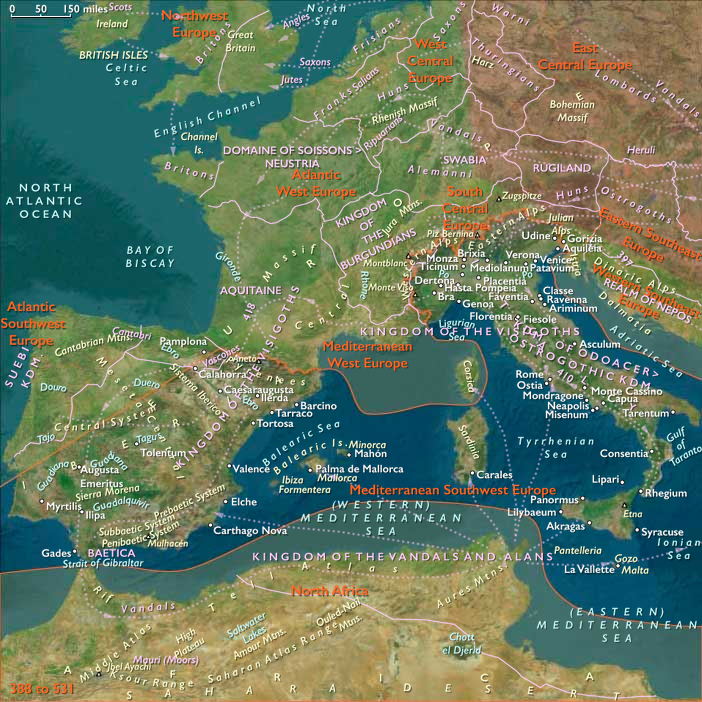
Mediterranean Southwest Europe (388–531 CE): Regional Kingdoms,…
388 CE to 531 CE
Mediterranean Southwest Europe (388–531 CE): Regional Kingdoms, Christian Institutions, and the Transformation of the Roman Landscape
The age 388–531 CE marks the decisive transition from the unified Roman Empire to the politically diverse but environmentally continuous landscapes of the early medieval western Mediterranean. Throughout Italy, Sicily, Sardinia, Malta, the Balearic Islands, southern Portugal, southern, south-central, and eastern Spain, Andorra, and the central and eastern Spanish Pyrenees, productive agricultural systems, transportation networks, and maritime exchange remained remarkably resilient. Yet imperial authority increasingly gave way to regional kingdoms, episcopal administration, and locally organized institutions that adapted rather than abandoned the mature Roman landscape inherited from previous centuries.
Enduring Agricultural Landscapes
Agriculture remained the principal foundation of Mediterranean society despite profound political transformation. Grain continued to be harvested across Sicily, Campania, Apulia, Andalusia, the Po Valley, and the lower Guadalquivir, while vineyards, olive groves, orchards, managed pasturelands, woodland resources, and irrigated districts remained productive throughout the subregion. Terraces, presses, drainage systems, mills, storage facilities, and carefully maintained field systems continued supporting prosperous rural communities.
Although warfare and political instability occasionally disrupted particular districts, the overwhelming impression remained one of environmental continuity. Most agricultural landscapes continued functioning successfully because local communities increasingly assumed responsibility for maintaining them regardless of changing political authority.
From Imperial Provinces to Regional Kingdoms
The political geography of Mediterranean Southwest Europe changed fundamentally during this period. Following the permanent division of the Roman Empire and the gradual disappearance of western imperial authority, new political systems emerged across landscapes that remained unmistakably Roman in their organization.
In Italy, Ostrogothic government preserved much of the existing administrative framework while maintaining roads, taxation, agricultural production, and municipal institutions. Ravenna became an important political center, while Rome increasingly exercised religious rather than imperial authority.
Across Mediterranean Iberia, the Visigothic Kingdom gradually consolidated political control over territories formerly administered by Rome. Provincial organization increasingly depended upon cooperation among regional aristocracies, bishops, municipal leaders, and agricultural landowners rather than direct imperial administration.
These successor kingdoms adapted Roman institutions rather than replacing them, producing landscapes characterized more by institutional continuity than political rupture.
Christian Institutions and the New Administrative Landscape
The most visible institutional transformation of the age was the expansion of Christianity into every level of regional society. Churches, episcopal centers, monasteries, charitable foundations, pilgrimage routes, and ecclesiastical estates became increasingly prominent components of ordinary landscapes.
Unlike earlier centuries, bishops now exercised substantial civil as well as religious authority. Cathedral towns coordinated education, charity, dispute resolution, and regional administration alongside traditional municipal functions. Monasteries increasingly managed agricultural estates, preserved technical knowledge, copied manuscripts, and provided hospitality along major transportation corridors.
These Christian institutions generally occupied long-established Roman settlements and transportation routes, illustrating adaptation rather than wholesale transformation.
Rural Continuity and Local Administration
Despite changing political structures, the countryside retained remarkable stability. Villas frequently evolved into villages, monasteries, or episcopal estates rather than being abandoned. Farmsteads, market villages, bridges, roads, workshops, and local marketplaces continued serving productive agricultural territories whose environmental organization had changed comparatively little.
Local administration increasingly depended upon regional cooperation. Aristocratic estates, village communities, monasteries, bishops, and municipal authorities together maintained roads, irrigation systems, bridges, markets, and agricultural infrastructure that earlier centuries had managed more directly through imperial institutions.
The landscape therefore became more locally governed without becoming environmentally fragmented.
Maritime Exchange and Island Communities
Mediterranean shipping remained one of the region's greatest sources of continuity. Italy, Sicily, Sardinia, Malta, the Balearic Islands, and Mediterranean Iberia continued exchanging grain, olive oil, wine, timber, ceramics, livestock, metals, textiles, and other goods through well-established maritime routes.
Although long-distance commerce became somewhat more regionalized, ports remained active and strategically important. Coastal towns increasingly relied upon local commercial networks while still participating in broader Mediterranean exchange connecting the Byzantine East, North Africa, southern Gaul, and the western Mediterranean islands.
The sea therefore continued functioning as the region's principal transportation corridor despite the disappearance of western imperial political unity.
Defensive Landscapes
Growing political uncertainty encouraged gradual changes in settlement organization. Existing city walls were repaired rather than greatly expanded, strategic hilltop locations became somewhat more important, and certain river crossings and coastal settlements acquired stronger defensive character.
These developments remained secondary to everyday agricultural and commercial life. Most communities continued emphasizing production, exchange, and regional cooperation rather than military activity. Defensive improvements represented prudent adaptation rather than widespread militarization.
Cultural Continuity and Regional Identity
Latin remained the principal language of administration, education, and religion throughout most of the subregion, while Greek continued exerting influence in southern Italy and Sicily. Roman engineering, agricultural practice, legal traditions, craftsmanship, and systems of land management remained deeply embedded within regional society.
At the same time, Visigothic, Ostrogothic, and other regional political traditions increasingly shaped aristocratic culture and governmental organization. Rather than replacing Roman civilization, these emerging identities became integrated into long-established Mediterranean landscapes whose environmental foundations remained remarkably stable.
Legacy of the Age
Between 388 and 531 CE, Mediterranean Southwest Europe completed the transition from a unified imperial province to a network of resilient regional societies. Political authority fragmented among successor kingdoms, bishops, monasteries, municipalities, and local aristocracies, yet the countryside remained productive, transportation networks continued functioning, and maritime exchange preserved regional connectivity.
The defining achievement of the age was successful institutional transformation without environmental collapse. Roads, bridges, ports, villages, estates, agricultural systems, and market towns continued organizing everyday life even as Christianity assumed expanding administrative responsibilities and new kingdoms replaced imperial government. By 531 CE, Mediterranean Southwest Europe remained recognizably Roman in its environmental organization while becoming unmistakably medieval in its political and institutional landscape, establishing the durable foundations upon which the Early Medieval period would build.
Images
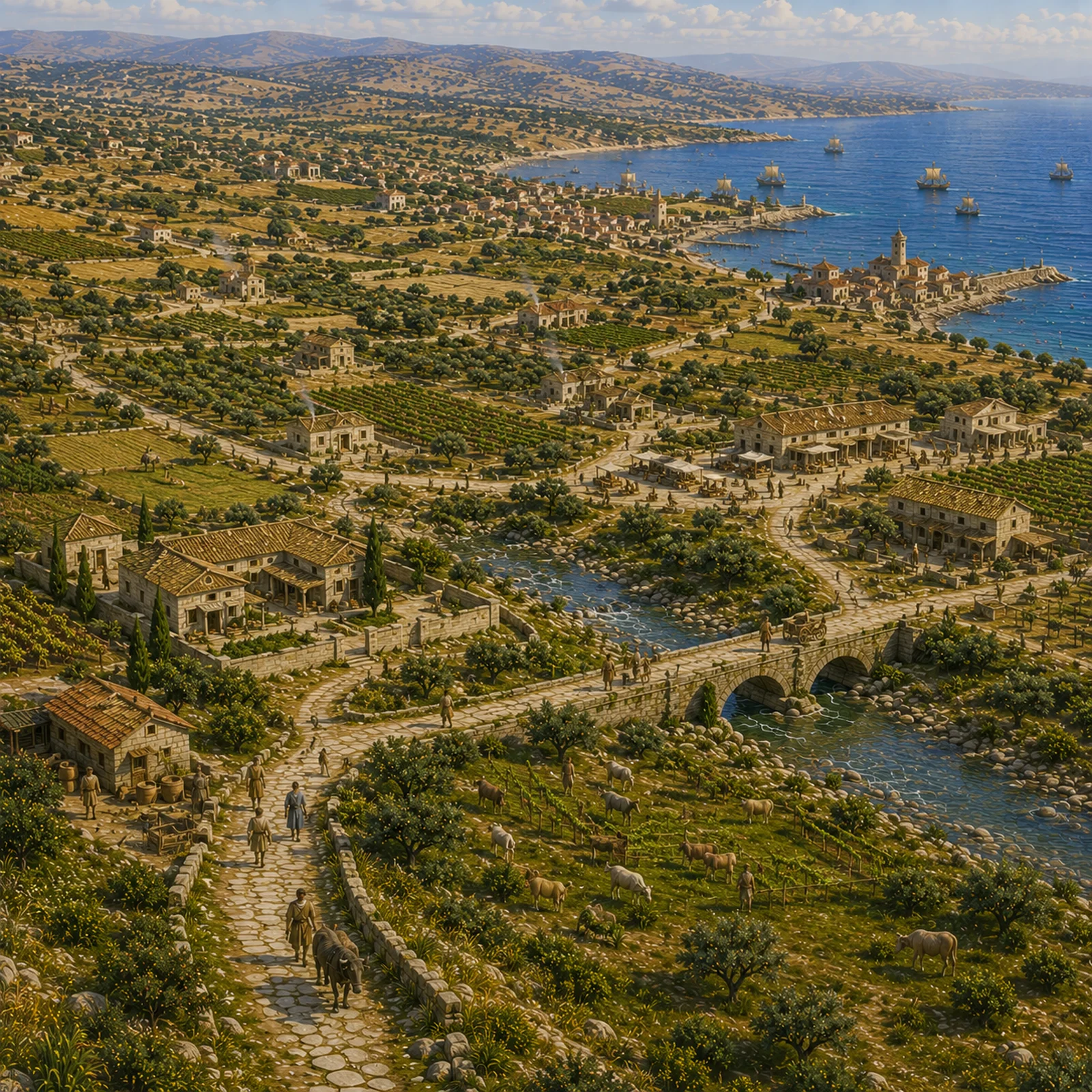
Mediterranean Southwest Europe in Late Antiquity II
People
Groups
Topics
Subjects
Regions
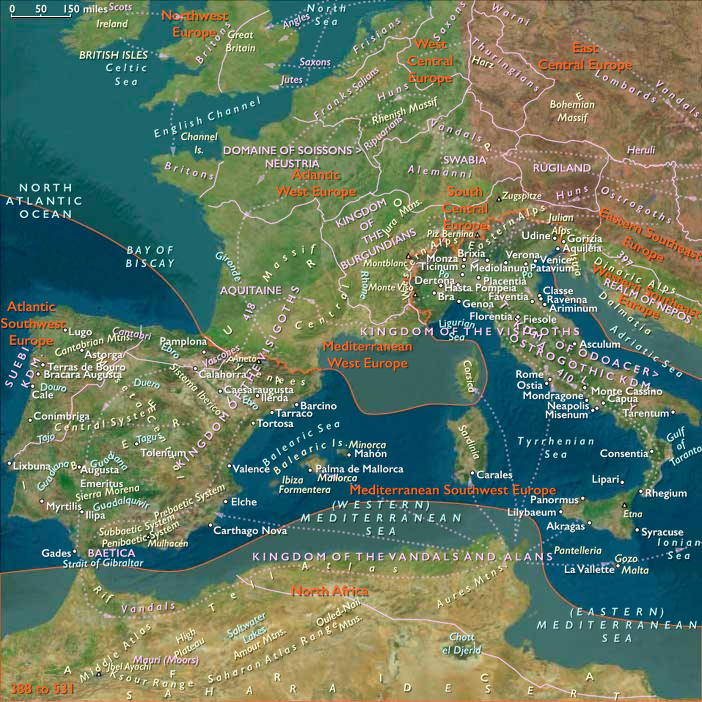
Southwest Europe
View →Subregions