Béla IV
King of Hungary and Croatia
Years: 1206 - 1270
Béla IV (1206–1270), King of Hungary (1235–70) and of Croatia (1235–70), duke of Styria 1254–58.
One of the most famous kings of Hungary, he distinguishes himself through his policy of strengthening of the royal power following the example of his grandfather Bela III, and by the rebuilding of Hungary after the catastrophe of the Mongolian invasion in 1241.
For this reason he is called by the Hungarians "the second founder of our country".

Related Events
Filter results
Showing 10 events out of 78 total
Central Europe (1108 – 1251 CE): Imperial Reform, Urban Expansion, and the Ostsiedlung
Between 1108 and 1251 CE, Central Europe—the heartland of the Holy Roman Empire and its eastern marches—entered an era of extraordinary growth. The Medieval Warm Period brought demographic expansion and agricultural innovation, while political fragmentation fostered new towns, laws, and civic institutions.
From the Rhineland cathedrals and Alpine passes to the plains of Poland and Hungary, Europe’s central belt fused feudal lordship, ecclesiastical reform, and the eastward movement of settlers into one of the most dynamic transformations of the medieval world.
Geographic and Environmental Context
Central Europe stretched from the Rhine to the Vistula and from the Baltic coast to the Alpine valleys and Pannonian plain, encompassing:
-
The Rhineland heartlands of Cologne, Mainz, and Strasbourg;
-
The Alpine crossroads of Tyrol, Zürich, and Geneva;
-
The eastern plains of Silesia, Poland, Bohemia, Moravia, and Hungary.
This was a continent within a continent—a network of fertile valleys, wooded uplands, and trade arteries defined by the Rhine, Elbe, Oder, Vistula, and Danube. Forest clearance and settlement transformed once-marginal lands into the agrarian and urban centers of late medieval Europe.
Climate and Environmental Shifts
The Medieval Warm Period (c. 950–1250) provided long growing seasons, enabling population growth and the spread of viticulture and grain farming north and east.
Favorable weather encouraged three-field rotation, iron ploughs, and horse collars, which revolutionized yields.
Localized floods along the Rhine and Danube enriched soils even as they reshaped towns and dikes.
The forests of Silesia, the Carpathians, and Bavaria yielded timber, salt, and silver—the mineral backbone of Central Europe’s economy.
Political and Institutional Developments
The Imperial Core:
The Holy Roman Empire, though politically fragmented, remained Europe’s constitutional and spiritual axis.
The Hohenstaufen emperors (1138–1254) sought to balance imperial unity with the autonomy of princes and cities.
Archbishops of Mainz, Trier, and Cologne, as imperial electors, embodied this duality of sacred and secular authority.
East Central Kingdoms:
-
Poland (Piast dynasty): The Testament of Bolesław III (1138) divided the realm among dukes, initiating two centuries of fragmentation. Kraków remained the senior duchy, while Silesia and Pomerania invited German settlers under Magdeburg Law, integrating Poland into the Ostsiedlung.
-
Bohemia and Moravia (Přemyslids): Secured hereditary kingship through the Golden Bull of Sicily (1212); Prague emerged as a royal and cultural capital, with silver mining at Kutná Hora enriching the crown.
-
Hungary (Árpád dynasty): The Golden Bull of 1222 codified noble rights; after the Mongol invasion (1241–42), Béla IV rebuilt the kingdom with stone fortifications and foreign settlers, initiating a second wave of colonization and urbanization.
Alpine and South Central Principalities:
Feudal fragmentation defined the Alps: counts of Tyrol, bishops of Geneva, and abbots of Einsiedeln and St. Gallcontrolled passes and tolls.
Urban communes in Zürich and Geneva asserted autonomy; local assemblies in Alpine valleys laid early foundations for Swiss communal governance.
The Rhineland Electorates:
Cologne, Mainz, and Trier dominated the political and spiritual life of the Empire.
Imperial cities such as Strasbourg, Worms, Speyer, and Basel gained privileges, fostering the growth of guilds, markets, and civic culture.
This west–east continuum—imperial in form, feudal in structure, and civic in aspiration—defined Central Europe’s political pluralism.
Economy and Trade
Agrarian Expansion:
Forest clearance and colonization extended cultivation across Silesia, Brandenburg, Bohemia, and Hungary. Heavy ploughs, crop rotation, and watermills drove rural productivity.
Mining and Industry:
Silver at Kutná Hora and Jihlava, salt at Wieliczka, and iron in the Alps and Swabia financed courts and monasteries.
Cistercian abbeys coordinated land reclamation and proto-industrial production.
Trade and Urban Growth:
-
Rhineland: The Rhine served as Europe’s commercial artery, connecting Cologne, Mainz, Strasbourg, and Basel to Flanders and Italy.
-
Alpine routes: Brenner and St. Gotthard passes moved Italian silk and spices north, returning with German metals and wool.
-
Eastern trade: The Oder–Elbe–Danube corridors linked Kraków, Wrocław, Prague, and Buda to Baltic and Adriatic markets.
German urban law (Magdeburg, Lübeck) standardized administration, embedding civic governance across Central Europe.
Urban and Technological Development
Cities expanded rapidly. Cologne, with over 40,000 inhabitants, ranked among Europe’s largest; Cologne Cathedral(begun 1248) inaugurated the Gothic age north of the Alps.
Stone castles, bridges, and Romanesque monasteries transformed the landscape; later Gothic cathedrals rose in Strasbourg, Prague, and Bamberg.
Watermills and guild industries powered textiles, glassmaking, and metalwork.
The Ostsiedlung infused new technology and law across Slavic lands, blending German civic models with local traditions.
Belief and Symbolism
Catholic Christianity unified the region’s culture and law.
-
The archbishoprics of Gniezno, Esztergom, and Prague became national spiritual centers.
-
The Cistercians, Dominicans, and Franciscans spread reform and education, while monasteries became agents of colonization and literacy.
-
Royal sanctity—seen in cults of St. Elizabeth of Hungary and St. Wenceslaus—legitimized dynastic rule.
Pilgrimage and relic cults (notably the Three Kings of Cologne) bound devotion to geography, turning the Rhine and Danube into sacred corridors.
Movement and Interaction Corridors
-
Rhine River: North–south trade spine from Basel to the North Sea.
-
Danube River: Crossed by the Hungarian plain and Bohemian frontier.
-
Elbe–Oder–Vistula basins: Arteries of the Ostsiedlung and grain export.
-
Alpine passes: Brenner and St. Gotthard linking Italy with Germany and Burgundy.
-
Pilgrimage and crusade routes: Swabian knights joined Crusades; Rhineland ports provisioned Mediterranean fleets.
These routes knit the region into Christendom’s spiritual, commercial, and military systems.
Adaptation and Resilience
-
Multipolar politics—Piast duchies, Přemyslid Bohemia, Árpád Hungary—prevented systemic collapse and encouraged local autonomy.
-
Alpine communes and imperial cities institutionalized cooperation and self-defense.
-
Ecclesiastical reform reinforced continuity amid dynastic change.
-
After the Mongol invasion, Hungary’s reconstruction and the eastward settlement drive demonstrated unparalleled resilience.
Fragmentation became an engine of innovation, not decline.
Long-Term Significance
By 1251 CE, Central Europe stood as the pivot of medieval Christendom:
-
The Empire’s Rhineland heartlands led in urbanization, cathedral culture, and commerce.
-
The Alpine passes bound Italy, Germany, and Burgundy into one economic zone.
-
The eastern kingdoms—Poland, Bohemia, and Hungary—had absorbed German colonists and Western institutions, laying the foundations of modern Central Europe.
Fragmented yet interconnected, the region’s plural order and settlement revolution made it Europe’s engine of transformation and resilience.
East Central Europe (1108 – 1251 CE): Piast Fragmentation, Přemyslid Kingship, Árpád Reforms, and the Ostsiedlung
Geographic and Environmental Context
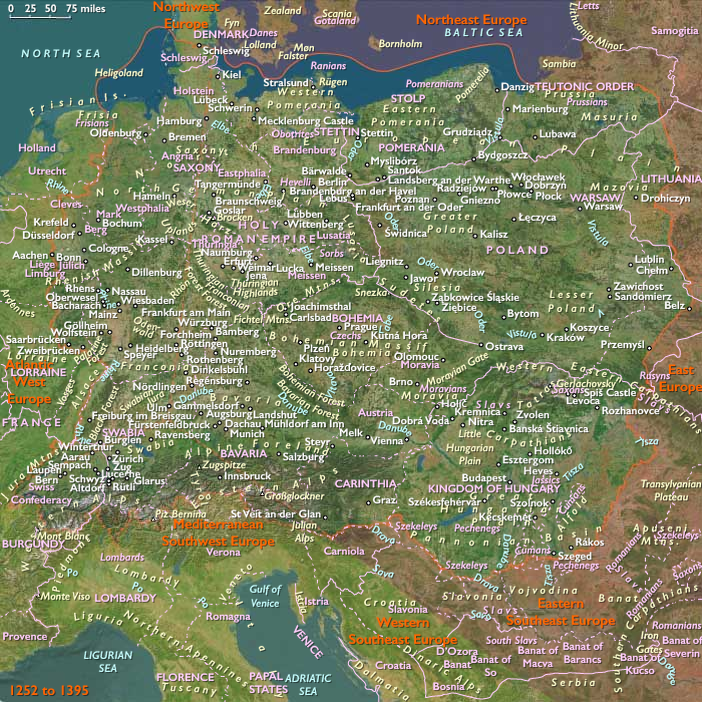
East Central Europe includes the greater part of Germany east of 10°E, Poland, Czechia (Bohemia and Moravia), Slovakia, and Hungary.
-
A vast corridor of plains and uplands—the Elbe, Oder, Vistula, and Danube basins—connected the Baltic to the Carpathians and the Pannonian Plain.
-
Forest clearance and settlement expansion tied the German imperial east to the kingdoms of Poland, Bohemia, and Hungary.
Climate and Environmental Shifts
-
The Medieval Warm Period favored population growth, higher cereal yields, and the spread of viticulture and orchards into sheltered valleys.
-
Floods and periodic droughts punctuated stability, but improved ploughs and crop rotations spread resilience.
Societies and Political Developments
-
Germany east of 10°E: Fragmented imperial principalities encouraged the founding of towns and the granting of civic laws (e.g., Magdeburg Law), attracting settlers and merchants.
-
Poland (Piast dynasty): The Testament of Bolesław III (1138) divided the realm among dukes, initiating a period of long-lasting fragmentation. Kraków served as the notional senior capital, while Silesia and Pomerania drew intense German colonization.
-
Bohemia and Moravia (Přemyslids): Elevated to hereditary kingship with the Golden Bull of Sicily (1212)under Přemysl Otakar I. Prague and Moravian centers like Brno and Olomouc flourished.
-
Hungary (Árpád dynasty): The Golden Bull of 1222 limited royal power and confirmed noble rights. The Mongol invasion (1241–1242) devastated the kingdom, forcing Béla IV into a massive rebuilding effort with stone castles and settlement incentives.
-
Slovakia (Upper Hungary): Integrated into Hungarian mining and defense networks.
Economy and Trade
-
Agrarian expansion: heavy plough, three-field system, and mass clearances extended farmland.
-
Mining: silver at Jihlava and Kutná Hora; salt at Wieliczka.
-
Trade corridors: Oder–Elbe–Danube routes moved grain, timber, and salt to the Baltic and Rhineland; Kraków, Wrocław, Prague, Pressburg, and Buda–Pest acted as hubs.
-
German urban law (Magdeburg, Lübeck) standardized town governance.
Subsistence and Technology
-
Watermills, collar harnesses, and improved ploughs boosted productivity.
-
Romanesque fortresses and Gothic cathedrals reshaped urban skylines.
-
Castles spread across Hungary and Bohemia, especially after Mongol devastation.
Movement and Interaction Corridors
-
The Ostsiedlung carried German-speaking peasants and artisans into Silesia, Pomerania, Brandenburg, and Bohemia.
-
Cistercian monasteries coordinated land clearance and settlement.
-
Mongol invasion briefly severed Carpathian corridors but reforms re-opened them.
Belief and Symbolism
-
Latin Christianity unified political culture: archbishoprics in Gniezno, Esztergom, and Prague guided ecclesiastical governance.
-
Cistercians, Dominicans, Franciscans spread reform, preaching, and literacy.
-
Cults of royal saints (e.g., St. Elizabeth of Hungary) tied dynastic legitimacy to sanctity.
Adaptation and Resilience
-
Multipolar politics (Piast duchies, Přemyslid Bohemia, Árpád Hungary) created redundancy.
-
Hungary’s reconstruction after the Mongols demonstrated adaptive resilience, with stone fortifications and immigrant resettlement.
-
Town networks spread risk through market integration.
Long-Term Significance
By 1251 CE, East Central Europe had become a densely networked agrarian and urban region: fragmented Piast duchies, a hereditary Bohemian kingdom, and a restructured Hungary coexisted within the framework of German colonization and urban law. This laid the institutional and demographic foundations for its later medieval flowering.
Batu leads the central force across the Carpathian Mountains in early April 1241, lures the army of King Bela IV of Hungary into battle at the Sajo River on April 11, and annihilates it.
The Mongols then seize Pest, and they spend the rest of the year consolidating their control of Hungary east of the Danube River.
Andrew II's son Béla IV (1235-79) tries with little success to reestablish royal preeminence by reacquiring lost crown lands.
His efforts, however, create a deep rift between the crown and the magnates just as the Mongols are sweeping westward across Russia toward Europe.
Aware of the danger, Béla orders the magnates and lesser nobles to mobilize.
Few respond, and the Mongols rout Béla's army at Mohi on April 11, 1241.
Béla flees first to Austria, where Duke Frederick of Babenberg holds him for ransom, then to Dalmatia.
The Mongols reduce Hungary's towns and villages to ashes and slaughter half the population before news arrives in 1242 that the Great Khan Ögedei has died in Karakorum.
The Mongols withdraw, sparing Béla and what remains of his kingdom.
Andrew has come into increasing conflict with the powerful Hungarian magnates, who are in turn embroiled in a struggle with the emerging lower nobility.
In early 1222, the latter faction, to protect their social and economic position, rebels and, coming to Andrew's court in a large body, forces Andrew to issue a Golden Bull (from the Latin “bulla,” meaning "seal," an important document with a gold seal attached).
This agreement, similar to England's Magna Carta, enumerates the rights and privileges of the nobility, including the right to disobey the King if he acts not in line with the provisions of the Golden Bull (ius resistendi), and compels the king to share his powers with them in a national Diet, or assembly.
Béla, the eldest son of Andrew II of Hungary, had in 1220 married Maria Laskarina, a daughter of the Emperor Theodore I Laskaris of Nicaea, and his father had entrusted him with the government of Slavonia.
However, the king, who had arranged Béla's marriage during his return from the Crusade, persuades Béla to separate from his wife in 1222.
Pope Honorius III denies to declare the marriage of Andrew and Maria null and void; therefore Béla takes back his wife and, fearing his father's anger, escapes to Austria and the protection of Duke Leopold VI.
Finally, Andrew makes an agreement with his son with the mediation of the Pope and Béla again takes over the government of Slavonia, Dalmatia and Croatia.
The first bishopric of Cumania, the land granted by King Andrew II of Hungary to the Cumans who had fled from the Mongol advance, is established in 1228, and Andrew’s son Béla assumes the title “king of Cumania.”
Hungary’s King Andrew II dies on September 21, 1235; his son succeeds as Béla IV to a weakened monarchy.
Béla IV of Hungary grants asylum in 1239 to the Cumans and their prince Kuthen, who had earlier tried unsuccessfully to organize Russian resistance to the Mongols.
Béla accepts the Cumans' pledge of forty thousand warriors to the defense of Hungary.
East Central Europe (1240–1251 CE): Mongol Invasion and Aftermath, Rebuilding under Béla IV, Polish Fragmentation after Legnica, Bohemian Stability, and Austria’s Babenberg Decline
Between 1240 and 1251 CE, East Central Europe—including modern-day Poland, Czechia, Slovakia, Hungary, and eastern regions of Germany and Austria east of 10°E and north of the defined southeastern boundary—experienced unprecedented turmoil, upheaval, and profound transformation due to the devastating Mongol invasion (1241–1242). The invasion dramatically reshaped regional power dynamics, political structures, and demographic landscapes. Hungary and Poland bore the brunt of Mongol destruction but subsequently entered phases of rebuilding and political realignment. Bohemia remained relatively stable under Wenceslaus I Přemysl, while Austria faced significant instability and dynastic decline following the end of the Babenberg dynasty. These developments had profound, lasting effects on regional governance, settlement patterns, and cultural identities.
Political and Military Developments
Devastating Mongol Invasion (1241–1242)
-
In 1241, Batu Khan’s Mongol armies swept across East Central Europe, causing catastrophic destruction. Major battles included the decisive defeats at Legnica (Poland) and Mohi (Hungary) in 1241, leading to mass casualties, widespread destruction, and significant territorial devastation.
-
Poland’s fragmented duchies suffered severely, notably in Silesia, where Duke Henry II the Pious fell at Legnica. Hungarian forces under King Béla IV (r. 1235–1270) were decisively defeated at Mohi, resulting in temporary royal exile and massive demographic losses.
Hungarian Reconstruction under Béla IV
-
Following the Mongol withdrawal in 1242, Béla IV initiated extensive reconstruction, fortification programs, and administrative reforms to rebuild Hungary’s political stability and security. He fostered new fortified towns and encouraged immigration and settlement to replenish population losses.
-
Béla IV’s recovery efforts fundamentally reshaped Hungary’s political structures, significantly increasing urban fortification and royal administrative reforms.
Polish Fragmentation Intensifies after Legnica
-
After the Battle of Legnica (1241) and the death of Henry II the Pious, Poland’s political fragmentation intensified. Silesia splintered further among Henry’s heirs, exacerbating regional rivalry and undermining previous unity efforts.
-
Silesian duchies, Greater Poland, Masovia, and Lesser Poland operated independently, deepening political decentralization and reducing unified governance.
Continued Stability in Bohemia under Wenceslaus I
-
Bohemia, under King Wenceslaus I (r. 1230–1253), managed to avoid direct Mongol devastation. Wenceslaus capitalized on this stability, continuing territorial consolidation, strengthening administrative governance, and maintaining regional political influence within the Holy Roman Empire.
Austrian Babenberg Dynasty Ends
-
In 1246, the Babenberg dynasty ended abruptly with the death of Duke Frederick II the Quarrelsome in battle. Austria plunged into dynastic uncertainty and instability, triggering a prolonged succession crisis that would reshape the duchy’s future within Central Europe.
Imperial Influence and Regional Instability
-
Emperor Frederick II’s (r. 1212–1250) declining authority in his final years contributed to regional instability, affecting political alliances and complicating dynastic succession disputes, notably in Austria and neighboring regions.
Economic and Technological Developments
Devastation and Economic Disruption from Mongol Invasions
-
The Mongol invasions caused severe economic disruption, widespread destruction of trade networks, agricultural devastation, and depopulation, especially in Hungary and Poland. Recovery efforts gradually restored commerce, though long-term impacts remained significant.
Reconstruction, Settlement, and Technological Advances
-
Post-invasion recovery saw significant rebuilding, settlement initiatives, and urban fortifications. Agricultural productivity and technological innovations—including improved fortification methods—played crucial roles in regional reconstruction.
Cultural and Artistic Developments
Hungarian Cultural Resilience and Reconstruction
-
Despite severe destruction, Béla IV strongly supported cultural restoration. Ecclesiastical architecture, manuscript illumination, and scholarly institutions gradually revived, reflecting Hungary’s resilient cultural identity and intellectual traditions.
Polish Cultural Continuity amid Fragmentation
-
Poland maintained significant cultural resilience, with monasteries and ecclesiastical institutions preserving cultural continuity, scholarship, and artistic traditions despite intensified fragmentation and political decentralization.
Bohemian Cultural Flourishing under Wenceslaus I
-
Bohemia, unaffected directly by the Mongol invasion, continued cultural and artistic development under Wenceslaus I. Prague’s significance as a center of manuscript production, ecclesiastical architecture, and scholarly activity notably increased.
Settlement and Urban Development
Hungarian Reconstruction and Urban Fortification under Béla IV
-
Béla IV initiated extensive rebuilding and urban fortification programs. New and existing towns, including Buda, Esztergom, and Visegrád, were substantially fortified, transforming Hungary’s urban landscape to better resist future invasions.
Continued Bohemian Urban Stability and Expansion
-
Bohemia’s urban centers, particularly Prague, remained stable, prospering commercially and culturally. Fortifications were reinforced strategically, and urban infrastructure continued developing, further enhancing regional prominence.
Austrian Instability and Urban Uncertainty
-
Following the Babenberg dynasty’s end (1246), Austrian urban growth temporarily slowed due to political uncertainty and dynastic instability. However, key centers like Vienna maintained essential administrative and economic functions, preserving continuity despite challenges.
Social and Religious Developments
Ecclesiastical Institutional Strength and Reconstruction
-
Ecclesiastical institutions played crucial roles in post-Mongol reconstruction, societal cohesion, and intellectual revival. Monasteries, bishoprics, and religious orders significantly influenced governance, education, and social recovery across East Central Europe.
Aristocratic Power, Social Transformation, and Urban Fortification
-
Aristocratic influence intensified due to the weakened royal authority from the Mongol invasion’s devastation. Nobility and local aristocrats played prominent roles in rebuilding, fortification, and regional governance, reshaping social and political structures.
Long-Term Consequences and Historical Significance
The era 1240–1251 CE was a transformative period for East Central Europe, marked by catastrophic destruction from the Mongol invasions and significant political realignments. Hungary under Béla IV undertook substantial reconstruction efforts, significantly altering its defensive strategies and urban landscapes. Poland faced deepened fragmentation following Legnica, hindering unified governance. Bohemia maintained political stability under Wenceslaus I, emerging with enhanced regional prominence. Austria’s Babenberg dynasty’s end introduced prolonged dynastic uncertainty. Collectively, these developments profoundly reshaped regional political, economic, social, and cultural structures, laying foundations for future medieval identities, governance patterns, and enduring legacies.