Boris Godunov
Tsar of All Russia
Years: 1551 - 1605
Boris Fyodorovich Godunov (c. 1551 – 23 April [O.S.
13 April] 1605) is de facto regent of Russia from 1584 to 1598 and then the first non-Rurikid tsar from 1598 to 1605.
The end of his reign sees Russia descend into the Time of Troubles.
Related Events
Filter results
Showing 10 events out of 34 total
Boris Feodorovich Gudonov, a member of the Saburov-Godunov family of Tatar origin who had been mentioned in 1570 as taking part in the Serpeisk campaign as one of the archers of the guard, had in 1571 strengthened his position at the court of Tsar Ivan IV by his marriage with Maria, the daughter of Ivan's odious favorite, Malyuta Skuratov.
The Tsar in 1580 chooses Irina, the sister of Boris, to be the bride of the pathetic Tsarevich Feodor, on which occasion Boris is promoted to the rank of boyar.
On his deathbed, Ivan appoints Boris Godunov, together with his Romanov relatives, as guardians of his son and successor; for Fyodor, despite his twenty-seven years, is both physically weak and feeble-minded.
Ivan's achievements have been many.
In foreign policy, all his actions have been directed toward forcing Russia into Europe—a line that Peter I the Great is to continue.
Internally, Ivan's reign of terror had eventually resulted in the weakening of all levels of the aristocracy, including the service gentry he had sponsored.
These factors, together with Tatar incursions, have resulted in the depopulation of a number of Russian provinces.
Nevertheless, he leaves his realm far more centralized both administratively and culturally than it had been previously.
Ivan has also encouraged Russia's cultural development, especially through printing.
He himself wrote well, and, though his surviving writings are mainly of a political nature, his command of words and his biting sarcasm are very evident.
Ivan has been a devout adherent of the Orthodox church.
His arguments on religious questions are striking in their power and conviction, but he places the most emphasis on defending the divine right of the ruler to unlimited power under God—a view with which most other monarchs of the time would have been in agreement.
The zemsky sobor, “assembly of the land”), composed of representatives from the ecclesiastical and monastic authorities, the boyar council, the landowning classes, and the urban freemen, had first been called by Ivan, and the assemblies had met often during his reign; the most important one (1566) considered the Livonian War against Poland.
A zemsky sobor confirms the accession of Fyodor at Ivan’s death in 1584.
With Moscow reportedly on the verge of anarchy due to the Tsar’s draconian policies, Feodor assumes the throne on May 31.
His reign begins with a rebellion in favor of the infant Tsarevich Dmitry, the son of Ivan's fifth wife Maria Nagaya; the result is the banishment of Dmitry, with his mother and her relations, to their appanage at Uglich.
On the occasion of the Tsar's coronation, Godunov is given honors and riches, yet he holds the second place in the regency during the lifetime of the Tsar's uncle Nikita Romanovich, on whose death, in August, he will be left without any serious rival.
Fyodor takes no part in government affairs, which are dominated by Godunov.
Godunov builds the fortress of Tsaryovokokshaysk in 1584 on the site of present Yoshkar-Ola, founded in 1578 on the Malaya (Little) Kokshaga River in western Russia, but the town’s remoteness from lines of communication prevents any development.
Today the capital of the Mari El Republic, it has a population of 281,165 (2002 Census), which is slowly increasing as people from neighboring areas move to the city.
Architect Fyodor Kon, at the behest of Tsar Feodor and Boris Godunov, begins construction in 1585 on the stone walls of Bely Gorod (Russian: “White Town”), a fortress and settlement comprising the third defense belt around Moscow, which is to join the Kremlin and Kitay-gorod on the left bank of the Moskva River.
The walls are cogged, like the Kremlin walls, loopholes allowed to keep a continuous fire.
Feodor proves incapable of effective rule, and the nobility establishes a dual regency of his uncle and Godunov, who becomes sole regent in 1586.
Godunov will oversee the elevation of the Russian Orthodox church to a patriarchate.
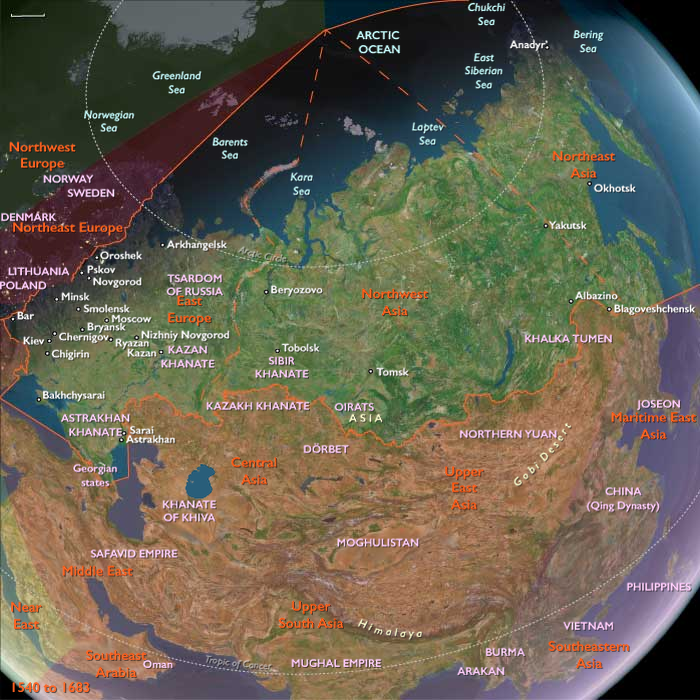
East Europe (1588–1599 CE): Muscovite Stability and Administrative Reforms
Political and Military Developments
Consolidation of Central Authority
From 1588 to 1599 CE, Muscovy further consolidated central authority, stabilizing governance following previous decades of turmoil. Tsar Feodor I’s reign, guided significantly by his regent Boris Godunov, saw strengthened administrative reforms aimed at enhancing political stability and efficiency.
Continued Territorial Integration
The integration and administration of diverse territories, particularly those involving ethnic groups such as the Bashkirs and other Ural and Volga populations, remained a priority. Diplomatic engagements and military presence ensured relative peace and administrative coherence across these regions.
Economic and Technological Developments
Sustained Economic Revival
Economic growth continued steadily, bolstered by robust trade along vital routes such as the Volga River and international commerce. Urban centers, notably Moscow, benefited from improved trade conditions and economic resilience.
Technological and Military Advancements
Military enhancements persisted, focusing on fortification improvements, refined siege tactics, and advancements in cavalry operations. These developments significantly bolstered Muscovy’s defensive capabilities and regional stability.
Cultural and Artistic Developments
Flourishing Cultural Patronage
Cultural and artistic patronage continued under Tsar Feodor I, facilitating the growth of architectural projects, religious artwork, and secular cultural initiatives. These activities contributed significantly to the Muscovite cultural identity and heritage.
Vibrant Intellectual Environment
Intellectual and literary productivity flourished, with chroniclers and scholars actively recording and analyzing the political, religious, and social developments. This scholarly activity maintained historical continuity and enriched Muscovy’s intellectual heritage.
Settlement Patterns and Urban Development
Urban Expansion and Development
Cities, particularly Moscow, expanded further, supported by strategic infrastructure investments, efficient urban planning, and enhanced administrative oversight. Population growth and economic vitality characterized this urban expansion.
Strengthened Fortifications and Regional Defense
Improvements in urban fortifications continued, ensuring security and stability amid ongoing regional management challenges and geopolitical dynamics.
Social and Religious Developments
Enhanced Social Stability
Social structures stabilized further, integrating diverse ethnic groups into cohesive administrative and societal frameworks. The continued incorporation of ethnic territories enhanced regional harmony and administrative efficiency.
Orthodox Church’s Continuing Influence
The Orthodox Church remained a central societal institution, guiding educational norms, moral values, and community cohesion, thus significantly contributing to overall societal stability and cultural continuity.
Long-Term Consequences and Historical Significance
The era from 1588 to 1599 CE represented continued administrative consolidation, economic growth, and cultural enrichment. These developments reinforced Muscovy’s central governance and territorial integration, setting essential foundations for future stability and state cohesion.
Boris Godunov is the most famous member of an ancient, now extinct, Russian family of Tatar origin, which came from the Horde to Kostroma in the early fourteenth century, through the Tatarian Prince Chet, who went from the Golden Horde to Russia and founded the Ipatiev Monastery in Kostroma.
Boris is the son of the late Feodor Ivanovich Godunov "Krivoy" ("One-eyed") and his wife Stepanida.
His older brother Vasily died young and without issue.
Godunov's career began at the court of Ivan the Terrible.
He is mentioned in 1570 as taking part in the Serpeisk campaign as an archer of the guard.
The following year, he became an oprichnik - a member of the Ivan's personal guard and secret police.
Godunov had in 1570/1571, strengthened his position at court by his marriage to Maria Grigorievna Skuratova-Belskaya, the daughter of oprichniks' head Malyuta Skuratov-Belskiy.
The Tsar had in 1580, chosen Irina (Alexandra) Feodorovna Godunova, the sister of Godunov, to be the wife of his son and heir, the fourteen year old Tsarevich Feodor Ivanovich.
Godunov was on this occasion promoted to the rank of Boyar.
He was present on November 15, 1581, at the scene of the Tsar's murder of his own son, also called Ivan: Godunov had tried to intervene, but received blows from the Tsar's scepter.
Ivan had immediately repented and Godunov rushed to get help for the Tsarevich, who died four days later.
Ivan on his deathbed had appointed a council consisting of Boris Godunov, Feodor Nikitich Romanov, Vasili Shuiski and others, to guide his son and successor, for Feodor is feeble both in mind and body.
At the new Tsar's coronation on May 31, 1584, Gudonov is given honors and riches as a member of the regency council in which he is second only to the Tsar's uncle Nikita Romanovich, who dies in August, leaving Gudonov without any serious rival.
A conspiracy against him by other boyars and Dionysius II, Metropolitan of Moscow, in 1588 seeks to break Boris's power by divorcing the Tsar from Godunov's childless sister.
It is unsuccessful, and the conspirators are banished or sent to monasteries.
Godunov, now supreme in Russia, corresponds with foreign princes as their equal.
A monk, originally named Ioann, who has assumed the religious name of Job, had spent fifteen years in the cloister and finally became its abbot in 1566 with the help of Ivan the Terrible, who had made Staritsa his residence during the time of the Oprichnina.
Job was in 1571 transferred to Moscow and appointed abbot of the Simonov Monastery.
He became the abbot of the Novospassky Monastery in 1575, and in 1581 had been consecrated as Bishop of Kolomna.
Known as a person of mediocre mental abilities, he has nevertheless managed to draw the attention of Boris Godunov by his talent for reading the longest of prayers by heart in a very expressive manner.
He had been appointed archbishop of Rostov and Metropolitan of Moscow and All Russia in 1587.
Godunov, realizing the necessity of strengthening the ecclesiastic authority in Russia, has managed to persuade the Patriarch of Constantinople Jeremias II to establish a patriarchate in Russia.
Job is on January 26, 1589, elected the first Patriarch of Moscow and All Russia.
He will exercise all his influence and play a major part in Boris Godunov's ascension to the Russian throne.
Job does not approve, however, of Godunov's proposal to open a university in Moscow staffed with foreign professors because he believes their influence and non-Orthodox faith would spread heterodoxy and endanger the purity of the Russian Church.
Under Job's supervision, the Russians correct books for the divine services and prepare them for publication.
He assists in the canonization of some of the Russian saints, ordering the celebration of the memory of Basil Fool for Christ in 1588, as well as that of Joseph Volotsky and others.
As Patriarch, Job also favors the construction of new cathedrals and monasteries and Christian missionary activities in the recently conquered Astrakhan Khanate and Siberia.
Godunov, according to a later widespread version, had wanted to get rid of Tsarevich Dmitry Ivanovich, son of Ivan the Terrible and Maria Nagaya, who could have succeeded the throne in light of Feodor's childlessness.
Godunov had in 1584 sent Dmitry, his mother and her brothers into exile to the Tsarevich's appanage city of Uglich.
The ten-year-old Dmitry is on May 15, 1591, found in the palace courtyard, a few steps from his residence, dead from a stab wound, under mysterious circumstances.
Suspicion immediately falls on Godunov.
Russian chroniclers and later historians offered two possible scenarios of what have happened to Dmitry.
In one scenario, Dmitry was killed by the order of Boris Godunov; the assassins made it look like an accident (this version was supported by the prominent nineteenth century historians Nikolai Karamzin, Sergei Soloviev, Vasily Klyuchevsky and others).
The critics of this version point out that Dmitry was Ivan's son from his fifth (or seventh) marriage, and thus illegitimate by the canon law (a maximum of three marriages are allowed in the Russian Orthodox Church).
This would make any claim of Dmitry's for the throne dubious at best.
In the second scenario, Dmitry stabbed himself in the throat during an epileptic seizure, while playing with a knife (this version was supported by historians Mikhail Pogodin, Sergei Platonov, V. K. Klein, Ruslan Skrynnikov and others).
The detractors of this scenario assert that, since during an epileptic seizure the palms are wide open, the self-infliction of a fatal wound becomes highly unlikely.
However, the official investigation, done at that time, asserted that the Tsarevich's seizure came while he was playing a version of darts game with a knife and thus holding the knife by the blade, turned toward himself.
With the knife in that position, the version of self-inflicted wound on the neck while falling forward during seizure appears more likely.
There is also a third version of Dmitry's fate, which found support with some earlier historians Konstantin Bestuzhev-Ryumin, Ivan Belyaev and others.
They considered it possible that Godunov's people had tried to assassinate Dmitry, but killed somebody else instead and he managed to escape.
This scenario explains the appearance of impostors, sponsored by the Polish nobility (see False Dmitry I, False Dmitry II, False Dmitry III).
Most modern Russian historians, however, consider the version of Dmitry's survival improbable, since it is hardly possible that the boy's appearance was unknown to his assassins.
Also, it is well-known that many Polish nobles who supported False Dmitry I did not believe his story themselves.
The death of the Tsarevich rouses a violent riot in Uglich, instigated by the loud claims of Dmitry's mother Maria Nagaya and her brother Mikhail that Dmitry had been murdered.
Hearing this, enraged citizens lynch fifteen of Dmitry's would-be "assassins", including the local representative of the Moscow government (dyak) and one of Dmitry's playmates.
The subsequent official investigation, led by Vasily Shuisky, after a thorough examination of witnesses, concludes the Tsarevich had died from a self-inflicted stab wound to the throat.
Official investigators cut a "tongue" from the cathedral bell that had rung the news of Dimitriy's death and "exile" it to Siberia.
Following the official investigation, Maria Nagaya is forcibly tonsured as a nun and exiled to a remote convent.
(When the political circumstances change, however, Shuisky will retract his earlier claim of accidental death and assert that Dmitry had been murdered on Godunov's orders.)
As Dimitry was the last scion (other than the mentally incompetent Tsar Feodor) of the central branch of the ancient Rurik dynasty, his death is a prelude the dynastic and political crisis known as the Time of Troubles.
Gudonov’s policy is generally pacific and always prudent.
He recovers from Sweden, through treaty in 1595, some towns lost during the former reign.
He had defeated a Tatar raid upon Moscow five years previously, for which he had received the title of Konyushy, an obsolete dignity even higher than that of Boyar.
He supports an anti-Turkish faction in the Crimea and gives the emperor subsidies in his war against the sultan.