Diocletian
51st Emperor of the Roman Empire
Years: 244 - 311
Diocletian (Latin: Gaius Aurelius Valerius Diocletianus Augustus; c. 22 December 244 – 3 December 311), is a Roman Emperor from 284 to 305.
Born to a family of low status in the Roman province of Dalmatia, Diocletian rises through the ranks of the military to become cavalry commander to the Emperor Carus.
After the deaths of Carus and his son Numerian on campaign in Persia, Diocletian is proclaimed Emperor.
The title is also claimed by Carus' other surviving son, Carinus, but Diocletian defeats him in the Battle of the Margus.
With his accession to power, Diocletian ends the Crisis of the Third Century.
He appoints fellow officer Maximian Augustus his senior co-emperor in 285.
Diocletian delegates further on 1 March 293, appointing Galerius and Constantius as Caesars, junior co-emperors.
Under this "Tetrarchy", or "rule of four", each emperor will rule over a quarter-division of the Empire.
Diocletian secures the Empire's borders and purges it of all threats to his power.
He defeats the Sarmatians and Carpi during several campaigns between 285 and 299, the Alamanni in 288, and usurpers in Egypt between 297 and 298.
Galerius, aided by Diocletian, campaigns successfully against Sassanid Persia, the Empire's traditional enemy.
In 299, he sacks their capital, Ctesiphon.
Diocletian leads the subsequent negotiations and achieves a lasting and favorable peace.
Diocletian separates and enlarges the Empire's civil and military services and reorganizes the Empire's provincial divisions, establishing the largest and most bureaucratic government in the history of the Empire.
He establishes new administrative centers in Nicomedia, Mediolanum, Antioch, and Trier, closer to the Empire's frontiers than the traditional capital at Rome had been.
Building on third-century trends towards absolutism, he styles himself an autocrat, elevating himself above the Empire's masses with imposing forms of court ceremonies and architecture.
Bureaucratic and military growth, constant campaigning, and construction projects increase the state's expenditures and necessitate a comprehensive tax reform.
From at least 297 on, imperial taxation is standardized, made more equitable, and levied at generally higher rates.
Not all of Diocletian's plans are successful: the Edict on Maximum Prices (301), his attempt to curb inflation via price controls, is counterproductive and quickly ignored.
Although effective while he ruled, Diocletian's Tetrarchic system collapses after his abdication under the competing dynastic claims of Maxentius and Constantine, sons of Maximian and Constantius respectively.
The Diocletianic Persecution (303–11), the Empire's last, largest, and bloodiest official persecution of Christianity, does not destroy the Empire's Christian community; indeed, after 324 Christianity becomes the empire's preferred religion under its first Christian emperor, Constantine.
In spite of his failures, Diocletian's reforms fundamentally change the structure of Roman imperial government and help stabilize the Empire economically and militarily, enabling the Empire to remain essentially intact for another hundred years despite having seemed near the brink of collapse in Diocletian's youth.
Weakened by illness, Diocletian leaves the imperial office on May 1, 305, and becomes the only Roman emperor to voluntarily abdicate the position.
He lives out his retirement in his palace on the Dalmatian coast, tending to his vegetable gardens.
His palace eventually becomes the core of the modern-day city of Split.
Related Events
Filter results
Showing 10 events out of 121 total
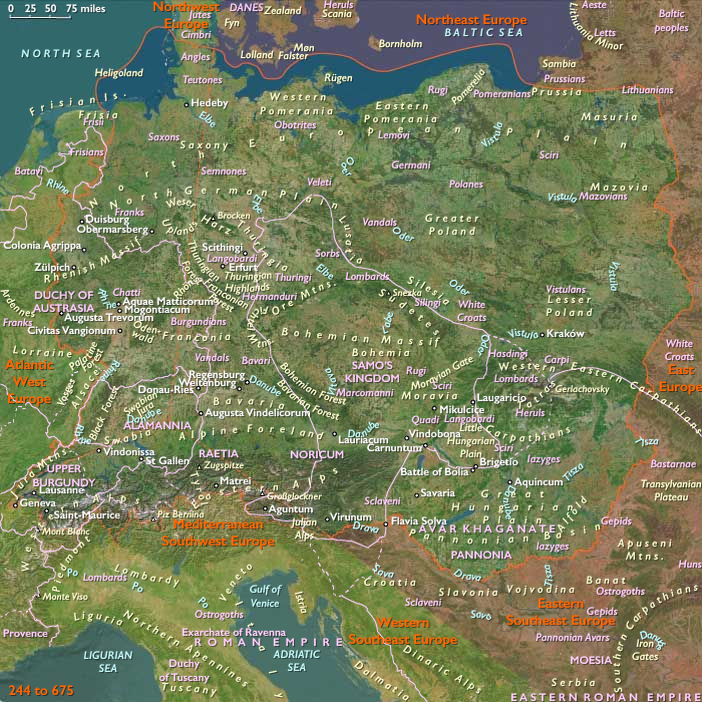
East Central Europe (244–387 CE): Germanic Migrations, Sarmatian Presence, and the Roman Frontier in Crisis
Between 244 and 387 CE, East Central Europe—encompassing modern-day Poland, Czechia, Slovakia, Hungary, and those parts of Germany and Austria lying east of 10°E and north of a line stretching southeastward from approximately 48.2°N, 10°E to the Austro-Slovenian border near 46.7°N, 15.4°E—experienced profound demographic, political, and cultural transformations. This period was characterized by major migrations of Germanic and other tribes—including the Vandals (Asdingi and Silingi), Langobardi (Lombards), Boii, Saxons, Thuringians, Hermunduri, Rugi, Alans, and early proto-Slavic groups such as the Carpi and proto-Croats. Concurrently, an influential nomadic Sarmatian presence, primarily represented by tribes like the Iazyges and Alans, significantly impacted regional dynamics, while weakening Roman frontier control along the Danube profoundly affected stability, trade networks, and cultural interactions.
Political and Military Developments
Migrations of Vandals, Langobardi, and Alans
The Vandals, divided into the Asdingi and Silingi, significantly reshaped regional demographics and political alignments. Originating from territories in present-day Poland and Czechia, they migrated southward and westward under pressure from other tribes, eventually crossing into Roman territories.
The Langobardi (Lombards), initially settled along the lower Elbe, moved steadily southward toward modern-day Austria, Slovakia, and Hungary, becoming influential in regional power struggles and alliances.
The Iranian-speaking Alans, closely allied with the Vandals and representing a major component of the broader Sarmatian tribal confederation, also migrated westward through East Central Europe. Renowned for their skilled cavalry warfare, they notably influenced local military strategies and cultural interactions.
Sarmatian Presence and Influence
The Sarmatians, particularly the Iazyges who inhabited the plains of modern-day Hungary and adjacent areas, exerted considerable political and military influence during the 3rd and early 4th centuries CE. Their powerful cavalry posed significant challenges to Roman frontier defenses, leading to conflicts and diplomatic exchanges that shaped regional political structures.
Rugian Migration and Settlement Stability in Pannonia
Around the early 4th century, the Rugii migrated southward from their homeland in Pomerania, establishing stable settlements along the upper Tisza River in Roman-controlled Pannonia (northeastern Hungary). Their presence provided regional stability amidst widespread upheaval, influencing diplomatic relations and tribal interactions.
Tribal Confederations and Regional Realignments
The Boii, previously dominant in Bohemia (from whom the region derives its name), gradually lost influence due to pressure from migrating Germanic tribes, either assimilating locally or migrating westward.
The rise of tribal confederations, notably the Thuringians and Hermunduri in modern eastern Germany, altered regional trade networks and power balances significantly.
Gothic Migrations and the Battle of Adrianople (376–378 CE)
Major Gothic migrations, driven westward by Hunnic incursions, culminated in the mass crossing of the Danube frontier in 376 CE, destabilizing Roman provinces. The catastrophic defeat of Roman forces at the Battle of Adrianople (378 CE) further eroded Roman frontier control and triggered profound geopolitical shifts.
Decline of Roman Influence in Noricum and Pannonia
Roman provincial authority weakened dramatically in frontier provinces such as Pannonia and Noricum (modern Austria) due to continual raids by Germanic and Sarmatian groups, ultimately leading to reduced military presence and administrative withdrawal.
Economic and Technological Developments
Trade Disruptions and Economic Decentralization
Persistent frontier instability severely disrupted established trade connections between the Roman Empire and East Central Europe, driving regional economies toward greater agricultural self-sufficiency and decentralized metalworking industries.
Roman Infrastructure Restoration
Despite wider disruptions, Roman emperors such as Aurelian (270–275 CE), Diocletian (284–305 CE), Constantine the Great (306–337 CE), and Valentinian I (364–375 CE) periodically strengthened frontier defenses, revitalizing certain regional economic activities and infrastructure such as roads and fortifications.
Technological Continuity and Exchange
Local Germanic, Sarmatian, and proto-Slavic populations continued refining ironworking, pottery, and agricultural techniques, selectively adopting and adapting Roman technologies to maintain productivity despite political disruptions.
Cultural and Artistic Developments
Cross-Cultural Hybridization
Interaction among diverse groups—including Germanic tribes (Vandals, Lombards, Saxons, Thuringians, Hermunduri, Rugi), Iranian-speaking Alans and Sarmatians, Celtic remnants (Boii), and early Slavic populations—resulted in dynamic cultural exchanges and hybridization visible in linguistic developments, artistic traditions, and societal customs.
Sarmatian Artistic Influence
The Sarmatian tribes introduced distinctive artistic styles, especially evident in sophisticated metalwork featuring animal motifs and elaborate cavalry equipment, influencing regional artistic traditions profoundly. Sarmatian burial practices, notably kurgan-style graves with rich grave goods, underscore their cultural impact.
Proto-Slavic Cultural Resilience
Proto-Slavic tribes, such as the Carpi and proto-Croats, began emerging prominently, maintaining stable cultural and social structures despite pressures from migrating Gothic groups. Although some proto-Slavic segments migrated northward, integrating into Finnic-speaking populations, most retained traditional territories, reinforcing local cultural continuity.
Settlement and Urban Development
Decline of Roman Frontier Settlements
Roman urban and military outposts along the Danube frontier experienced widespread decline or abandonment following Gothic incursions, internal Roman weaknesses, and the fallout of the Battle of Adrianople.
Stability of Rugian Settlements
The Rugian settlements along the upper Tisza region maintained considerable stability and economic vibrancy even as adjacent Roman towns deteriorated, demonstrating resilience amid regional disruptions.
Emergence of Germanic and Proto-Slavic Villages
Germanic tribes and early Slavic groups increasingly developed dispersed agricultural settlements characterized by village clusters, timber longhouses, and protective earthworks, replacing earlier Celtic-Roman urbanized settlements.
Social and Religious Developments
Germanic Tribal Leadership and Social Structure
Germanic societies were structured around influential warrior aristocracies, whose leadership relied on military strength, control of trade routes, and diplomatic marriages and alliances.
Sarmatian Social Impact and Equestrian Traditions
Sarmatian nomadic society significantly influenced regional social hierarchies and military organization, particularly through their celebrated equestrian traditions, cavalry tactics, and leadership structures.
Religious Practices and Syncretism
Diverse tribal populations retained traditional religious beliefs—nature worship, ancestral veneration, communal rituals—while interactions between Germanic, Iranian (Alanic and Sarmatian), and Celtic cultures encouraged significant religious syncretism.
Long-Term Consequences and Historical Significance
The period 244–387 CE transformed East Central Europe profoundly, driven by intensified Germanic migrations, influential Sarmatian presence, weakening Roman frontier authority, and the catalytic Gothic invasions culminating in the Battle of Adrianople. The resulting demographic shifts, cultural hybridization, economic decentralization, and political realignments laid essential groundwork for the emergence of early medieval societies. Significantly, the Sarmatian legacy persisted, influencing regional military practices, artistic styles, and later cultural identities—most notably in the enduring cultural mythology adopted by the Polish nobility in subsequent centuries.
The Roman Empire is plagued by internal strife and economic crisis in the third century CE. Two ethnic Illyrian emperors, both born in Southeastern Europe, take decisive steps to prolong the empire’s survival.
- Emperor Diocletian, born in Dalmatia, implements strong central control, establishes a bureaucratic system, and abolishes the last remnants of Roman republican institutions. In an effort to strengthen loyalty to the state, he launches a persecution of Christians, seeking to reduce their allegiance to the church.
- Emperor Constantine, born near Naissus (modern Niš, Serbia), reunites the empire after years of turmoil, introduces dynastic succession, and in 330 CE, founds a new capital at Byzantium, later named Constantinople. He also legalizes Christianity, marking a pivotal shift in Roman religious policy.
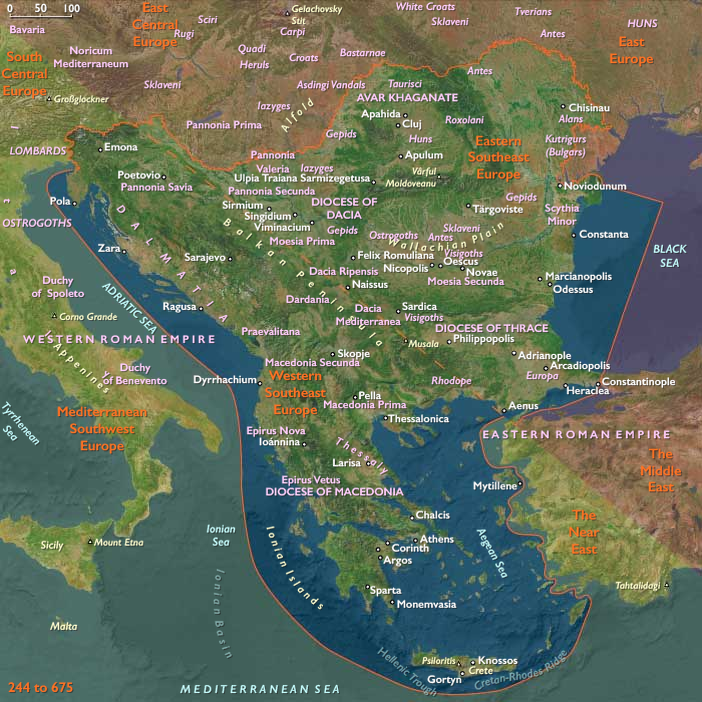
Eastern Southeast Europe (244–387 CE): Imperial Challenges and Transformations
Settlement and Migration Patterns
Intensified Migration and Border Conflicts
Between 244 and 387 CE, Eastern Southeast Europe experienced increased migration pressures and border conflicts. Gothic tribes, notably under leaders such as Cniva, increasingly tested the region’s northern borders, dramatically impacting settlement patterns. In 251 CE, Cniva conquered Philippopolis (modern-day Plovdiv) and killed Roman Emperor Decius and his son at the Battle of Abritus—the first Roman emperor to fall in combat against barbarians. Emperor Aurelian, facing ongoing invasions, ordered a strategic withdrawal from Roman Dacia in 271 CE, relocating Roman troops, officials, and colonists south of the Danube. Many Dacian peasants, however, remained, preserving cultural continuity and influencing future settlement patterns.
Urban Fortification and Adaptation
In response to these increasing pressures, urban centers intensified their fortification efforts. Key cities such as Byzantium (Constantinople), Philippopolis, and especially Serdica (modern-day Sofia) fortified extensively. Serdica flourished as a significant administrative and trading center. The division of the Roman Empire in 395 CE, enacted by Emperor Theodosius’ sons, further solidified regional defense strategies, marking a permanent administrative and cultural separation between Greek-speaking Constantinople and Latin-speaking Rome, profoundly affecting future regional identities.
Economic and Technological Developments
Economic Resilience Amidst Disruptions
Despite external disruptions from frequent invasions, regional economic activities exhibited notable resilience. Agricultural productivity, mining (particularly gold and silver), and trade networks continued functioning effectively, though occasionally compromised by migration and conflict. The Romans actively maintained critical infrastructure, sustaining roads connecting fortresses, mining centers, and trade hubs, thereby ensuring economic continuity.
Defensive Infrastructure and Military Adaptation
Technological advancements primarily focused on military defense and infrastructure development. Enhanced fortifications, improved roads, and robust logistical networks were maintained and expanded to secure military effectiveness. Strategic adjustments such as the abandonment of northern provinces (Dacia) signaled a shift toward consolidating defensible frontiers along the Danube, laying the groundwork for subsequent Byzantine military strategies.
Cultural and Artistic Developments
Cultural Continuity and Artistic Adaptation
Despite disruptions, artistic and cultural traditions endured, adapting to reflect contemporary themes of imperial resilience, spirituality, and stability. Urban centers preserved Greco-Roman heritage through continued patronage of public art, architecture, and monuments, gradually blending these traditions with emerging Christian iconography, notably within urban centers such as Constantinople and Philippopolis.
Intellectual Vitality and the Preservation of Learning
Intellectual and educational pursuits flourished in major cities. The establishment of a university at Constantinople by Theodosius II in 425 (though slightly after this age, its roots lie in this period's intellectual environment) emphasized the ongoing commitment to classical and philosophical learning, fostering scholarly activities and laying foundations for Byzantine intellectual life.
Social and Religious Developments
Administrative Reorganization and Governance Shifts
The empire underwent significant governance shifts due to ongoing external pressures. Diocletian’s administrative reorganization in 285 CE created distinct spheres of jurisdiction between the Greek-speaking East and the Latin-speaking West, fundamentally reshaping regional governance. The relocation of the imperial capital by Emperor Constantine to Byzantium (renamed Constantinople) in 330 CE further strengthened administrative control, making Constantinople a pivotal center for regional governance and military command.
Spread and Institutionalization of Christianity
Christianity’s influence expanded significantly during this era, particularly following official toleration under the Edict of Milan (313 CE). Churches, monastic communities, and theological institutions proliferated throughout Eastern Southeast Europe, embedding Christianity deeply within the region’s social fabric. Constantinople emerged as a central religious hub, where an established patriarchate exercised ecclesiastical authority over the Greek East, laying essential groundwork for future religious developments and theological debates.
Long-Term Consequences and Historical Significance
The period from 244 to 387 CE proved transformative for Eastern Southeast Europe. Intensified migrations, strategic territorial adjustments, administrative reorganizations, and the growing dominance of Christianity deeply impacted regional development. These changes established critical frameworks and traditions that significantly influenced the subsequent historical evolution of the Byzantine Empire, leaving a lasting imprint on regional identity, governance, and culture.
The emperor Diocletian undertakes the reorganization of the Roman Empire in 285, dividing jurisdiction between its Latin-speaking and Greek-speaking halves.
Diocletian's successor, Constantine, establishes his capital in 330 at the Greek city of Byzantium, a "New Rome" strategically situated on the European side of the Bosporus at its entrance to the Sea of Marmara.
The city, embellished and renamed Constantinople, will for nearly twelve centuries remain the capital of the Roman Empire—better known in its continuous development in the East as the Byzantine Empire.
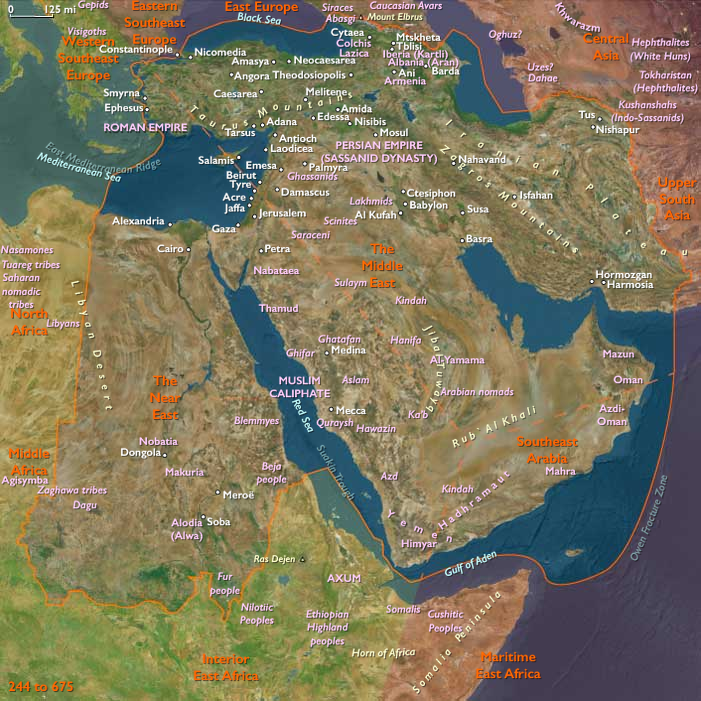
The Middle East: 244–387 CE
Rise of the Sassanid Empire and Persistent Roman Rivalries
The period from 244 to 387 CE in the Middle East is marked by the decline of the Parthian Empire and the rise of the Sassanid Empire, reshaping the political, cultural, and religious landscape. Ardashir I, son of the priest Papak and claiming descent from the legendary hero Sasan, overthrows the last Parthian king in 224 CE and establishes the Sassanid dynasty, which endures for four centuries. Ardashir and his successors reassert Iranian cultural traditions, deliberately distancing themselves from previous Greek influences by fostering a national Persian renaissance.
Under Sassanid rule, the empire approximates the frontiers of the ancient Achaemenid Empire, with its capital established at Ctesiphon. Sassanian rulers adopt the title shahanshah (king of kings), governing numerous local rulers (shahrdars). Persian society is rigidly structured into four primary classes: priests, warriors, secretaries, and commoners, with powerful priests (led by the mobadan mobad), military leaders (eran spahbod), and bureaucratic officials reinforcing this social stratification.
Military Confrontations with Rome
The Roman Empire remains Persia's principal western adversary, inheriting the rivalry from the Greeks. Emperor Shapur I (241–272) conducts successful military campaigns against Rome, culminating in the capture of Emperor Valerian in 260 CE at the Battle of Edessa, symbolizing a high point of Persian military achievement.
However, the fortunes of war fluctuate significantly over this period. Roman Emperor Carus sacks Ctesiphon in 283, temporarily weakening Persian dominance. Under Emperor Diocletian, Roman forces achieve a decisive victory in 298 at the Battle of Satala, reclaiming extensive territories and exerting renewed control over Armenia. Despite these setbacks, the Sassanians retain substantial power, sustaining intermittent hostilities with Rome, notably under Shapur II (309–379), who captures Armenia and repeatedly confronts Emperor Constantius II.
The drawn-out Roman–Sassanian confrontations, epitomized by engagements at Singara and multiple sieges of the fortress city of Nisibis, underscore the sustained strategic rivalry. A notable truce occurs in 387 CE with the Peace of Acilisene, partitioning Armenia into Roman and Persian spheres of influence, temporarily stabilizing the contested frontier.
Religious Transformations and Christianity’s Spread
Religious and cultural transformations are equally significant during this era. Armenia, influenced by early Christian centers like Antioch and Edessa, officially adopts Christianity as its state religion in approximately 306 CE under King Tiridates III, credited to the miracles performed by Saint Gregory the Illuminator. This conversion precedes Emperor Constantine’s legalization of Christianity within the Roman Empire. Similarly, Georgian King Mirian III converts in 330 CE, aligning Georgia culturally and politically with the Byzantine Empire.
Christianity also thrives in Cyprus, bolstered by the legacy of apostles like Paul and Barnabas. Roman rule brings economic prosperity and infrastructure advancements to the island, despite periodic devastation from earthquakes that continually diminish the grandeur of cities like Salamis.
Sassanian Cultural Influence and Economic Expansion
Sassanian Persia’s influence extends significantly across the Persian Gulf, reaching its apex during this period. Persian authorities establish agricultural colonies in Oman, employing local nomadic tribes as border guards against Roman incursions, promoting Persian agricultural practices, irrigation techniques, and Zoroastrian beliefs. Zoroastrianism, Persia's state religion, reinforces Sassanian rule, elevating the priestly class to a powerful political force.
Urban Prosperity and Cultural Exchange
The people of Greater Syria, notably in cities such as Damascus, Palmyra, and Busra ash Sham, maintain economic vitality, leveraging advanced irrigation, alphabetic writing, and astronomical knowledge predating Roman annexation. Emperor Constantine’s relocation of the Roman capital to Byzantium (Constantinople) in 324 reorients regional administrative structures, dividing Greater Syria into provinces Syria Prima and Syria Secunda, enhancing Roman administrative efficiency and economic integration.
Meanwhile, powerful Arab civilizations like the Nabataeans and the Palmyrenes exert economic influence, with Palmyra flourishing as a vital trade hub along caravan routes.
Thus, from 244 to 387 CE, the Middle East undergoes transformative geopolitical, cultural, and religious shifts. The ascendancy of the Sassanid Empire, sustained Roman–Persian confrontations, and the profound spread of Christianity collectively redefine regional dynamics, laying foundational patterns that endure into subsequent eras.
Near East (244–387 CE): Christianity, Imperial Reforms, and Cultural Shifts
Between 244 and 387 CE, the Near East experiences critical transformations through religious developments, imperial restructuring, and cultural shifts that profoundly shape regional dynamics.
Religious Developments and Imperial Christianity
The reign of Emperor Diocletian (284–305) is marked by severe persecutions against Christians, beginning in 303 CE, known as the "Era of Martyrs." Churches are demolished, sacred texts burned, and Christians persecuted throughout the empire. Many Egyptian Christians survive only because their labor is required in the empire's porphyry quarries and emerald mines.
The religious landscape dramatically shifts with Emperor Constantine I, who converts to Christianity and establishes it as the official religion of the empire by 312 CE. Constantine’s Edict of Milan (313 CE) guarantees religious freedom. He moves the imperial capital to Byzantium, renaming it Constantinople (modern-day Istanbul) in 330 CE, which becomes the center of Eastern Roman (Byzantine) political and religious authority.
Egypt experiences rapid Christianization, and by the mid-fourth century, the Egyptian Church is organized under the Patriarchate of Alexandria, second in rank only to Rome. The Council of Nicea (325 CE) affirms Alexandria’s influential status, profoundly shaping early Christian doctrines.
Imperial Administration and Regional Changes
Diocletian introduces significant administrative and fiscal reforms, dividing Egypt into three provinces to streamline governance. His restructuring of the Roman Empire divides jurisdiction into eastern Greek-speaking and western Latin-speaking halves, laying the groundwork for the eventual split between Eastern and Western Roman Empires.
Roman rule extends into the Nabataean kingdom when Emperor Trajan formally annexes the territory in 106 CE, establishing the Roman province of Arabia. The Nabataeans flourish culturally and economically under Roman administration, connected to broader imperial trade networks.
Cultural and Intellectual Contributions
Cultural developments include the influential mathematical contributions of Diophantus of Alexandria, whose seminal work, Arithmetica, introduces algebraic symbolism and sets foundational precedents for number theory. His innovative techniques, later termed Diophantine analysis, inspire centuries of mathematical inquiry.
Christian monasticism arises in the deserts of Egypt and Syria, pioneered by figures such as Saint Anthony the Great and Macarius the Elder, whose monastic communities form the spiritual and cultural backbone of Eastern Christianity.
Socio-Economic Exploitation and Decline
Roman rule in Egypt is characterized by economic exploitation, leading to progressive social and economic decline. The empire treats Egypt primarily as an agricultural estate to benefit Roman elites, with resources drained and minimal reinvestment into local infrastructure.
Despite this, Roman administrators continue religious and architectural traditions, such as completing the Temple of Isis on Philae Island and developing the distinctive Fayum mummy portraits—painted wood images placed on mummy coffins that demonstrate a unique synthesis of Egyptian and Greco-Roman artistic traditions.
Legacy of the Age
This era establishes Christianity as a dominant cultural and political force, restructures imperial governance, and experiences both significant cultural achievements and economic strain. The division of the Roman Empire, the institutionalization of Christianity, and notable cultural advancements set lasting patterns for the Near East’s historical trajectory.
A renaissance of imperial authority and effectiveness takes place under Emperor Diocletian.
The partition of the Roman Empire into eastern and western segments begins during his reign (284-305).
Diocletian inaugurates drastic political and fiscal reforms and seeks to simplify imperial administration.
The administrative unity of Egypt is destroyed under Diocletian by his transforming Egypt from one province into three.
Emperor Diocletian, seeing Christianity as a threat to Roman state religion and thus to the unity of the empire, launches a violent persecution of Christians.
He issues a decree in 303 ordering all churches demolished, all sacred books burned, and all Christians who are not officials made slaves.
The decree is carried out for three years, a period known as the "Era of Martyrs."
The lives of many Egyptian Christians are spared only because more workers are needed in the porphyry quarries and emerald mines that are worked by Egyptian Christians as "convict labor."
The Emperor Diocletian undertakes the reorganization of the Roman Empire in 285, dividing its jurisdiction between its Latin-speaking and Greek-speaking halves.
Diocletian's successor, Constantine, accepts conversion and becomes the first Christian Roman emperor.
He establishes his imperial residence at Byzantium, on the shore of the Bosporus, in 324.
Byzantium is renamed Constantinople and eventually becomes the capital of the Eastern (Byzantine) Empire.
From Constantine's establishment until the crusaders arrive more than eight hundred years later, the history of Cyprus is part of the history of that empire.
Under Constantinople's rule, the Greek orientation that had been prominent since antiquity develops the strong Hellenistic-Christian character that continues to be a hallmark of the Greek Cypriot community.
Christianity is probably already predominant on Cyprus by the time Constantine accepts the new religion for himself, owing mainly to the early missionary work of Paul, Barnabas, and Mark.
Earthquakes in the early fourth century create havoc on the island, and drought seriously damages the economy.
The most significant event of the century, however, is the struggle of the Church of Cyprus to maintain its independence from the patriarchs of Antioch.
Three bishops represent Cyprus at the first Ecumenical Council of Nicaea in 325.
At the second council (Sardica, 343), there are twelve Cypriot bishops, indicating a great increase in the number of communicants in the intervening years.
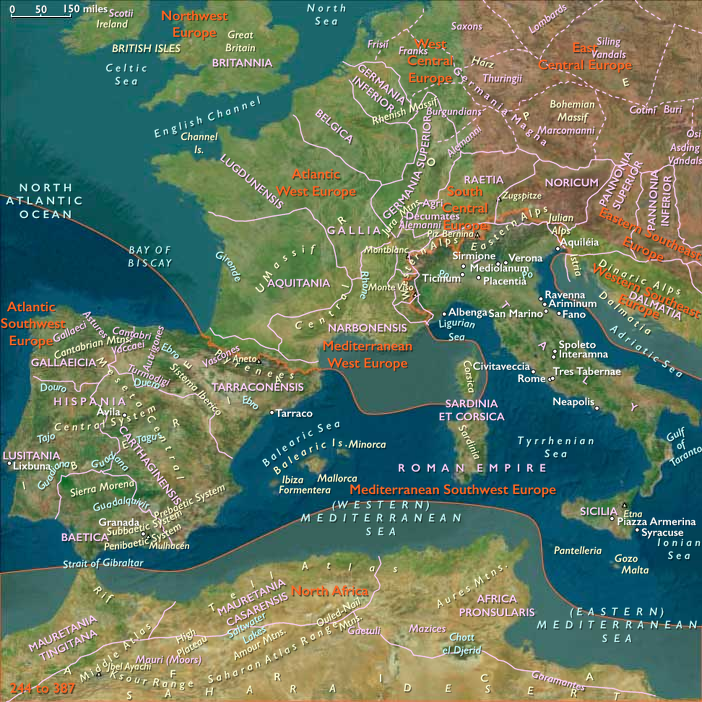
Mediterranean Southwest Europe (244–387 CE): Crisis, Reform, and Transformation
The age 244–387 CE in Mediterranean Southwest Europe encompasses a critical period marked by profound imperial instability, extensive administrative and economic reforms, significant cultural and religious developments, and major transformations within the Roman Empire.
Military Anarchy and Imperial Fragmentation (244–267 CE)
Following the collapse of the Severan dynasty, Rome descends into military anarchy, characterized by frequent changes in imperial leadership, widespread economic disruption, and intensified external pressures from Germanic and Persian incursions. Economic decline and provincial autonomy grow as centralized authority weakens.
Aurelian's Restoration and Economic Reforms (268–279 CE)
Emperor Aurelian (270–275 CE) briefly restores imperial unity, reconquering breakaway territories and initiating critical economic reforms. He constructs defensive fortifications such as Rome's Aurelian Walls, revitalizing stability and temporarily reversing economic deterioration.
Diocletian's Reforms and the Tetrarchy (280–303 CE)
Diocletian ascends in 284 CE, significantly reforming administrative, military, and economic structures through the establishment of the Tetrarchy—a system designed to stabilize governance by dividing power among four emperors. His policies include provincial restructuring, fortified frontiers, currency stabilization, and the Edict on Maximum Prices.
Collapse of the Tetrarchy and Constantine’s Rise (304–315 CE)
The Tetrarchy disintegrates following Diocletian’s retirement in 305 CE, leading to intense civil wars. Constantine the Great emerges victorious at the Battle of Milvian Bridge (312 CE), issuing the landmark Edict of Milan (313 CE), which grants religious tolerance to Christianity and reshapes imperial religious policy.
Constantine's Consolidation and the Council of Nicaea (316–327 CE)
Constantine consolidates imperial authority, establishing the new imperial capital, Constantinople, in 324 CE. His reign sees the First Council of Nicaea (325 CE), decisively shaping Christian doctrine through the Nicene Creed, significantly impacting religious uniformity and ecclesiastical structures.
Dynastic Rivalries and Imperial Instability (328–351 CE)
Following Constantine’s death, dynastic rivalries erupt among his sons—Constantine II, Constantius II, and Constans—leading to internal conflict, division of the empire, and instability. The assassination of Constans (350 CE) by the usurper Magnentius further destabilizes the empire, underscoring deep-seated political vulnerabilities.
Cultural Flourishing and Christian Symbolism (352–363 CE)
Cultural life thrives despite political uncertainties, notably illustrated by the sarcophagus of Junius Bassus (359 CE). Christian symbolism increasingly permeates artistic and intellectual expression, transforming classical Roman traditions through integration with Christian narratives and iconography.
Imperial Division and Valentinian Dynasty (364–375 CE)
Valentinian I divides imperial responsibilities with his brother Valens in 364 CE, establishing a precedent for administrative separation between Western and Eastern empires. His reign sustains regional prosperity, fortifies frontier defenses, and navigates religious tensions, reflecting complex internal dynamics.
Gothic Crisis and Imperial Struggles (376–387 CE)
The Gothic influx of 376 CE triggers severe crises, culminating in the catastrophic Battle of Adrianople (378 CE), where Emperor Valens perishes. Theodosius I’s subsequent rule attempts imperial recovery, notably through treaties integrating Gothic tribes as federate allies, and the Edict of Thessalonica (380 CE), which declares Nicene Christianity the empire’s official faith.
Legacy of the Age
The age 244–387 CE profoundly reshapes Mediterranean Southwest Europe through cycles of crisis, reform, and transformation. Among its enduring legacies are the restructuring of imperial governance, the rise and consolidation of Christianity as the official religion, and resilient cultural developments. The Roman influence deeply shapes Western civilization, evident in the widespread adoption of Romance languages derived from Latin, the numerical system, the modern Western alphabet and calendar, and the establishment of Christianity as a major world religion. Christianity, introduced into Spain in the first century, becomes widespread in urban centers by the second century but gains significant influence in rural areas only by the late fourth century. Despite the emergence of heretical sects, the Spanish Church remains subordinate to the Bishop of Rome, shaping the region’s religious identity for centuries.