Gaius Gracchus
Roman politician and general
Years: 154BCE - 121BCE
Gaius Sempronius Gracchus (154 BCE – 121 BCE) is a Roman Populari politician in the 2nd century BC and brother of the ill-fated reformer Tiberius Sempronius Gracchus.
His election to the office of tribune in the years 123 and 122 BCE and reformative policies while in office prompts a constitutional crisis and his death at the hands of the Roman Senate in 121.

Related Events
Filter results
Showing 8 events out of 8 total
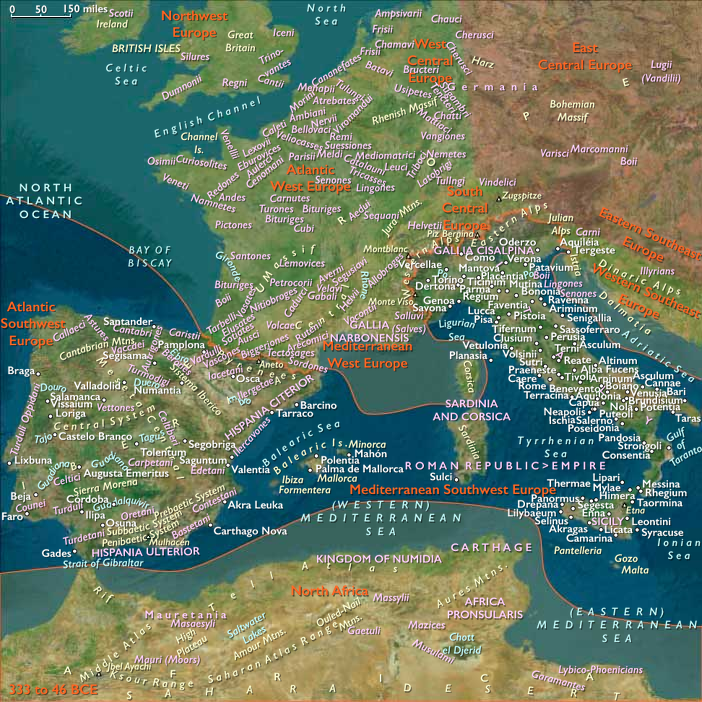
Mediterranean Southwest Europe (189 BCE–46 BCE): Roman Expansion and the End of the Republic
The age 189 BCE to 46 BCE is characterized by Rome's expansion and consolidation of power throughout Mediterranean Southwest Europe, marked by significant military conflicts, colonization, and internal political upheaval culminating in the collapse of the Roman Republic.
Rome’s Dominance and Greco-Roman Integration
Following Rome's victory against Seleucid king Antiochus III around 189 BCE, the Roman Republic asserts itself as the dominant power across the Mediterranean basin. Rome notably rewards its supporters such as Pergamon and Rhodes, while punishing opponents like the Aetolians, thereby altering the balance of power in favor of its allies and signaling the start of an era characterized by the fusion of Greek and Roman political and cultural elements.
Roman Expansion and Conflict in Hispania
From 181 to 179 BCE, the First Celtiberian War is fought between Rome and the Celtiberian tribes of Hispania Citerior, highlighting Rome’s increasing involvement in Iberian affairs. Rome’s aggressive colonization and military presence trigger continuous resistance among the indigenous populations, laying groundwork for future conflicts such as the prolonged and challenging Numantine War (154–133 BCE), initiated by rebellions among the Celtiberian tribes around Numantia.
Socio-Political Reform and Unrest
The internal struggles of Rome intensify significantly in the late second century BCE, epitomized by the reform efforts of the Gracchi brothers. Attempting to address vast socio-economic disparities through land reform legislation, both brothers ultimately face assassination, revealing deep-rooted tensions between the plebeians and the ruling patrician elite, and highlighting the vulnerability of the Roman political system.
Military Crises and Civil Wars
Rome endures several severe military and internal crises in the late second and early first centuries BCE. The catastrophic Roman defeat at the Battle of Arausio in 105 BCE against the migrating Cimbri and Teutones triggers a major military reform under Gaius Marius. This reform significantly reshapes the Roman army, paving the way for Roman victories at Aquae Sextiae (102 BCE) and Vercellae (101 BCE).
Meanwhile, internal conflicts intensify, as evidenced by Sulla’s civil wars (88–82 BCE), the Social War (90–88 BCE), and subsequent confrontations such as the rebellions led by Marcus Aemilius Lepidus and the insurgency of Sertorius in Hispania (80–72 BCE). These struggles underscore the Republic’s escalating internal instability.
Julius Caesar and the Collapse of the Republic
The final decades of this era are dominated by the political and military ascent of Julius Caesar, culminating in Caesar’s Civil War (49–45 BCE). Caesar’s crossing of the Rubicon River in 49 BCE symbolizes the irreversible rupture of Roman political order, sparking a conflict against the senatorial faction led by Pompey the Great.
After pivotal victories at Pharsalus, the Battle of the Nile in Egypt, and at Thapsus in Africa, Caesar consolidates unprecedented political power. His dictatorship marks the definitive end of the Republic, transitioning Rome toward imperial governance.
Colonization and Cultural Developments
Throughout this era, Roman colonization continues, notably in northern Italy. The region around modern Como, inhabited by the Celtic Orobii tribe, becomes a Roman colony, exemplifying Rome’s strategic and cultural assimilation in newly conquered territories.
Researchers have also detected cobalt in glass found in the ruins of Pompeii, indicating sophisticated Roman manufacturing techniques and trade networks, further reflecting the region's economic and technological advancement during this period.
Legacy
The period from 189 BCE to 46 BCE significantly reshapes Mediterranean Southwest Europe, marking Rome’s transformation from a powerful Republic to the cusp of imperial dominion. Political turmoil, military expansion, socio-economic reforms, and cultural integration during these critical centuries forge the region’s historical legacy and lay foundations for the forthcoming Roman Empire.
Scipio Aemilianus, sent as consul to Hispania Citerior in 134 CE to end the war, recruits twenty thousand Roman soldiers and forty thousand allies, including Numidian cavalry under Jugurtha.
Scipio builds a ring of seven fortresses around Numantia itself before beginning the siege proper.
Scipio is accompanied by his brother-in-law Gaius Sempronius Gracchus, the younger brother of Tiberius.
Quintus Fabius Maximus Aemilianus, Scipio’s elder brother, had served under his blood father in the Third Macedonian War and was sent by his father to Rome to announce the news of the Roman victory at Pydna.
Fabius had served as praetor in Sicily during 149 BCE - 148 BCE and was elected consul for 145 BCE.
After his consulship he had gone as proconsul to Hispania where he fought and defeated Viriathus in an episode of the Lusitanian War but had failed to capture him.
He serves at Numantia as Scipio’s legate.
After suffering pestilence and famine during an eight-month siege, most of the four thousand surviving Numantines commit suicide rather than surrender to Rome.
The Romans completely raze Numantia and enslave or kill its inhabitants.
The great Roman victory ushers in an era of peace in Hispania that will last until the Sertorian War over half a century later.
Tiberius, elected to the office of tribune in 133 BCE, immediately begins pushing for a program of land reform, partly by invoking an old Licinian law that limits the amount of land that could be owned by a single individual.
Using the powers of Lex Hortensia, Tiberius establishes an agrarian commission to oversee the redistribution of land holdings from patricians to peasants.
The commission consists of himself, his father-in-law Appius, and his brother Gaius.
Their post allows them to survey the ager publicus, publicly owned land that Tiberius wants to distribute among veterans of the Punic War.
Another faction in the Senate opposes them, as does the city’s conservative Optimate faction.
Even liberal senators are agitated, fearing their own lands would be confiscated.
Senators arranged for other tribunes to oppose the reforms.
The Senate gives trivial funds to the commission.
However, late in 133 BCE, Attalus III of Pergamon having died and left his entire fortune (including the whole kingdom of Pergamon) to Rome, Tiberius sees his chance and immediately uses his tribunician powers to allocate the fortune to fund the new law.
This is a direct attack on Senatorial power, since it is traditionally responsible for the management of the treasury and for decisions regarding overseas affairs.
The opposition of the Senate to Gracchus increases.
His overruling of the tribunician veto is considered illegal, and his opponents are determined to prosecute him at the end of his one year term, since he is regarded as having violated the constitution and having used force against a tribune.
Tiberius now appeals to the people, and argues that a tribune who opposes the will of the people in favor of the rich is not a true tribune.
The senators are left with only one constitutional response – to threaten prosecution after Tiberius's term as a tribune ends.
To protect himself further, Tiberius Gracchus seeks reelection to the tribunate, promising to shorten the term of military service, abolish the exclusive right of senators to act as jurors, and admit allies to Roman citizenship.
As the voting proceeds, violence breaks out on both sides.
Tiberius' cousin, Publius Cornelius Scipio Nasica, saying that Tiberius wishes to make himself king, leads the senators down towards Tiberius.
In the resulting confrontation, Tiberius is beaten to death with the chairs of the senators and thrown into the Tiber.
They also had gathered an ad hoc force, with several of them personally marching to the Forum.
Some three hundred of Tiberius’ followers, who were waiting outside the senate, perish with him, clubbed to death.
This is the first open bloodshed in Roman politics for nearly four centuries.
Plutarch says, "Tiberius' death in the senate was short and quick.
Although he was armed, it did not help him against the many senators of the day."
Mediterranean Southwest Europe (129–118 BCE): The Gracchan Reforms and Roman Social Turmoil
The era 129–118 BCE witnesses pivotal developments within the Roman Republic, characterized by profound political and social tensions centered on land reform and wealth redistribution, accompanied by innovations in public communication. These events significantly influence Roman governance, social dynamics, and political culture in Mediterranean Southwest Europe and beyond.
The Gracchan Reform Movement
The Roman Republic faces escalating social tensions stemming from the increasing disparity between Rome's wealthy patrician elite and the disenfranchised plebeian majority. In response, two influential Roman tribunes, brothers Tiberius and Gaius Gracchus, propose sweeping land reform legislation aimed at redistributing extensive patrician landholdings among landless and impoverished plebeian citizens. Their reform efforts also include wider measures addressing economic inequality and social injustice.
Initially, the Gracchi achieve notable legislative successes, rallying popular support and challenging entrenched senatorial interests. However, their reforms threaten the political and economic power of Rome's senatorial aristocracy, prompting fierce opposition from powerful patrician factions.
Tragically, both Gracchi brothers ultimately fall victim to this elite backlash. Tiberius Gracchus is assassinated in 133 BCE, marking the first significant eruption of organized political violence in the Republic, and his younger brother, Gaius Gracchus, meets a similar violent fate in 121 BCE. These assassinations starkly illustrate the increasing volatility and internal conflict plaguing the Roman state, signaling profound future implications for republican governance.
Emergence of the Acta Diurna
Concurrent with this period of social unrest, Rome experiences significant advances in public information dissemination. Around 131 BCE, the establishment of the Acta Diurna (Latin: "Daily Acts") introduces a state-sanctioned daily news gazette posted prominently in public locations, such as the Roman Forum. These postings report on varied topics, including official government appointments, notable births and deaths, significant public decisions, and even astronomical occurrences.
Carved on stone or metal tablets, the Acta Diurna represent an innovative attempt by the Roman Republic to ensure transparency and enhance public communication, setting a precedent for future methods of mass communication across the Roman world. This pioneering institution provides citizens with regular access to official information and public records, facilitating an increased awareness of civic affairs and reflecting the changing relationship between Rome's government and its populace.
Long-Term Impact and Significance
The Gracchan reforms and their violent suppression, alongside the advent of the Acta Diurna, significantly shape Rome's subsequent social, political, and administrative trajectory. The events of this era underscore growing tensions between populist reform movements and entrenched elite interests, presaging the deep internal conflicts that will ultimately transform the Roman Republic. The era also sees early innovations in civic communication, indicative of Rome's ongoing evolution toward greater administrative complexity and societal interconnectedness, foreshadowing the imperial era ahead.
The popularity of Scipio Africanus Minor has waned in direct proportion to his increasing conservatism.
Although not in sympathy with the extreme conservative party, Scipio is decidedly opposed to the schemes of the Gracchi (whose sister Sempronia is his wife).
When he heard of the death of Tiberius Gracchus, he is said to have quoted the line from the Homer's Odyssey (i. 47), "So may all who engage in such lawless conspiracies perish"; after his return to Rome he was publicly asked by the tribune Gaius Papirius Carbo what he thought of the fate of Tiberius, and had replied that he was justly slain.
The crowd listening to this comment had responded with jeers, to which Scipio quickly replied: "I have never been scared by the shouts of the enemy in arms. Shall I be frightened by your outcries, you stepsons of Italy?" (Ward, Allen M., Heichelheim, Fritz M., and Yeo, Cedric A., A History of the Roman People, Prentice Hall, Upper Saddle River, New Jersey, 2003, 158).
This had given dire offense to the popular party, which was now led by his bitterest foes.
Soon afterwards, in 129 BCE, on the morning of the day on which he had intended to make a speech in reference to the agrarian proposals of the Gracchi, he is found dead in bed with marks "allegedly evident" on his body.
There have been three scenarios proposed for his death; murder, suicide, or suffocation.
The mystery of his death is never solved.
Quintus Fabius Maximus, a known orator and a man of letters, presents a banquet to the citizenry of Rome and pronounces the funeral oration of the deceased general, who is his blood uncle.
Gaius Sempronius Gracchus, having taken on the reforms of his murdered brother, is elected tribune in 123 BCE.
He promotes further redistribution of land to the poor, grain subsidies, and public-works employment.
Gaius also presses for citizenship for Rome's Italian allies and increased power for the wealthy, nonsenatorial class of equestrians, through control of the courts trying provincial officials and control of provincial tax collecting.
Equestrians replace the senators in Rome’s jury system in 122 BCE.
Opponents of Gaius’ reforms appeal to disparate interests among the Roman factions to deny Gaius their support, but he narrowly wins election to a second term.
Opponents of Gaius’s reforms appeal to disparate interests among the Roman factions to deny Gaius their support, but he narrowly wins election to a second term as tribune.
The patrician Marcus Livius Drusus, set up as tribune by the Senate in 121 BCE to undermine Gaius Gracchus' land reform bills, leads a conservative faction that works to disgrace the reformer.
To do this, he proposes creating twelve colonies with three thousand settlers each from the poorer classes, and relieving rent on property distributed since 133 BCE.
He also says the Latin allies should not be mistreated by Roman generals, which is the counteroffer to Gaius' offer of full citizenship.
These are known as the Leges Liviae, but they are never enacted, because the Senate simply wants to draw support away from Gracchus.
Their plan is successful and Drusus has enough support to veto Gaius' bill.
When Gaius fails to win election to a third tribunate, he assembles armed followers to oppose the repeal of his legislation.
A murder results, and the Senate for the first time passes the senatus consultum ultimum (extreme decree of the senate), declaring a state of emergency.
Gaius is killed during the subsequent mob violence, in which 3000 of his plebeian followers also die.
Both Gaius and his brother Tiberius had intended their reforms to deal with urgent problems, but they also designed them to strengthen themselves in their rivalry with other senators.
Their deaths open Rome to anarchy and civil war.
The Gracchi’s attempts at reform also herald the beginning of two political groupings in the Senate: the “Optimates,” the conservative "good men," and the “Populares,” who agitate for reforms, are not political parties but rather representative of trends, or tendencies.