John II Casimir Vasa
King of Poland and Grand Duke of Lithuania
Years: 1609 - 1672
John II Casimir (Polish: Jan II Kazimierz Waza; German: Johann II.
Kasimir Wasa; Lithuanian: Jonas Kazimieras Vaza (22 March 1609 – 16 December 1672) is King of Poland and Grand Duke of Lithuania during the era of the Polish-Lithuanian Commonwealth, Duke of Opole in Upper Silesia, and titular King of Sweden 1648-1660.
His parents are Sigismund III Vasa (1566-1632) and Constance of Austria (1588-1631).
His older brother, and predecessor on the throne, is Władysław IV Vasa.
Related to the Habsburg rulers of the Holy Roman Empire he is the third and last monarch on the Polish throne from the House of Vasa.
He is the last ruler of Polish-Lithuanian Commonwealth bearing a dynastical blood of House of Gediminas and a branch of it, the Jagiellons, although from the female line.
Related Events
Filter results
Showing 10 events out of 161 total
The potop is one of the most dramatic instances of the Poles' knack for prevailing in adversity, but despite the improbable survival of the commonwealth in the face of the episode, it has inflicted irremediable damage and contributes heavily to the ultimate demise of the state.
When Jan II Kazimierz abdicates in 1668, the population of the commonwealth has been nearly halved by war and disease.
War has destroyed the economic base of the cities and raised a religious fervor that ends Poland's policy of religious tolerance.
Henceforth, the commonwealth will be on the strategic defensive facing hostile neighbors.
Never again will Poland compete with Russia as a military equal.
In the mid-seventeeth century, a Cossack military quasi-state, the Zaporozhian Host, is formed by Dnieper Cossacks and by Ruthenian peasants who have fled Polish serfdom.
Poland exercises little real control over this population, but finds the Cossacks to be a useful opposing force to the Turks and Tatars, and at times the two are allies in military campaigns.
However the continued harsh enserfment of peasantry by Polish nobility and especially the suppression of the Orthodox Church alienates the Cossacks.
The Cossacks seek representation in the Polish Sejm, recognition of Orthodox traditions, and the gradual expansion of the Cossack Registry.
These are rejected by the Polish nobility, who dominate the Sejm.
In 1648, Bohdan Khmelnytsky and Petro Doroshenko lead the largest of the Cossack uprisings against the Commonwealth and the Polish king John II Casimir.
After Khmelnytsky makes an entry into Kiev in 1648, where he is hailed liberator of the people from Polish captivity, he founds the Cossack Hetmanate, which will exist until 1764 (some sources claim until 1782).
Khmelnytsky, deserted by his Tatar allies, suffers a crushing defeat at Berestechko in 1651, and turnsto the Russian tsar for help.
In 1654, Khmelnytsky signs the Treaty of Pereyaslav, forming a military and political alliance with Russia that acknowledges loyalty to the Russian tsar.
Northeast Europe (1648–1659 CE): Treaty of Westphalia, Swedish Expansion, and Regional Rivalries
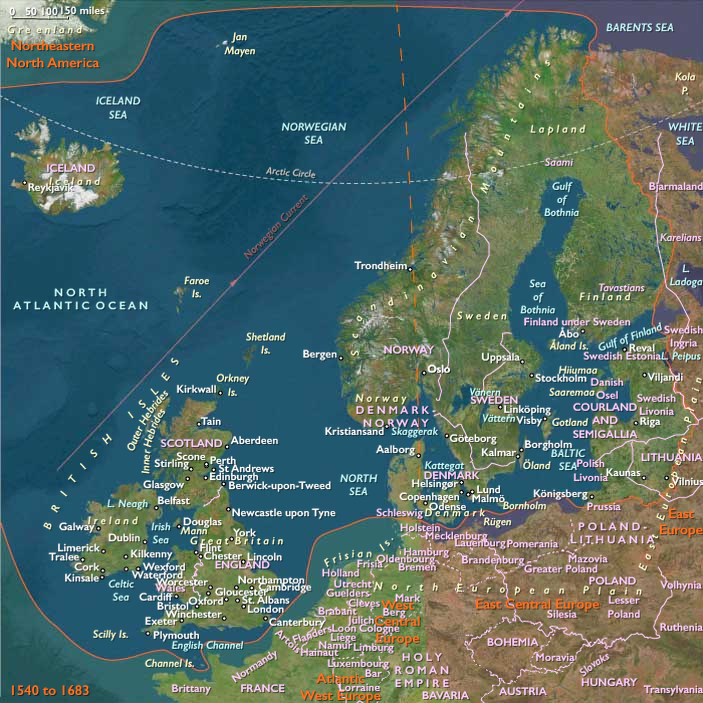
Between 1648 and 1659 CE, Northeast Europe experienced profound changes driven by the aftermath of the Thirty Years' War and the Treaty of Westphalia. The era was characterized by continued Swedish territorial expansion, renewed Danish–Swedish rivalry, and complex diplomatic maneuverings that reshaped regional alliances and cultural developments.
Impact of the Treaty of Westphalia
The Treaty of Westphalia (1648), ending the Thirty Years' War, confirmed Sweden's status as a major European power. Sweden secured significant territories along the Baltic coast, including Western Pomerania, reinforcing its dominance in the region and bolstering its economic and strategic influence. This settlement marked a critical turning point, enhancing Swedish prestige and geopolitical power.
Continued Swedish Expansion and Influence
Under Queen Christina until her abdication in 1654, and subsequently under Charles X Gustav (r. 1654–1660), Sweden consolidated territorial acquisitions in Livonia, Estonia, and along the Baltic coastline. Cities such as Reval (Tallinn), Riga, and Narva saw enhanced military fortifications and expanded governance, solidifying Swedish authority and economic prosperity.
Danish–Swedish Rivalry and Conflicts
Renewed hostilities emerged between Sweden and Denmark–Norway, culminating in the Northern Wars. Under King Frederick III (from 1648), Denmark–Norway challenged Sweden's regional ascendancy, leading to the outbreak of war in 1657. Despite initial Danish successes, Sweden achieved significant victories, notably crossing the frozen Danish straits in 1658 and forcing Denmark into the Treaty of Roskilde (1658), transferring substantial territories, including Scania, Halland, and Blekinge, to Sweden.
Polish–Lithuanian Commonwealth and Eastern Stability
The Polish–Lithuanian Commonwealth under King John II Casimir Vasa (from 1648) faced significant internal strife and external threats, notably from Sweden and Muscovy. The devastating Swedish invasion during the Deluge (1655–1660) severely weakened the Commonwealth, prompting diplomatic and military efforts to stabilize eastern territories and recover lost influence.
Muscovy’s Assertiveness and Expansion
Under Tsar Alexis I (r. 1645–1676), Muscovy intensified efforts to reclaim influence in the Baltic and neighboring regions. Alexis pursued active diplomatic and military strategies, challenging Polish–Lithuanian and Swedish interests, especially in contested territories like Livonia and Ingria, marking a more assertive Muscovite presence in regional politics.
Prussian Strength and Strategic Neutrality
The Duchy of Prussia, under Duke Frederick William I (the Great Elector), continued strengthening internal stability and economic prosperity. Prussian neutrality during regional conflicts enabled Königsberg and surrounding urban centers to flourish economically and politically, establishing Prussia as a significant and stable entity within Northeast Europe.
Economic Prosperity in Key Urban Centers
Cities such as Reval (Tallinn), Riga, Königsberg, and Visby remained economic hubs, driven by robust maritime commerce, merchant activities, and effective urban governance. These urban centers maintained regional economic stability despite military conflicts and political turbulence.
Cultural and Intellectual Vibrancy
Protestant institutions, particularly Lutheran universities and academies, continued to thrive, advancing educational and cultural development. Increased literacy, intellectual exchanges, and scholarly pursuits significantly enhanced Northeast Europe's cultural and intellectual landscape, reaffirming its position as a leading intellectual hub.
Scientific and Scholarly Advances
The region maintained a strong intellectual tradition, with continued contributions in astronomy, mathematics, and natural sciences. Inspired by scholars like Tycho Brahe, Northeast European scientists and intellectuals contributed significantly to European scientific discourse, fostering innovation and scholarly prestige.
Complex Diplomatic Maneuvers
Diplomatic interactions intensified during this period, marked by shifting alliances, strategic negotiations, and careful management of territorial interests. Relations among Sweden, Denmark–Norway, Poland–Lithuania, Muscovy, and Prussia remained fluid and strategically complex, reflecting ongoing geopolitical uncertainties.
Legacy of the Era
The period from 1648 to 1659 CE significantly reshaped Northeast Europe's political, territorial, and cultural landscapes. The aftermath of Westphalia, renewed rivalries, and substantial cultural advancements deeply influenced subsequent historical trajectories, setting enduring regional boundaries, political alliances, and cultural identities.

Khmelnytsky, assured that John II Casimir Vasa, elected to succeed his nephew-by-second-marriage on the Polish throne, will not interfere with his designs on Ruthenia, makes a triumphant entry into Kiev on Christmas Day of 1648, where he is hailed as "the Moses, savior, redeemer, and liberator of the people from Polish captivity ... the illustrious ruler of Rus".
Khmelnytsky, persuaded not to lay siege to Lviv in exchange for two hundred thousand red guldens, now rests in Zamość, awaiting the election of a new Polish King.
From Vienna, Petar Parchevich next visits the new Polish king, Jan II Kazimierz Vasa, as well as ...
....the Austrian royal court, being denied assistance at all three places.
The tide turns against the Poles following the inconclusive battle at Zbarazh, in which the Commonwealth forces withstand a forty-three-day siege, and ...
the bloody two-day battle of Zboriv, where Crown forces of about twenty-five thousand led by King John II Casimir, on the march to relieve the forces besieged in Zbarazh, meet with a combined force of Cossacks and Crimean Tatars, led by Hetman Bohdan Khmelnytsky and Khan İslâm III Giray of Crimea respectively, which numbers about eighty thousand.
The Poles ask for talks, and the khan forces Khmelnytsky to enter into them, possibly after being bribed by the Poles.
Khmelnytsky gains numerous privileges for the Cossacks under the Treaty of Zboriv, which places the Bratslav Voivodeship, Chernihiv Voivodeship, and the Kiev Voivodeship under complete control of the Cossacks; the Orthodox Church is granted privileges, and the Crimean Khanate is to be paid a large sum of money.
The Polish Sejm’s refusal to ratify the Treaty of Zboriv leads to a resumption of fighting in 1651.
At the three-day Battle of Berestechko (the biggest battle of the seventeenth century), two thousand Polish cavalry (one regiment under the command of Aleksander Koniecpolski, supported by Jerzy Lubomirski, six pancerni cavalry companies of Jeremi Wiśniowiecki and winged hussars under the command of Stefan Czarniecki) repulse the Tatars, who suffer heavy losses.
During the first day of the battle, on June 28, the Poles are victorious.
Encouraged by their victory in the first day, the Poles deploy all available cavalry on the second.
Polish infantry and artillery stay in the camp and do not support the cavalry, thus enabling the Tatar cavalry to defeat its Polish counterpart.
The Tatars come near to the Polish camp but are repulsed by heavy fire from the Polish infantry.
The Poles lose three hundred soldiers, including many officers.
The rebels are victorious during the second day of the battle.
On the afternoon of the third day of battle, Duke Jeremi Wiśniowiecki leads a successful charge of eighteen cavalry companies against the right wing of the Cossack-Tatar Army.
The Polish center, under the command of John Casimir, moves forward.
The Tatars try to attack it, but are repulsed.
During the fight, a Polish nobleman called Otwinowski notices a banner of the Tatar Khan.
Polish artillery starts to fire in that direction, and a Tatar standing next to the Khan falls dead.
Panicked, the Khan escapes and the Tatars retreat, kidnapping Khmelnytsky.
Only the Cossack wagons remain at the field of battle, which Polish forces now besiege.
Initially, the wagons had been commanded by Colonel Filon Dzhalalii but after some days, he had been replaced by Colonel Ivan Bohun, a close associate and friend of Khmelnytsky.