Matthew Kantakouzenos
East Roman (Byzantine) emperor
Years: 1325 - 1383
Matthew Kantakouzenos or Cantacuzenus (c. 1325 – June 15, 1383) is East Roman (Byzantine) emperor from 1353 to 1357.


Related Events
Filter results
Showing 10 events out of 10 total
The Byzantine civil war of 1352–1357, which marks the continuation and conclusion of a previous conflict that lasted from 1341 to 1347, involves John V Palaiologos against the two Kantakouzenoi, John VI Kantakouzenos and his eldest son Matthew Kantakouzenos.
John V emerges victorious as the sole emperor, but the resumption of civil war complete the destruction of the previous conflict, leaving the East Roman (Byzantine) state in ruins.
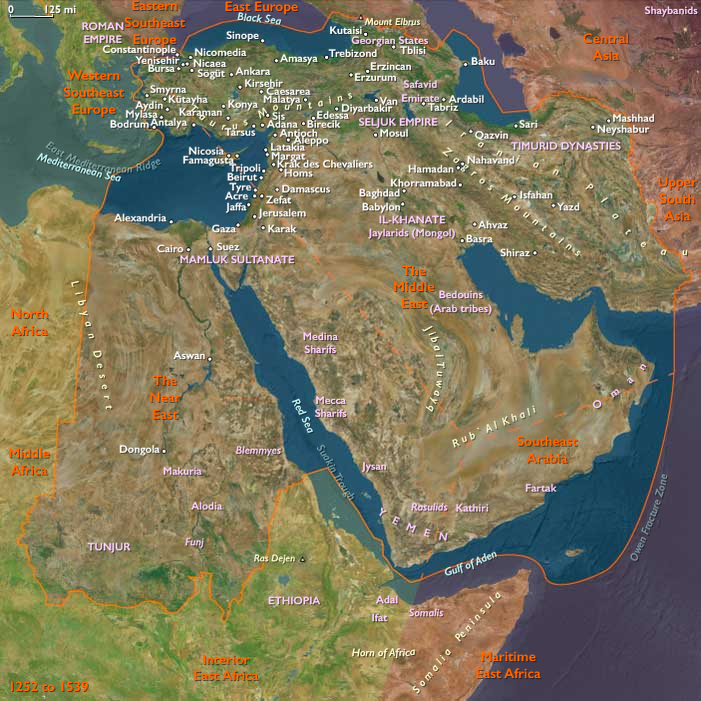
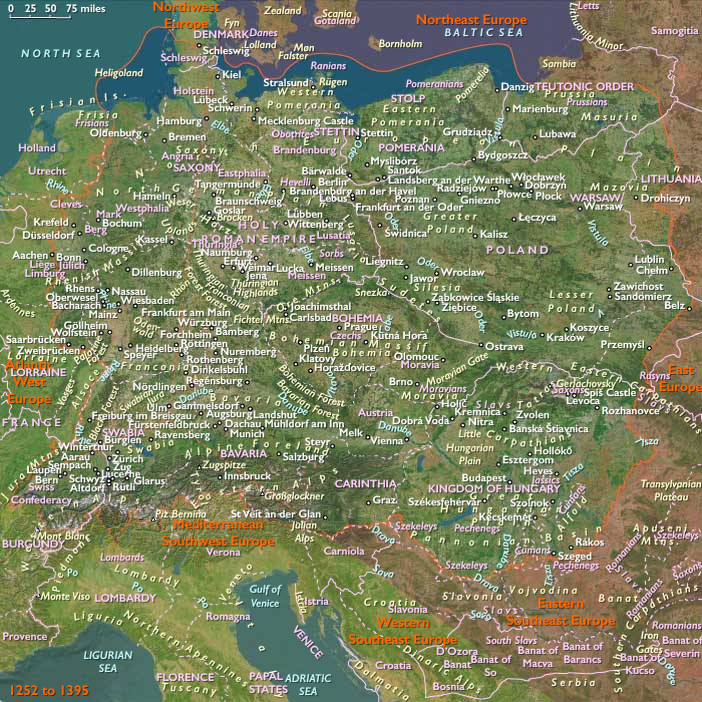
Eastern Southeast Europe (1348–1359 CE): Civil War, Regional Ascendancy, and Early Ottoman Incursions
Settlement and Migration Patterns
Civil War and Population Displacement
From 1348 to 1359, Eastern Southeast Europe endured continued internal upheaval and population displacement caused by the protracted Byzantine civil wars. The Byzantine civil war of 1352–1357, marking the continuation and conclusion of the earlier conflict (1341–1347), severely disrupted urban and rural life, leading to economic collapse and significant demographic shifts within Byzantine territories.
Moldavian Frontier and Hungarian Settlements
In Moldavia, new settlements emerged under Hungarian influence. In 1353, Hungarian King Louis I dispatched Dragoș, a Vlach leader from Maramureș, to establish defensive settlements against incursions from the Golden Horde along the Siret River. This initiative formed the nucleus of what would become the principality of Moldavia, centered around Baia (Târgul Moldovei or Moldvabánya), reinforcing Hungarian dominance east of the Carpathians.
Political Dynamics and Regional Rivalries
Byzantine Civil War and Imperial Decline
The Byzantine civil war of 1352–1357 between John V Palaiologos and the Kantakouzenoi (John VI Kantakouzenos and his son Matthew Kantakouzenos) further weakened Byzantine central authority. John V eventually emerged victorious as sole emperor, but the protracted internal conflicts left the empire critically vulnerable to external threats, particularly the rapidly expanding Ottoman Turks.
Serbian Ascendancy under Stefan Dušan
Under King Stefan Dušan (r. 1331–1355), the Serbian kingdom reached its zenith, expanding from Belgrade to the southern Greek territories, nearly forming a new Serbo-Greek empire. His sudden death in 1355 at age forty-seven halted further Serbian consolidation, significantly altering Balkan power dynamics and inadvertently enabling Ottoman expansion into the region.
Bulgarian Fragmentation
The weakening of the Bulgarian Empire, exacerbated by territorial losses to Serbia and internal feudal conflicts, resulted in the fragmentation of Bulgarian territories into two rival kingdoms in the late 1350s: one centered at the imperial capital Veliko Tŭrnovo, and the other at Vidin along the Danube, reflecting Bulgaria’s declining political cohesion.
Economic and Technological Developments
Economic Devastation from Civil Strife
The Byzantine civil wars inflicted lasting economic devastation, undermining trade networks, agricultural productivity, and urban commercial activities. The resulting fiscal collapse severely weakened Byzantine economic structures, making recovery difficult and further exposing the empire to external threats.
Hungarian Frontier Defense and Development
The Hungarian fortifications along the Moldavian frontier, initiated by Dragoș’s expedition, significantly influenced local economies and settlements. Defensive structures along the Siret River region—including the fortified settlements near Chilia and other strategic locations—facilitated trade and agricultural stability while ensuring frontier security.
Cultural and Artistic Developments
Continuation of Byzantine Cultural Traditions
Despite political upheaval, Byzantine cultural traditions persisted. Art, literature, and religious practices maintained continuity, particularly within ecclesiastical centers. However, resources for monumental cultural projects sharply declined due to political instability and economic devastation.
Serbian Cultural Flourishing
Under Stefan Dušan, Serbian culture experienced considerable advancement, marked by significant architectural and artistic patronage, notably monasteries and churches that exemplified a fusion of Byzantine and Serbian stylistic traditions, contributing to a distinctive Serbian cultural legacy.
Social and Religious Developments
Deepening Societal Fragmentation
Byzantine society experienced deeper fragmentation along aristocratic and populist lines due to the prolonged civil war. The aftermath left a weakened social structure susceptible to external manipulation and internal division, complicating governance and social cohesion.
Religious and Ethnic Dynamics in Transylvania
The Hungarian influence in Transylvania intensified the process of Magyarization among Romanian nobility. The Romanian serf class retained their language and Orthodox Christian faith, highlighting significant cultural and religious divides reinforced by feudal dynamics and Hungarian political dominance.
Long-Term Consequences and Historical Significance
The era from 1348 to 1359 CE was marked by catastrophic internal conflicts within Byzantium, Serbian ascendancy and subsequent decline, Bulgarian fragmentation, and the emergence of Moldavia under Hungarian influence. Collectively, these developments reshaped Eastern Southeast Europe, critically weakening established powers and setting the stage for the accelerated Ottoman advance into the Balkans.
Constantinople’s empire is again near collapse; the south Slavs of the Western Balkans, united under Serbian monarch Stephen Dusan, have take most of Greece and southern Dalmatia, capturing Epirus and Thessaly in 1348.
Emperor John VI Kantakouzenos nevertheless does what he can to restore the economy and stability of the Greek empire.
To coordinate the scattered fragments of its territory he assigns them as appanages to individual members of the imperial family.
His son Manuel takes over the province of the Morea in 1349 with the rank of despot.
Ottoman raiding parties have begun to move regularly through Gallipoli into Thrace, where Kantakouzenos had in 1347 given a principality to his eldest son, Matthew, in return for the support he had given to his father during his struggle with John V Palaiologos.
Emperor John VI Kantakouzenos, as part of his efforts to establish a well-integrated realm, appoints his Kantakouzenos kinsmen as rulers of imperial territories.
As the emperor becomes engaged in battling Turkish incursions in Thrace and Macedonia, the deposed Emperor John V Palailogos assembles troops to depose John VI and regain the imperial throne.
The opposing armies meet in battle at Adrianople in 1352, where John VI’s forces, aided by some Turks, hold fast against the assault of John V.
Orhan, as John VI's ally, had in 1346 married Theodora, John's daughter, and had acquired the right to conduct raids in the Balkans.
Ottoman raiding parties had begun to move regularly through Gallipoli into Thrace.
Huge quantities of captured booty strengthen Ottoman power and attract thousands from the uprooted Turkmen masses of Anatolia into Ottoman service.
Orhan’s campaigns provide the Ottomans with an intimate knowledge of the area.
John Kantakouzenos has never been popular as an emperor, and feeling against him comes to a head when some of his Ottoman mercenaries, under Orhan's son Süleyman, take the occasion of the destruction of Gallipoli by earthquake to occupy and fortify the city in March 1354.
They refuse to leave, despite the protests of Kantakouzenos and others.
It is the Ottomans' first permanent establishment in Europe, at the key point of the crossing from Asia.
From Gallipoli, Süleyman’s bands move up the Maritsa River into southeastern Europe, raiding as far as Adrianople.
Kantakouzenos' relationship with the Turks had been based on personal friendship with their leaders, among them Orhan, to whom he had given his daughter in marriage.
However, now that the Turks have set up a base on European soil and have seen the possibilities of further conquest, such relationships are no longer practicable.
Kantakouzenos is anxious to continue his rule and in 1354 crowns his son, Matthew, co-emperor, but he soon falls from power, at least partially because of his cooperation with the Turks, and Europe begins to be aware of the extent of the Turkish danger.
In November of the same year, John V Palaiologos, encouraged by the anti-Kantakouzenist party, appeals to the Venetians for aid.
After a period of guerilla warfare waged by John V, the deposed emperor’s adherents successfully storm Constantinople in December, compel the abdication of Kantakouzenos, and installing the twenty-two-year-old John V as sole emperor.
John V in 1355 forcibly retakes the territories controlled by Kantacouzene family members.
John VI Kantakouzenos himself becomes a monk, although he continues to advise the government.
Kantakouzenos' son Matthew has fought on for a few years following his father's abdication, but the dynasty of Kantakouzenos will not be perpetuated.
From his Thracian domain, centered on Gratzianous, a well-fortified town named for the Roman emperor Gratian, has led several wars against the Serbs.
An attack, which he had prepared in 1350, had been frustrated by the defection of his Turkish auxiliaries.
However with five thousand Turks he had tried to reestablish his former appanage along the Serbian-Byzantine border by attacking this region but had failed to take Serres and soon is defeated in battle in late 1356 or early 1357 by a Serb army under Vojvoda Vojihna, the holder of Drama, a major fortress in the vicinity.
The Serbs capture Matthew with the intention of releasing him when he has raised the large ransom they demand.
However John V Palaiologos, who has rapidly moved in to occupy Matthew's lands, offers Vojihna an even larger sum to turn Matthew over to him.
In exchange for the Despotate of the Morea, Matthew surrenders Gratzianous and all his Thracian domains to John V.
Fine frescoes decorate the vaults of the Church of Pantanasa, constructed in 1365 Mistra.
The frescoes in the Peribleptos Monastery Church, dating between 1348 and 1380, are a very rare surviving late Byzantine cycle, crucial for the understanding of Byzantine art.
Manuel Kantakouzenos had been recognized eventually as governor of Morea by the new regime in Constantinople.
Following the abdication of his father John Kantakouzenos, who is now the monk Josaph, the rest of his family had joined Manuel in the Morea.
Some of Manuel's enemies circulated a rumor that his older brother, the former Emperor Matthew Kantakouzenos, was plotting to replace him as governor, but when he was persuaded the rumor was false, the two worked together in the administration of the province.
For the larger portion of his reign, Manuel maintains peaceful relations with his Latin (Western European)neighbors and secures a long period of prosperity for the area.
Greco-Latin cooperation includes an alliance in the 1360 to contain the raids of Murad I into Moreas.
The Aragonese version of the Chronicle of the Morea states that, in alliance with Gautier de Lor, the Venetians, and the Hospitallers, he scored a naval victory over a Turkish fleet off Megara, setting fire to thirty-five of the enemy ships; the survivors then fled to Roger de Llúria, the Aragonese vicar-general at Thebes.