Nikephoros Ouranos
East Roman (Byzantine) official and general
Years: 955 - 1010
Nikephoros Ouranos (fl.
c. 980 – c. 1010), Latinized as Nicephorus Uranus, is a high-ranking Byzantine official and general during the reign of Emperor Basil II (r. 976–1025).
One of the emperor's closest associates, he is active in Europe in the wars against the Bulgarians, scoring a major victory at Spercheios, and against the Arabs in Syria, where he holds command during the first decade of the 11th century as Basil's virtual viceroy.
A well-educated man, he writs a military manual (Taktika) and composes several surviving poems and hagiographies.
Related Events
Filter results
Showing 10 events out of 13 total
An imperial army under the Domestic of the West, Nikephoros Ouranos, is sent after the Bulgarians, who return north to meet it.
Basil II has appointed Ouranos commander of all Balkan territories of the Empire and has given him a large army to cope with the Bulgarians.
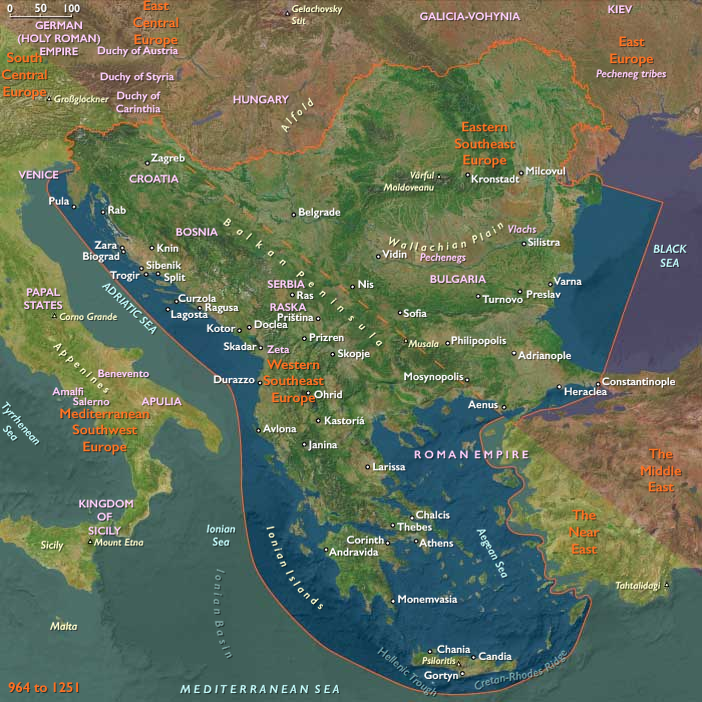
He follows the Bulgarian army and confronts it after the Bulgarians go through the Thermopylae pass on the river of Spercheios.
Due to heavy rainfalls, the river has swollen and flooded a large area on both shores.
The Bulgarians camp on the southern shore and the imperial forces on the northern, separated from each other by the river.
The two armies remain thus encamped for several days.
Samuel is confident that the Greeks will be unable not cross, and neglects to take measures to protect his camp.
Ouranos however, seeks and finds a ford, leading his army across during the night, and attacking the Bulgarians at dawn.
The Bulgarians are not able to put up effective resistance, and the larger part of their army is routed.
Samuel himself is wounded and he and his son Gavril Radomir evade capture by feigning death among the bodies of their slain soldiers while twelve thousand of their men are said to be captured.
After nightfall, they set off to Bulgaria and in the Pindus mountains gather the remains of their army.
Due to the difficult four-hundred-kilometer journey to Ochrid, his arm healed at an angle of 140°.
According to Yahya of Antioch, Nikephoros Ouranos returned to Constantinople with one thousand heads of Bulgarian soldiers and twelve thousand captives.
The battle is the first major defeat of the Bulgarian army.
Damian has engaged in operations against the amir Nazzal of Tripoli, and forced him to agree to terms.
Soon, however, Nazzan had been overthrown by the city's populace, forcing Dalassenos to resume operations along the northern Syrian coast.
He marches his troops to Apamea to seize the city after a catastrophic fire.
Here, he is killed on July 19 while pursuing a force of Bedouins under the command of the Fatimid general Jaush ibn al-Samsama, and is succeeded as doux by Nikephoros Ouranos.
Basil II, brought once again to Syria in October 999 by this new defeat, spends three months campaigning, during which the imperial forces raid as far as Baalbek, …
…take and garrison Shaizar, capture three minor forts in its vicinity (Abu Qubais, Masyath, and 'Arqah), and …
…sack Rafaniya.
Hims is not seriously threatened, but a month-long siege of Tripoli in December fails.
Although Basil does not have sufficient forces to drive into Palestine and reclaim Jerusalem, his victories have restored much of Syria to the empire.
No emperor since Heraclius has been able to hold these lands for any length of time, and they will remain possessions of Constantinople for the next seventy-five years.
Eastern Southeast Europe (1000–1011 CE): Byzantine Advances, Bulgarian Decline, and Hungarian Consolidation
Settlement and Migration Patterns
Continued Demographic Stability
From 1000 to 1011 CE, Eastern Southeast Europe maintained its demographic stability, despite ongoing conflicts and shifting power dynamics caused by Byzantine expansion and Bulgarian resistance.
Political and Military Developments
Bulgarian Expansion under Tsar Samuel
Tsar Samuel of Bulgaria significantly expanded Bulgarian territory, ruling from the Adriatic to the Black Sea and reclaiming regions lost during earlier conflicts with Kievan Rus'. Samuel’s forces conducted successful raids into Byzantine territory, penetrating as far as central Greece, posing a considerable challenge to Byzantine authority.
Byzantine Counteroffensive and Samuel’s Defeat
The Byzantine Empire, under Emperor Basil II, began to systematically counter Bulgarian advances. After a pivotal victory at the Battle of the River Spercheios in Thessaly in 996, led by general Nikephoros Ouranos, the tide turned decisively against Bulgaria. Samuel narrowly escaped capture along with his son Gabriel.
Basil II's Strategic Campaigns
From the year 1000, Basil II intensified a persistent and strategically insightful campaign against Bulgaria. Byzantine forces, led by generals Nikephoros Xiphias and Theodorokan, successfully captured key Bulgarian cities, including Great Preslav, Lesser Preslav, and Pliskova, marking significant advances into Bulgarian territory.
Hungarian Territorial Consolidation
Many Hungarian lords refused to accept Stephen I's suzerainty even after his coronation. Stephen initially confronted his maternal uncle, Gyula the Younger, ruler of a notably prosperous territory described by the Illuminated Chronicle as "most wide and rich." Stephen invaded Transylvania around 1002 or 1003, capturing Gyula and his family. According to the contemporary Annals of Hildesheim, Stephen forcibly converted his uncle's lands to Christianity following their conquest. Consequently, historians typically date the establishment of the Diocese of Transylvania to this period. If the identification proposed by Hungarian historians, such as Kristó and Györffy, linking Gyula with Prokui (Stephen's uncle mentioned by Thietmar of Merseburg), is correct, Gyula later escaped captivity and sought refuge with Bolesław I the Brave, Duke of Poland (r. 992–1025). The establishment of the Transylvanian Catholic episcopacy was completed in 1009, confirmed by the bishop of Ostia acting as papal legate.
Economic and Technological Developments
Economic Stability Amidst Conflict
Despite ongoing warfare, regional economies remained resilient, sustained by local crafts, trade activities, and stable agricultural production, particularly within fortified towns.
Military Infrastructure
Strategic investments in fortifications and military logistics continued, especially by Byzantine forces, reinforcing their territorial gains and ensuring logistical support for prolonged campaigns.
Cultural and Artistic Developments
Emergence of Popular Poetry
This era witnessed the emergence of popular poetry written in vernacular Greek, marking an important cultural shift and reflecting broader trends in cultural and literary expression across Byzantine territories.
Continued Cultural Resilience
Cultural and artistic traditions persisted robustly in Byzantine and Bulgarian territories, sustaining regional identities and traditions despite political and military upheaval.
Social and Religious Developments
Dominance of Orthodox Christianity
Orthodox Christianity maintained its crucial role, providing spiritual and societal stability amid persistent conflict. Ecclesiastical institutions continued to reinforce community cohesion and religious practices across the region.
Influence of Bogomilism
The Bogomil religious movement retained influence, particularly in rural areas, shaping local religious beliefs and societal structures with its dualistic doctrines.
Long-Term Consequences and Historical Significance
The period from 1000 to 1011 CE was marked by significant Byzantine territorial gains, Bulgarian setbacks, and important Hungarian territorial consolidation. Basil II’s successful campaigns fundamentally shifted regional power balances, paving the way for complete Byzantine reconquest of Bulgaria and shaping Eastern Southeast Europe's historical trajectory for subsequent generations.

Bulgaria’s Tsar Samuel had extended his rule from the Adriatic Sea to the Black Sea, recovering most of the lands that had been Bulgarian before the invasion of Svyatoslav of Kievan Rus', during the years when Emperor Basil II had been distracted with internal rebellions and recovering the military situation on his eastern frontier.
Samuel had also conducted damaging raids into imperial territory as far as central Greece.
The tide had turned in 996, when the imperial general Nikephoros Ouranos inflicted a crushing defeat on a raiding Bulgarian army at a battle on the River Spercheios in Thessaly.
Samuel and his son Gabriel were lucky to escape capture.
Basil II, beginning in 1000, is free to focus on a war of outright conquest against Bulgaria, a war he prosecutes with grinding persistence and strategic insight.
In this year, the imperial generals Nikephoros Xiphias and Theodorokan take the old Bulgarian capital of Great Preslav and the towns of Lesser Preslav and Pliskova.
Basil himself, operating from Thessalonica, had been able to regain control of Vodena, Verrhoia, and Servia in 1001.
The following year he bases his army in Philippopolis and occupies the length of the military road from the western Haemus Mountains to the Danube, thereby cutting off communications between Samuel's Macedonian heartland and Moesia.
Basil follows his success at Philippopolis by laying siege to Vidin, which eventually falls following a prolonged resistance, the eight-month siege broken because of the betrayal of the local bishop.
Samuel reacts to the Empire’s campaign with a daring stroke; he launches a large-scale raid into the heart of imperial Thrace and surprises the major city of Adrianople.