Saud bin Abdul-Aziz bin Muhammad bin Saud
3rd ruler of the First Saudi State
Years: 1750 - 1814
Imam Saud bin Abdul-Aziz bin Muhammad bin Saud rules the First Saudi State from 1803 to 1814.
During his rule, Saud annexes Makkah and Madinah from the Ottoman Empire.
Related Events
Filter results
Showing 10 events out of 13 total
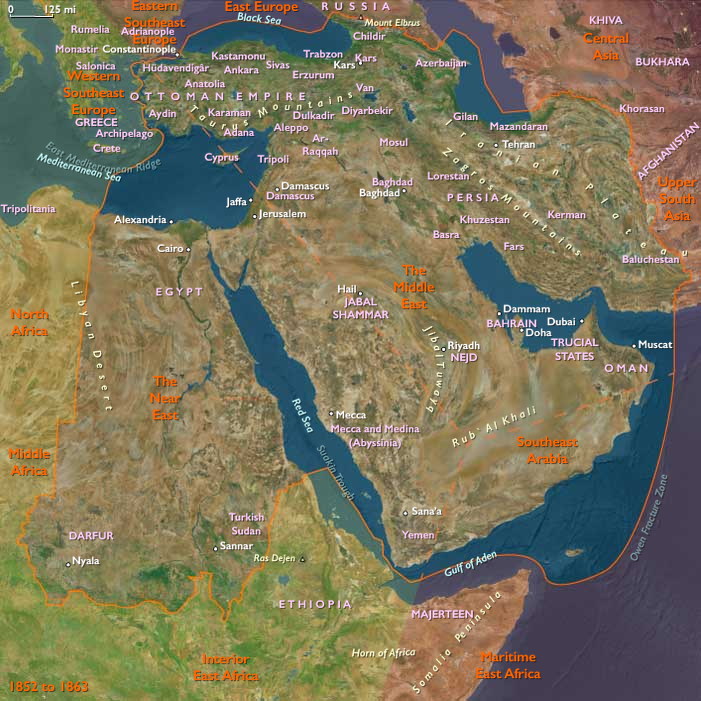
The Middle East: 1756–1767 CE
Expansion of the Saudi-Wahhabi State
From 1756 to 1767, the Saudi-Wahhabi alliance, forged by Muhammad ibn Saud and Muhammad ibn Abd al Wahhab, continues to strengthen and expand its influence throughout central Arabia. Driven by the militant interpretation of Wahhabism, Saudi forces successfully annex surrounding tribes and settlements, spreading their austere version of Islam. Muhammad ibn Saud, alongside his son Abdul Aziz, vigorously leads armies into Najdi towns and villages, eradicating popular and Shia practices and unifying the tribes under their banner. By 1765, Wahhabi authority is established firmly over most of Najd, significantly threatening regional powers such as the Ottoman Empire and its local allies. Abdul Aziz continues this aggressive territorial expansion and ideological consolidation following Muhammad ibn Saud's death in 1765.
Stabilization and Economic Growth in Oman
In Oman, Ahmad bin Said al-Busaidi consolidates his rule, firmly establishing internal control after decades of instability. Ahmad emerges as undisputed ruler following the death of rival Imam Bal'arab bin Himyar in 1749. He distances himself from traditional Ibadi centers by moving the capital from Ar Rustaq to the bustling commercial port of Muscat, significantly reviving maritime trade. Under his leadership, Oman experiences notable economic rejuvenation, asserting its maritime influence in the Persian Gulf and Indian Ocean. His reign sees Muscat revitalized as a pivotal trading hub, marking a strategic shift towards commercial prosperity.
Persian Fragmentation and Regional Impact
The fragmentation of Persian authority following Nader Shah's assassination continues to severely impact regional stability. Mohammad Hasan Khan, leader of the Qajar tribe, extends his influence over Astarabad, Mazandaran, and Gilan amidst weakening central Persian authority. These internal divisions exacerbate instability across neighboring territories, creating opportunities for tribal and regional authorities in Iraq and the Persian Gulf to assert their autonomy. This declining Persian influence reshapes Gulf politics, fostering increased local governance and autonomy.
Ottoman Control and Tribal Independence
Ottoman authority remains compromised as local tribal autonomy increasingly challenges central governance. Tribes such as the Muntafiq and Bani Lam in southern Iraq, and the Kurdish Baban Dynasty in the north, further entrench their independence. Ottoman attempts to reassert control over these autonomous regions largely fail, reinforcing fragmented and decentralized rule throughout their Arab territories. This dynamic encourages local governance structures that resist Ottoman administrative centralization.
Prosperity and Tribal Settlement in the Persian Gulf
Economic prosperity continues in the Persian Gulf due to robust pearl harvesting, agriculture, and trade. The Al Khalifa and Al Jalahima sections of the Bani Utub tribe migrate from Kuwait to Qatar's northwest coast, establishing the prosperous trading and pearling settlement of Az Zubarah in 1766. Meanwhile, tribes such as the Al Thani further transition from nomadic life to settled communities involved in fishing, pearling, date cultivation, and trade. The popularity of Wahhabism among tribes such as the Al Thani heightens tensions, particularly with the Al Khalifa, who reject the movement. This tribal migration and settlement enhance the Gulf region's economic and social landscape, reinforcing its importance as a vibrant commercial and cultural crossroads.
Legacy of the Era
Between 1756 and 1767, the Middle East experiences profound political consolidation and economic rejuvenation, particularly in central Arabia and Oman. The Saudi-Wahhabi alliance expands its territorial and ideological reach, significantly reshaping regional religious and political dynamics. Oman stabilizes and economically prospers under Ahmad bin Said, emerging as a vital maritime power. Persian fragmentation deepens regional decentralization, while persistent tribal autonomy increasingly challenges Ottoman rule. These transformative developments lay critical foundations for subsequent political, economic, and social evolutions across the Middle East.
The Middle East: 1768–1779 CE
Continued Saudi-Wahhabi Expansion
Between 1768 and 1779, the Saudi-Wahhabi state, under the vigorous leadership of Abdul Aziz ibn Muhammad ibn Saud, continues its aggressive expansion and consolidation efforts across the Arabian Peninsula. The austere and puritanical doctrines of Wahhabism further motivate the Saudi forces to confront both Sunni and Shia rivals, systematically enforcing religious orthodoxy across the territories they control. Under Abdul Aziz's command, significant efforts are made to subdue remaining resistant centers, notably the crucial city of Riyadh, which falls decisively into Saudi-Wahhabi hands in 1773. This victory enhances their political authority and facilitates further unification of Najdi tribes under their rigid religious and political framework.
Regional Struggles and the Rise of the Qajar Dynasty
In Persia, the weakening Zand dynasty, led by Karim Khan Zand until his death in 1779, maintains a tenuous hold on power amidst growing factionalism and tribal rebellion. This decline creates opportunities for ambitious tribal leaders like the Qajars, under Agha Mohammad Khan Qajar, to extend their influence. The Qajars consolidate power in Mazandaran, Astarabad, and parts of northern Persia, laying critical groundwork for their eventual dominance. Their rise intensifies regional instability, influencing political dynamics across adjacent territories.
Oman: Maritime Dominance and Internal Stability
Ahmad bin Said al-Busaidi continues to solidify Oman’s maritime power and internal stability, reinforcing Muscat as a prosperous trading hub in the Persian Gulf and Indian Ocean. His reign fosters economic and political consolidation, further distancing the capital from traditional Ibadi centers and strengthening centralized governance. Under Ahmad’s leadership, Oman asserts increasing maritime influence, securing trade routes and protecting its interests against regional competitors.
Persian Gulf: Tribes and Economic Rivalries
Economic prosperity driven by pearl harvesting and maritime trade continues to shape social and political dynamics in the Persian Gulf region. The settlement of the Al Khalifa and Al Jalahima clans in Qatar’s prosperous Az Zubarah deepens local rivalries, particularly with the Al Thani clan, who embrace Wahhabi doctrines. The competition over economic resources and ideological differences creates tension and sporadic conflict, notably between the Wahhabi-influenced Al Thani and the non-Wahhabi Al Khalifa. Such tribal competition characterizes the economic and political climate of the Gulf throughout this era.
Declining Ottoman Influence
Throughout the period, Ottoman control over its Arab provinces continues to weaken as tribal autonomy and local governance increasingly assert themselves. In southern Iraq and northern Kurdish territories, tribal leaders such as the Muntafiq, Bani Lam, and the Baban Dynasty reinforce their independence, successfully resisting centralized Ottoman authority. This period further entrenches decentralized governance, limiting the Ottoman Empire's capacity to effectively administer its distant Arab provinces.
Legacy of the Era
The years 1768 to 1779 witness critical transformations in regional power structures, characterized by the continued territorial and ideological expansion of the Saudi-Wahhabi state, the emerging dominance of the Qajar dynasty in Persia, and sustained maritime prosperity under Oman’s Al Bu Sa'id dynasty. These developments occur alongside increasing tribal autonomy and declining Ottoman influence, shaping enduring political, economic, and social landscapes across the Middle East.
The Middle East: 1780–1791 CE
Saudi-Wahhabi Consolidation and Expansion
Between 1780 and 1791, the Saudi-Wahhabi state under Abdul Aziz ibn Muhammad ibn Saud significantly consolidates its dominance across the Arabian Peninsula. Continuing aggressive military campaigns, Saudi forces extend their strict Wahhabi doctrines deeper into eastern Arabia, notably taking control of Al-Hasa, an essential center of Shi'a influence and economic prosperity, in 1790. The capture of Al-Hasa strengthens Saudi economic resources through access to valuable trade routes and fertile agricultural lands, reinforcing the political and religious unification of Najdi tribes under the expanding Saudi state.
Ascendancy of the Qajar Dynasty
In Persia, the Qajar dynasty decisively rises under the leadership of Agha Mohammad Khan Qajar, capitalizing on the fragmented and declining authority of the Zand rulers following Karim Khan Zand's death in 1779. By systematically subduing rival factions and tribal groups, Agha Mohammad Khan expands his rule across central and northern Persia, notably seizing Tehran in 1786 and making it the new capital of the Qajar realm. His rigorous military campaigns set the stage for the Qajar dynasty's dominance, reshaping Persia’s political landscape for the coming century.
Oman: Economic Stability and Maritime Dominance
Under the reign of Said bin Ahmad al-Busaidi (1783–1786) followed by Hamad bin Said al-Busaidi (1786–1792), Oman maintains and enhances its regional maritime dominance. Muscat continues to flourish as a vital trade hub, with increasing commercial interactions across the Indian Ocean and Persian Gulf. The ongoing prosperity reinforces internal stability and enables further centralization of power away from traditional Ibadi tribal centers toward the commercially vibrant coast.
Persian Gulf: Tribal Rivalries and Economic Competition
The late eighteenth century witnesses intensified competition among prominent tribal groups around the Persian Gulf, driven largely by economic motivations linked to pearl diving and trade. In Qatar, the settlement of Az Zubarah continues to thrive economically, despite ongoing hostilities between the Al Khalifa and Al Jalahima clans. The Al Thani clan further asserts its Wahhabi-influenced political identity, fueling tensions with other local factions. Such tribal rivalries remain critical determinants of regional stability and economic power dynamics.
Declining Ottoman Authority and Tribal Autonomy
Ottoman authority across its Arab provinces continues to diminish significantly during this period, with local tribal leaders exercising increasing autonomy. Tribal confederations such as the Muntafiq, Bani Lam, and the Baban Dynasty expand their influence in southern Iraq and Kurdish territories, respectively, frequently resisting Ottoman efforts to reassert centralized control. This period marks a clear trend toward decentralized governance, underscoring the weakening grip of the Ottoman Empire on its peripheral Arab territories.
Legacy of the Era
The era from 1780 to 1791 solidifies major shifts in Middle Eastern geopolitics, highlighted by the Saudi-Wahhabi state's territorial and doctrinal expansion, the definitive rise of the Qajar dynasty in Persia, and the sustained maritime prosperity of Oman. Coupled with increasing tribal autonomy and declining Ottoman influence, these developments lay foundational elements for the enduring political, social, and economic patterns that continue to shape the region.
Abdul Aziz, in a large public gathering in 1787 chaired by Muhammad ibn 'Abd al-Wahhab, forms a new type of inherited authority (Wilayat ul-A'hed) based on the Wahhabi views and, in direct opposition to the Khaleef, or Caliph, in Istanbul, declares himself leader of the Muslims.
'Abd al-'Aziz then appoints his son Saud as the Khalifah designate after him.
Muhammad ibn 'Abd al-Wahhab agrees to this authority and passes a Fatwah of Jihad against the Ottomani Khilafah.
Sa'ud's father is assassinated in 1803, soon after the return of his son from the capture of Mecca, by a Shi'ite in the mosque of Ad-Dir'iyah in revenge for the desecration of Karbala'.
The popular and Shia practices to which the Wahhabis object are important to other Muslims, the majority of whom are alarmed that shrines are destroyed and access to the holy cities restricted.
Moreover, rule over the Hijaz is an important symbol.
The Ottoman Turks, the most important political force in the Islamic world at the time, refuse to concede rule over the Hijaz to local leaders.
The Ottomans at the beginning of the nineteenth century are not in a position to recover the Hijaz, because their forces are weak and overextended.
Accordingly, the Ottomans delegate the recapture of the Hijaz to their most ambitious client, Muhammad Ali, the semi-independent commander of their garrison in Egypt.
Muhammad Ali, in turn, hands the job to his son Tusun, who leads a force to the Hijaz in 1816; Muhammad Ali later joins his son to command the force in person.
Muhammad ibn Abd al Wahhab had meanwhile, died in 1792, and Abd al Aziz died shortly before the capture of Mecca.
The movement had continued, however, to recognize the leadership of the Al Saud and so followed Abd al Aziz's son, Saud, until 1814; after Saud died in 1814, his son, Abd Allah, ruled.
Accordingly, it is Abdullah bin Saud bin Abdul-Aziz who faces the invading Egyptian army.
Tusun's forces take Mecca and Medina almost immediately.
Abdullah chooses this time to retreat to the family's strongholds in Najd.
Sa'ud captures Medina in 1804, thus extending his Wahhabi empire throughout the whole of Arabia down to Yemen and Oman.
Sa'ud has made annual visits to Mecca from 1805 to preside over the pilgrimage as the imam of the Muslim congregation.
Britain severely curbs the naval allies of the Wahhabis in 1809.
The Wahhabi sack of Karbala in 1802 had resulted in five thousand deaths and the plundering of the Imam Husayn Shrine; by 1805, the Wahhabis controlled Mecca and Medina.
The Wahhabis also attack Ottoman trade caravans, which interrupts the Ottoman finances.
The Saudi amir has denounced the Ottoman sultan and called into question the validity of his claim to be caliph and guardian of the sanctuaries of the Hejaz.
The Ottoman Empire, suspicious of the ambitious Muhammad Ali, have instructed him to fight the Wahhabis, as the defeat of either would be beneficial to them.
Tensions between Muhammad Ali and his Albanian troops also prompt him to send them to Arabia and fight against the Wahhabi movement, where many die.
Muhammad Ali had been ordered as early as December 1807 by Sultan Mustafa IV to crush the Saudi state, but internal strife within Egypt had prevented him from giving full attention to the Wahhabis.
The Albanians are not able to recapture the holy cities until 1811.
Ottoman sultan Mahmud III, appalled at the At-Ta'if slaughter and the Saudi capture of the holy cities but preoccupied in other directions, assigns the task of crushing the Wahhabi “heretics” to Muhammad (Mehmet) 'Ali Pasha, the virtually independent viceroy of Egypt.
Acknowledging the sovereignty of the Ottoman Sultan and at his command, Muhammad Ali dispatches an army of twenty thousand men (including two thousand horses) under the command of his son Tusun, a youth of seventeen; the Egyptians land on the Hejaz coast.
By the end of 1811, Tusun has received reinforcements and captured Medina after a prolonged siege.